

What Are Cannabis Concentrates and Extracts?
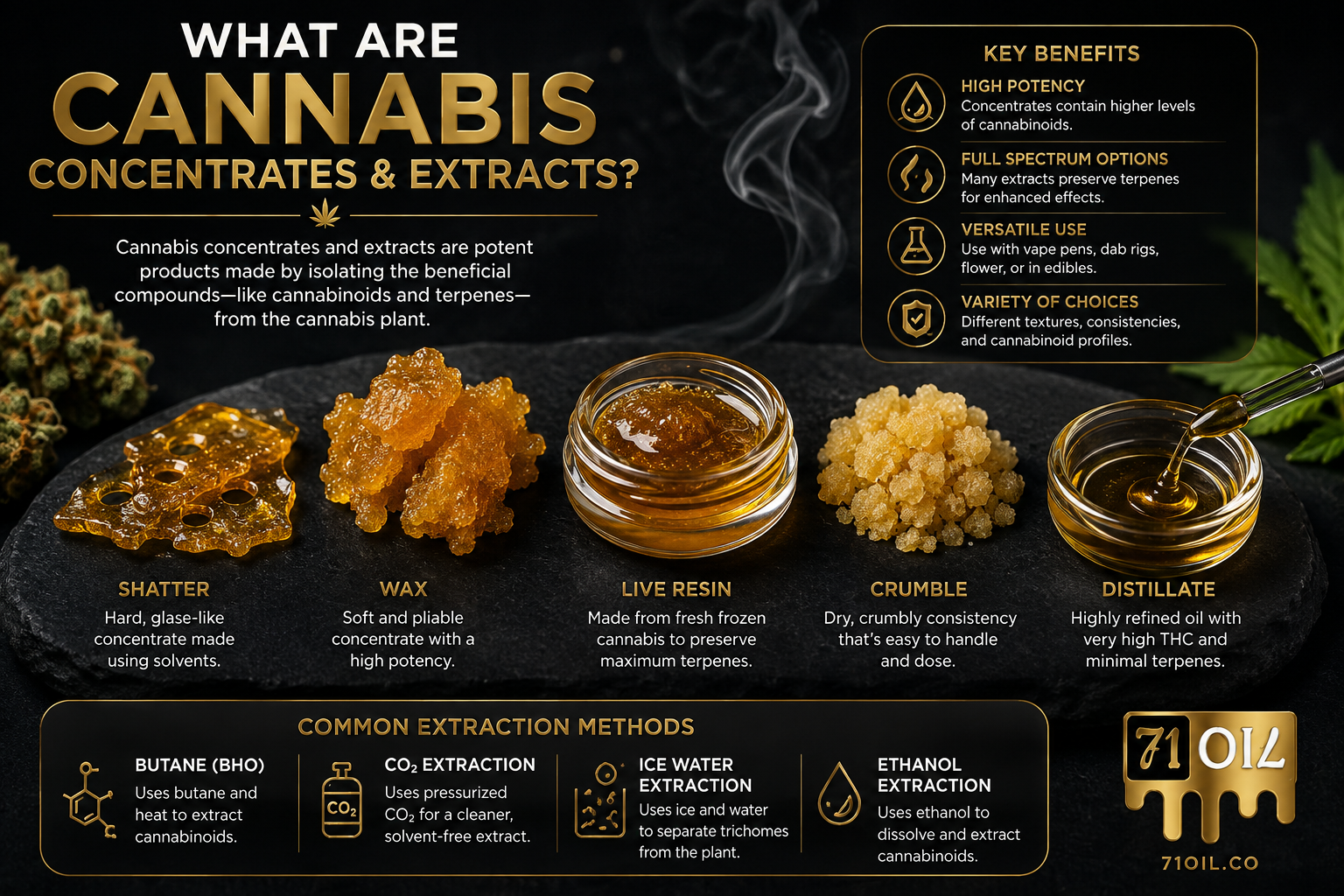
Cannabis concentrates and extracts collect or concentrate selected compounds from the cannabis plant into a smaller amount of material.
Depending on the product, they may contain cannabinoids such as THC and CBD, aromatic terpenes, or resin-rich material from the plant’s trichomes.
Common examples include kief, hash, rosin, live resin, wax, shatter, distillate, cannabis oils, vape liquids, and High-Terpene Full-Spectrum Extract, or HTFSE.
Although people often use concentrate and extract interchangeably, the terms can describe different production methods, textures, refinement levels, and final product formats.
TL;DR: What Are Cannabis Concentrates and Extracts?
| Cannabis concentrates contain a greater proportion of selected cannabis compounds than raw plant material. Extracts are generally produced by separating compounds from cannabis through physical or solvent-based processing, although market terminology overlaps. In Canada, cannabis extract is also an official product class that includes products such as oils, vape liquids, kief, hash, resin, rosin, wax, and shatter. |
What Counts as a Cannabis Concentrate or Extract?
A cannabis concentrate is a broad industry term for cannabis material in which resin, cannabinoids, terpenes, or other selected compounds have been concentrated.
Some concentrates are collected through physical separation. Kief, for example, consists mainly of trichome-rich material separated from cannabis flower. Hash is made by collecting and forming resin-rich material.
Other products are produced through extraction. Licensed processors may use controlled mechanical, solvent-based, or refinement processes to separate selected cannabis compounds and prepare them for a specific product format.
The word extract commonly emphasizes that an extraction process was used. However, it does not have one universal market definition.
Canada also uses cannabis extract as an official product class. Health Canada’s cannabis label guidance includes oil and tinctures, vape liquids, kief, hash, resin, rosin, wax, shatter, and certain infused products within this class.
Readers can explore more product-specific explanations through the 71 Oil Cannabis Concentrates & Extracts content hub.
Cannabis Concentrate vs. Extract: What Is the Difference?
A useful industry shortcut is that concentrate is the broader category, while extract often refers to a concentrate produced through extraction.
However, this should not be treated as a universal legal definition.
| Term | Common industry meaning | Examples |
|---|---|---|
| Cannabis concentrate | Broad term for material with concentrated cannabis compounds | Kief, hash, rosin, resin, wax, shatter, distillate |
| Cannabis extract | Often describes material made through extraction or further processing | Live resin, distillate, cannabis oil, vape liquid |
| Cannabis extract in Canada | Official regulated product class that includes both physically and chemically concentrated products | Kief, hash, oils, vape liquids, resin, rosin, wax, shatter |
This Canadian classification explains why kief and hash may appear as cannabis extracts on a legal product label even though they can be produced through mechanical separation.
The product name alone is therefore not enough to explain how it was made or how it should be used. The label, intended-use information, ingredients, cannabinoid values, and product description provide better context.
Why Cannabis Concentrate Names Can Be Confusing
Concentrate names do not all describe the same feature.
Some identify the production method. Others refer to the starting material, level of refinement, physical consistency, extract profile, or final formulation.
Process
Names such as rosin describe a production category. Rosin is generally made by applying controlled heat and mechanical pressure to cannabis material.
Starting Material
The word live generally indicates that fresh or frozen cannabis material was used instead of conventionally dried material.
Live resin and live rosin both use this type of starting material, but their processing methods differ.
Live resin and live rosin share the “live” starting-material concept, but they use different processing approaches. See our live resin vs live rosin comparison for the differences that matter when comparing products.
Refinement
Distillate describes an extract that has undergone substantial refinement and separation. It is commonly formulated around selected cannabinoids, although the exact composition depends on the product.
Distillate is one highly refined extract category. Read our cannabis distillate guide for the dedicated definition, refinement context, and product checks.
Texture
Names such as wax, budder, badder, crumble, and shatter mainly describe physical consistency.
Texture alone does not confirm the cannabinoid profile, terpene content, production quality, or intended use.
Final Formulation
Terms such as cannabis oil, tincture, and vape liquid usually describe the product’s final form or intended application rather than one specific extraction method.
Extract Profile
Terms such as full-spectrum and HTFSE describe how a producer positions the extract’s chemical or terpene profile.
For a dedicated explanation of the broader profile term, read what full-spectrum cannabis extract means and how it differs from refinement, starting-material, and process terminology.
These terms do not guarantee one exact composition across every product. Product-specific cannabinoid, terpene, ingredient, and testing information should support the description.
To compare one highly refined extract approach with broader-profile vape formulations, read our distillate vs. full-spectrum cannabis vape guide.
How Are Cannabis Concentrates and Extracts Made?
Cannabis processing generally begins by collecting or separating resin-rich material from the rest of the plant.
Processors may then filter, refine, separate, combine, or formulate the material depending on the desired product.
Health Canada’s licensing guidance distinguishes mechanical concentration methods, such as separating trichomes to produce kief or hash, from processing that uses solvents such as ethanol or carbon dioxide.
Physical and Solventless Concentration
Physical processes collect resin-rich material without using a chemical solvent as the main extraction medium.
Examples include:
- Sifting cannabis material to collect kief
- Separating trichomes to produce certain types of hash
- Applying controlled heat and pressure to produce rosin
The word solventless only identifies part of the production process. It does not automatically mean a product is safer, purer, more potent, or higher quality.
The same principle applies to potency. See why THC percentage does not tell the whole product story and what other characteristics adults can compare.
Solvent-Based Extraction
Licensed processors may use controlled solvent-based systems to separate cannabinoids, terpenes, and other compounds from cannabis material.
The resulting composition depends on several factors, including:
- Starting material
- Extraction medium
- Processing conditions
- Filtration
- Refinement
- Formulation
- Storage
Solvent-based products may include resin, live resin, wax, shatter, distillate, and other extract formats.
Live resin is one concentrate type built around fresh-frozen starting material and solvent-based extraction. See what live resin means and how to compare it with other extracts.
Refinement and Post-Processing
Extracted material may undergo additional filtration, distillation, separation, crystallization, or texture development.
These processes can change its cannabinoid concentration, aromatic profile, consistency, appearance, and intended product use.
Cannabis extraction should only take place in appropriately licensed and controlled facilities. Attempting extraction with flammable solvents or unsuitable equipment can create fire, explosion, contamination, and injury risks. This article does not provide home-extraction instructions.
For a side-by-side look at the two main production categories, read our guide to solvent-based vs. solventless cannabis concentrates
Common Types of Cannabis Concentrates and Extracts
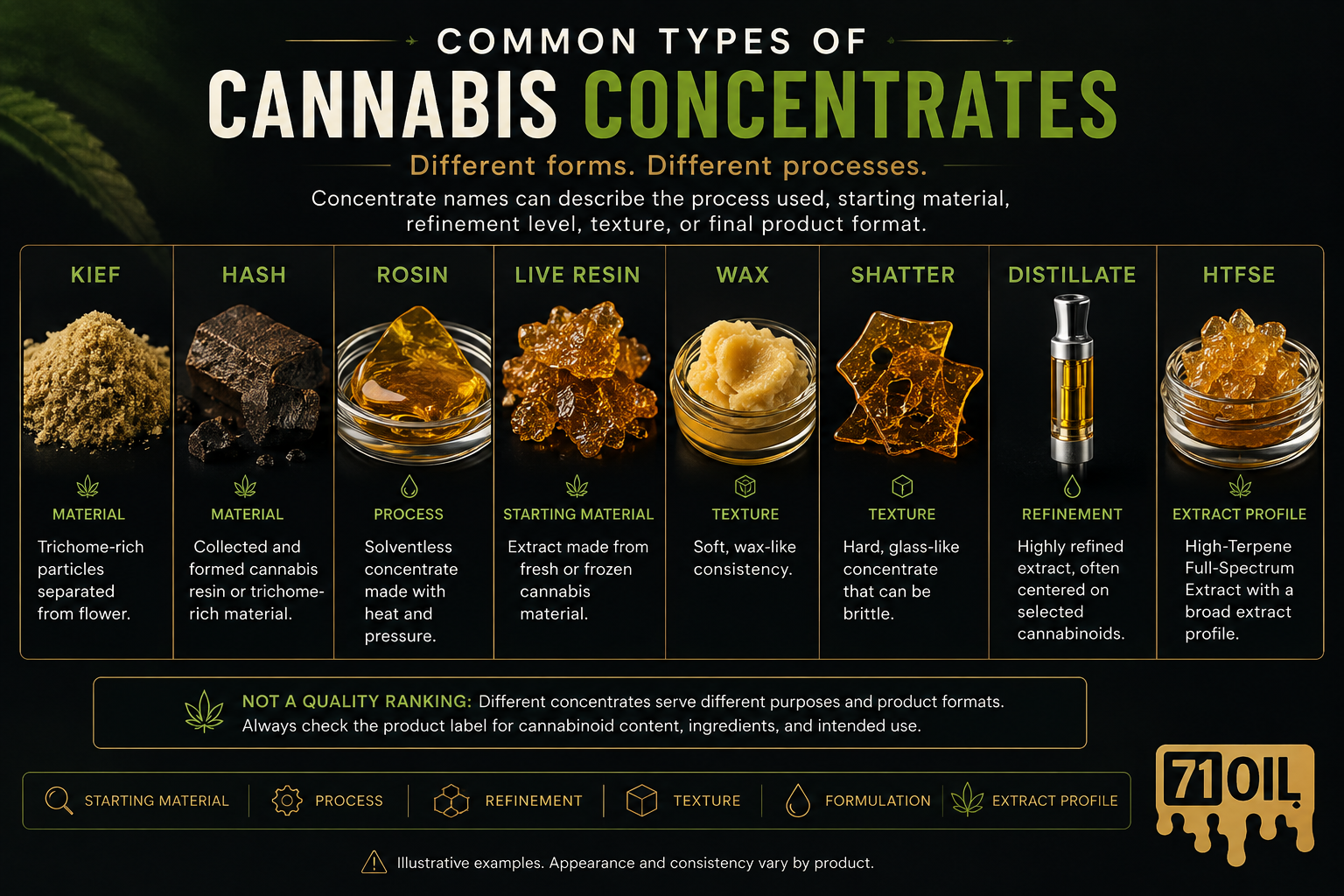
The table below explains what the most common names primarily describe.
| Product type | What the name mainly describes | General description |
|---|---|---|
| Kief | Collected plant material | Loose, trichome-rich particles separated from cannabis flower |
| Hash | Material and processing | Collected and formed cannabis resin or trichome-rich material |
| Rosin | Production process | Solventless concentrate made with controlled heat and pressure |
| Live rosin | Starting material and process | Rosin produced from fresh or frozen cannabis material or hash made from that material |
| Resin | Broad extract terminology | General resin-rich extract term whose exact meaning can vary by producer |
| Live resin | Starting material and extraction | Extract made from fresh or frozen cannabis material |
| Wax, budder, badder, and crumble | Texture | Softer, whipped, wax-like, or crumbly extract consistencies |
| Shatter | Texture | Firm or brittle extract with a glass-like appearance |
| Distillate | Refinement | Extensively refined extract commonly centred on selected cannabinoids |
| HTFSE | Extract profile | High-Terpene Full-Spectrum Extract, positioned around terpene content and a broader extract profile |
| Cannabis oils and tinctures | Final formulation | Liquid extracts formulated for a stated intended use |
| Vape liquids | Final product format | Cannabis extracts formulated for compatible inhalation devices |
Extract terminology helps identify product type, but it does not establish overall quality. See what makes cannabis premium when formulation, hardware, labels, and transparency are compared together.
These categories are not a quality ranking. A product called live resin is not automatically better than rosin, distillate, or another extract.
For a more detailed explanation of one terpene-focused category, read What Is HTFSE? High-Terpene Full-Spectrum Extract Explained.
What Do Cannabinoids and Terpenes Mean in a Concentrate?
Cannabinoids and terpenes are important parts of a concentrate’s product profile.
THC is the primary cannabinoid associated with cannabis intoxication and impairment. CBD does not produce the same intoxicating effect as THC.
On legal Canadian cannabis packaging, the front label must display Total THC and Total CBD. The required units depend on the product class, quantity, format, and intended use. See Health Canada’s cannabis label guidance.
These numbers help adults compare cannabinoid content, but they do not provide a complete quality assessment.
A high Total THC value does not automatically mean a product has:
- Better manufacturing quality
- More complete strain character
- Greater terpene content
- Stronger flavour or aroma
- Better hardware performance
- Greater suitability for an individual consumer
Terpenes are aromatic compounds that contribute to the smell and flavour of cannabis. Depending on the product, a terpene profile may be described as citrus, pine, earthy, floral, herbal, peppery, fruit-forward, or fuel-like.
When aromatic compounds are used in an inhaled format, cannabis vape odour can vary by the extract, formulation, hardware, and surrounding airflow.
However, terpene names should not be used to promise a particular effect or health benefit.
The final profile can be influenced by the cannabis material, processing method, refinement, formulation, packaging, storage, and product age.
How Are Concentrates Used in Vape Cartridges and Disposable Pens?
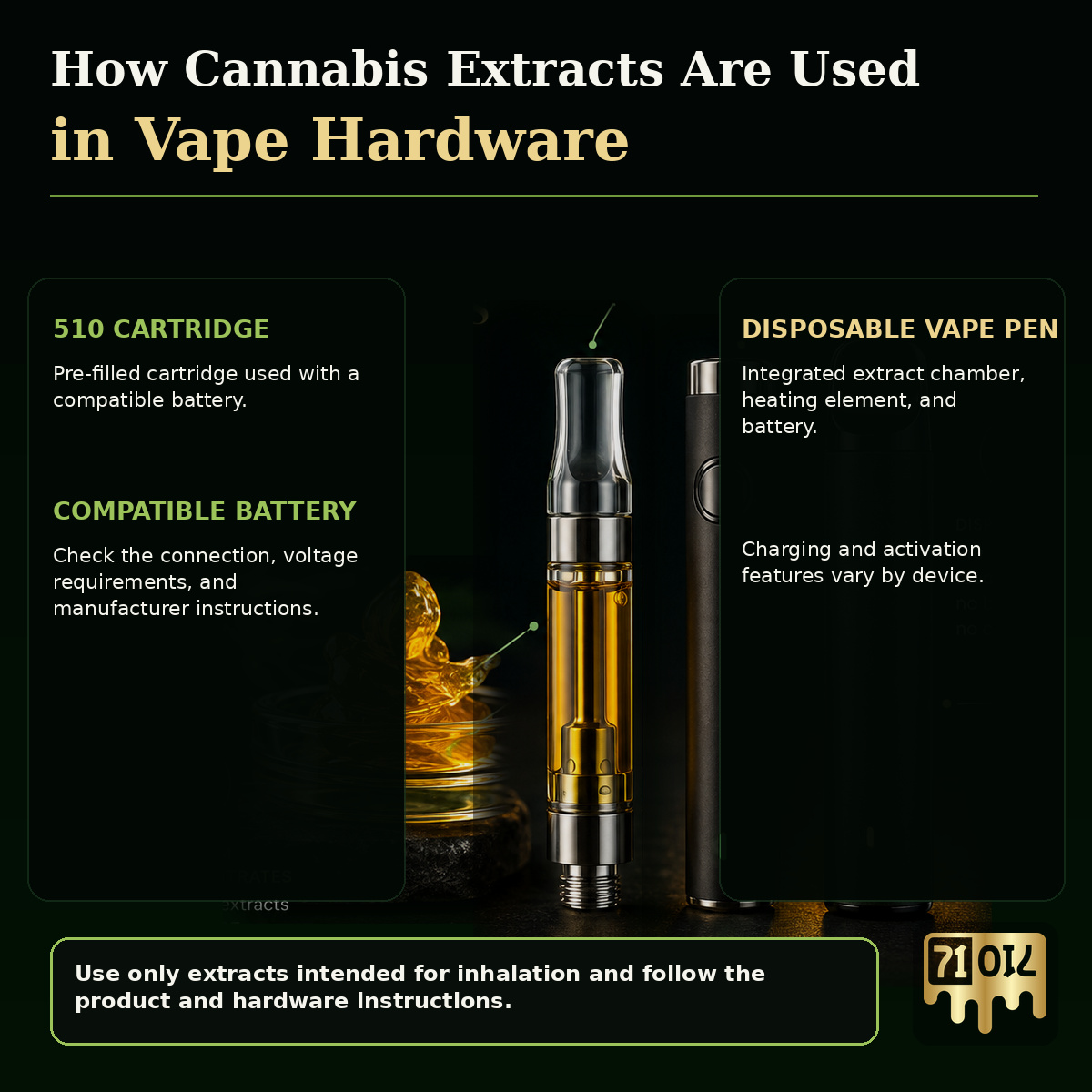
Cannabis vape cartridges and disposable vape pens contain extracts formulated for use with their specific hardware.
Extract type is only one layer of a vape product. See how cannabis vapes work to understand how the extract, heating element, battery, and airflow fit together.
Not every concentrate, cannabis oil, or tincture is suitable for inhalation.
A product intended for ingestion should never be placed into a cartridge or vaping device. Consumers should follow the intended-use information on the label and the instructions supplied with the hardware.
Vape Cartridges
A cannabis vape cartridge contains a liquid extract formulation and normally requires a separate compatible battery.
For the hardware side of that process, see how cannabis vapes work and how extract, heat, airflow, and the device interact.
Many cartridges use a 510-thread connection. However, connection type alone does not guarantee compatibility. Cartridge dimensions, airflow, voltage range, battery design, and manufacturer instructions can also matter.
The 71 Oil guide to weed carts, THC carts, and vape cartridges explains this terminology in more detail.
Adults using a separate cartridge setup can also review what a 510-thread battery is and how compatibility works before choosing hardware.
Disposable Vape Pens
A disposable vape pen combines the extract chamber, heating element, mouthpiece, and battery in one integrated device.
This removes the need to pair a separate cartridge with a reusable battery. The extract may be delivered through different hardware. Compare vape cartridge and disposable vape formats before choosing between separate and integrated devices.
However, consumers should still review the product instructions, charging information where applicable, storage guidance, cannabinoid content, ingredients, and extract type.
Vaping cannabis is not risk-free. Health Canada’s guidance on cannabis accessories for inhalation states that cannabis vaping aerosols can contain harmful substances and that metals or other contaminants may enter the aerosol. Vaping accessories can also malfunction.
What Should Adults Check on a Cannabis Extract Label?
Legal product information is more reliable than informal terms such as strong, pure, premium, or full-spectrum.
Because vape liquids are classified as cannabis extracts in Canada, adults can also review how cannabis vape labels present Total THC, Total CBD, ingredients, intended use, and traceability details.
Before comparing a cannabis extract, review:
Product Class
Check whether the label identifies the product as a cannabis extract, edible cannabis, dried cannabis, or another regulated class.
Intended Use
Confirm whether the product is formulated for inhalation, ingestion, or another use.
Do not assume that every cannabis oil can be used in the same way.
Total THC and Total CBD
Review both cannabinoid values and the units used.
Depending on the product, the values may be shown by weight, volume, individual unit, activation, or full package.
Ingredients
Check the ingredient list for carrier ingredients, flavouring ingredients, cannabis extracts, or other components included in the formulation.
Net Quantity
Confirm how much extract the package, cartridge, container, or device holds.
A larger size contains more material, but size alone does not determine quality, potency, compatibility, or suitability.
Product and Package Information
Review the licence-holder information, lot number, packaging date, required warnings, and package condition.
Legal non-medical cannabis in Canada is sold through retailers authorized by the applicable province or territory. Choosing an authorized source provides regulated packaging, labelling, production, and product-information requirements, but it does not make cannabis risk-free.
Potency, Inhalation, and Responsible Adult Use
Cannabis extracts and concentrates can contain high concentrations of THC. Health Canada’s Lower-Risk Cannabis Use Guidelines state that higher THC exposure is associated with greater impairment and a higher likelihood of adverse effects.
Legal-age adults who choose to consume cannabis should consider the following:
- Review Total THC and Total CBD before use.
- Consider lower-THC options.
- Avoid combining cannabis with alcohol or other impairing substances.
- Do not drive or operate machinery after consuming cannabis.
- Use only products intended for the selected format.
- Follow the product and hardware instructions.
- Avoid damaged, leaking, modified, or overheating vape hardware.
- Store cannabis securely away from children and pets.
- Purchase cannabis and accessories through authorized sources.
Health Canada’s inhalation-accessory guidance also recommends following manufacturer instructions, avoiding overcharging rechargeable vaping accessories, and replacing or reporting malfunctioning equipment.
The 71 Oil Health & Safety of Vaping guide provides additional information about cannabis inhalation, product sourcing, hardware condition, storage, and responsible adult-use considerations.
Frequently Asked Questions
Are cannabis concentrates and extracts the same?
The terms overlap, but people do not always use them in the same way. Concentrate generally serves as the broader industry term. Extract often refers to a product created through extraction or processing. In Canada, Health Canada also recognizes cannabis extract as an official product class that includes kief, hash, oils, vape liquids, resin, rosin, wax, and shatter.
What are common examples of cannabis concentrates?
Common cannabis concentrates include kief, hash, rosin, live rosin, resin, live resin, wax, budder, badder, crumble, shatter, distillate, cannabis oils, vape liquids, and HTFSE.
Are kief and hash cannabis extracts in Canada?
Yes. Health Canada includes kief and hash within the cannabis extract product class, even though producers may make these products through mechanical separation rather than solvent-based extraction.
Is rosin a solventless concentrate?
Yes. Producers generally classify rosin as solventless because they use controlled heat and mechanical pressure instead of a chemical solvent as the main extraction medium. However, the term solventless does not automatically mean safer, purer, stronger, or better.
Is live resin the same as distillate?
No. Producers make live resin from fresh or frozen cannabis material. Distillate goes through extensive refinement and commonly focuses on selected cannabinoids. The exact composition still varies by product.
For a direct side-by-side breakdown, see our distillate vs. live resin guide.
Can every cannabis oil be used in a vape pen?
No. Manufacturers may formulate cannabis oils for ingestion, inhalation, or another intended use. Only use cannabis oil in a vape device when the product label and manufacturer information confirm that the oil suits that device and intended purpose.
Understand the Extract Before Comparing the Format
Cannabis concentrate names become easier to understand when you identify what each term describes.
Some refer to the production process. Others describe the starting material, refinement level, consistency, extract profile, or final formulation.
Because these terms overlap, adults should compare more than the product name. Review the legal source, intended use, Total THC, Total CBD, ingredients, extract information, package condition, and hardware requirements.
Adults interested in a cartridge-based setup can compare the available 71 Oil 510 vape cartridges by strain, size, extract profile, and hardware format.
Those who prefer an integrated format can explore 71 Oil disposable vape pens by strain, extract profile, device size, and product format.
Cannabis is intended for legal-age adults where legally available. Cannabis use can cause impairment and carries health risks. Follow the product information and applicable laws, never drive after consumption, and keep all cannabis products away from children and pets.
0 Responses