

Solvent-Based vs. Solventless Cannabis Concentrates: What’s the Difference?
Understanding solvent based vs solventless concentrates starts with how cannabis compounds are separated from the starting material. Solvent-based concentrates use an extraction medium during processing, while solventless concentrates rely mainly on physical or mechanical methods such as water and ice separation, heat, or pressure.
That distinction is useful, but it is not a quality ranking. By itself, the extraction category does not show whether a product is safer, purer, stronger, more flavourful, or better. Starting material, processing controls, formulation, storage, label information, and available testing details all matter.
TL;DR: Solvent-Based vs. Solventless Concentrates
| Solvent-based concentrates use an extraction medium such as hydrocarbons, ethanol, or carbon dioxide during processing. Solventless concentrates rely mainly on physical or mechanical separation, water and ice, heat, or pressure. Live resin and shatter are common solvent-based examples; kief, hash, rosin, and live rosin are common solventless examples. Extraction method is one product characteristic, not a safety or quality ranking. |
In This Guide
- What Does Solvent-Based vs. Solventless Mean?
- What Are Solvent-Based Cannabis Concentrates?
- What Are Solventless Cannabis Concentrates?
- Solvent-Based vs. Solventless Concentrates: Key Differences
- Common Examples of Each Type
- Does Extraction Method Determine Flavour, Terpenes, or Quality?
- Is Solventless Better Than Solvent-Based?
- What Should Canadian Adults Check Before Comparing a Concentrate?
- Potency and Responsible Adult Use
- Frequently Asked Questions
What Does Solvent-Based vs. Solventless Mean?
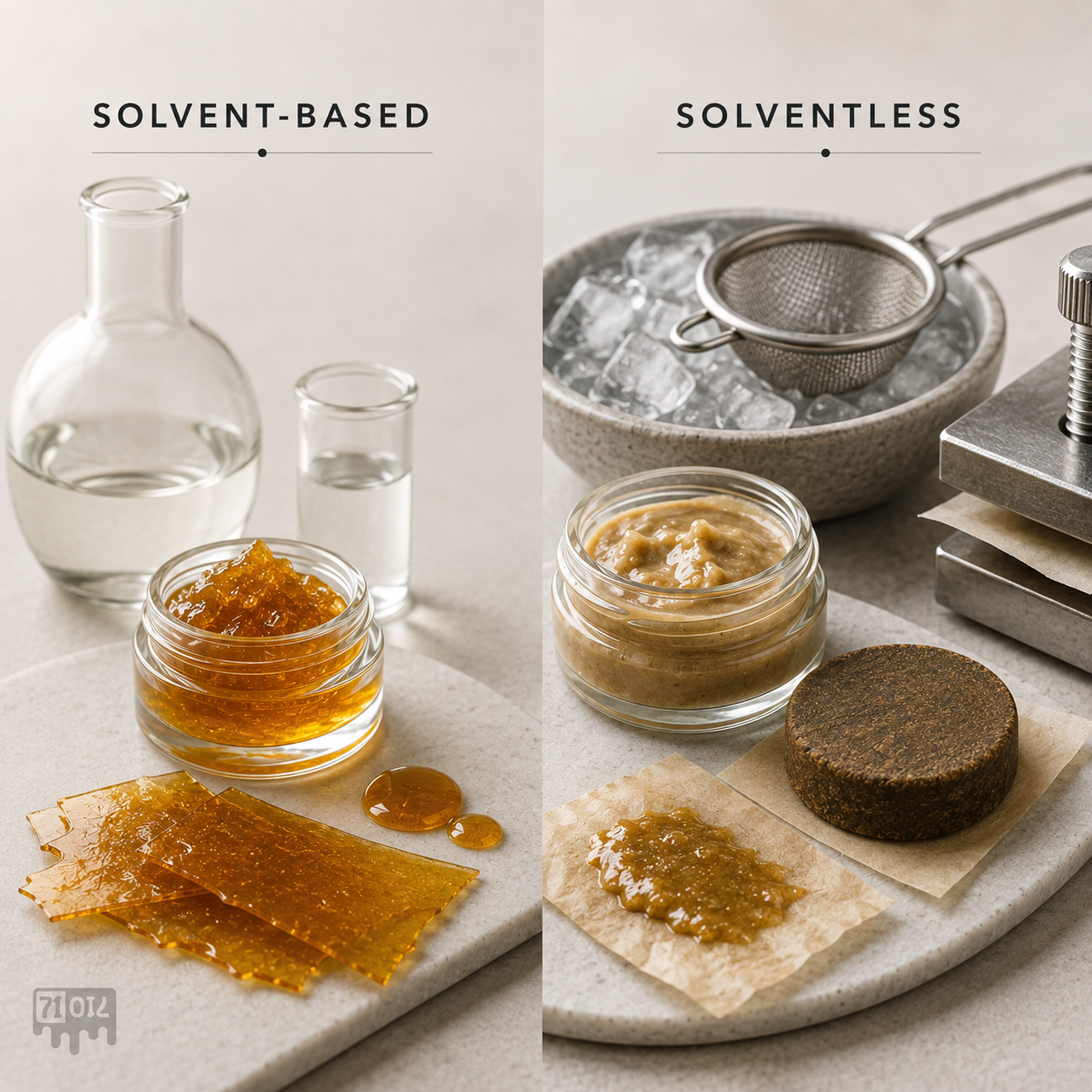
“Solvent-based” and “solventless” are common cannabis-industry terms for broad production approaches. They help explain how resin, cannabinoids, terpenes, and other components are separated or collected from plant material.
In Canada, however, these are not separate legal product classes. “Cannabis extract” is the regulated product class. Solvent-based and solventless are better understood as production categories used in cannabis education and industry discussion. Health Canada’s cannabis extract composition guidance provides the regulatory context for cannabis extracts as finished products.
There is also a terminology nuance. “Solventless” is an established cannabis term, but it is not chemically literal in every case because water itself can function as a solvent. In cannabis discussions, the term generally means that an added chemical extraction solvent is not used as the primary separation medium.
For a broader overview of concentrate terminology and formats, see 71 Oil’s guide to cannabis concentrates and extracts.
What Are Solvent-Based Cannabis Concentrates?
Solvent-based cannabis concentrates use an extraction medium during processing to separate selected compounds from plant material. Depending on the method, the extraction medium may include hydrocarbons, ethanol, or carbon dioxide.
Common solvent-based examples may include live resin, shatter, and many wax, budder, or badder products. However, the product name or texture does not always reveal the complete production method. Terms such as wax, budder, and badder can describe consistency as much as processing.
Live resin is a useful example of how starting material and extraction category overlap. Read our live resin guide for what “live” means, common formats, and product checks.
Distillate is better understood as a refinement category than a single extraction method. Crude cannabis extract may be further purified by short-path or molecular distillation, which research describes as a post-extraction refinement step.
For the dedicated definition and refinement context, see how cannabis distillate fits into the broader extraction process.
Refinement is a separate comparison from solvent-based versus solventless processing. See how distillate compares with full-spectrum cannabis vapes for the product-profile distinction.
The word “solvent” should not be used as a shortcut for judging the finished product. A solvent may be used during production without establishing the residual-solvent profile of the final concentrate. Canada’s Cannabis Regulations address microbial and chemical contaminants, while cannabis extracts are also subject to composition requirements. Only product- or batch-specific evidence can support a specific residual-solvent claim.
What Are Solventless Cannabis Concentrates?
Solventless cannabis concentrates are commonly defined as concentrates produced without an added chemical extraction solvent serving as the primary separation medium.
Instead, processors may use physical or mechanical separation, water and ice, or heat and pressure. At a high level, these methods separate resinous material from the plant without relying on an added chemical extraction solvent as the main extraction medium.
Common solventless examples include kief, dry sift, certain hash products, rosin, and live rosin.
The term describes the production approach, not the complete finished-product profile. Starting material, handling, processing conditions, formulation, packaging, storage, and product age still affect the concentrate.
Solvent-Based vs. Solventless Concentrates: Key Differences
The main difference between solvent-based and solventless concentrates is the separation method used during processing.
| Comparison | Solvent-Based | Solventless |
|---|---|---|
| Processing category | Uses an extraction medium during processing. | Relies mainly on physical/mechanical separation, water/ice, heat, or pressure without an added chemical extraction solvent as the primary medium. |
| Common examples | Live resin, shatter, many wax/budder/badder products. | Kief, dry sift, certain hash products, rosin, live rosin. |
| Starting material | Can vary depending on the extract and producer. | Can also vary depending on the product and process. |
| Texture range | May range from viscous extracts to shatter, wax, budder, or similar textures. | May range from loose kief or hash to pressed or viscous rosin products. |
| Refinement | May include multiple extraction, separation, or refinement stages. | May also include multiple physical separation or processing stages. |
| Flavour/aroma | Starting material, process conditions, refinement, formulation, and storage can influence the final profile. | Starting material, handling, heat/pressure, formulation, and storage can influence the final profile. |
| What to check | Label, intended use, Total THC/CBD, ingredients, producer, lot/package information, available testing. | The same product-specific information. |
| What it does not prove | Solvent-based does not mean low quality or unsafe. | Solventless does not mean safer, purer, stronger, cleaner, or better. |
Texture terms need extra care. Shatter, wax, budder, or badder do not always map perfectly to one extraction method without product-specific information. When the exact method matters, rely on the producer’s or authorized retailer’s product information rather than the texture name alone.
Common Examples of Each Type
A simple way to organize common concentrate terms is:
| Solvent-Based Concentrates | Solventless Concentrates |
|---|---|
| Live resin | Rosin |
| Shatter | Live rosin |
| Many wax/budder/badder products | Kief |
| Other resin extracts | Dry sift / certain hash products |
Product names may reflect process, starting material, texture, or refinement. Distillate is not placed in either column because distillation is a downstream refinement step rather than a single upstream extraction method.
Rosin and resin are a good example of why the terminology can be confusing. Rosin is generally associated with solventless processing, while live resin is generally produced using a solvent-based extraction method.
A useful product-level example is live resin versus live rosin: both can use fresh or frozen cannabis material, but one is commonly solvent-based while the other is solventless.
Does Extraction Method Determine Flavour, Terpenes, or Quality?
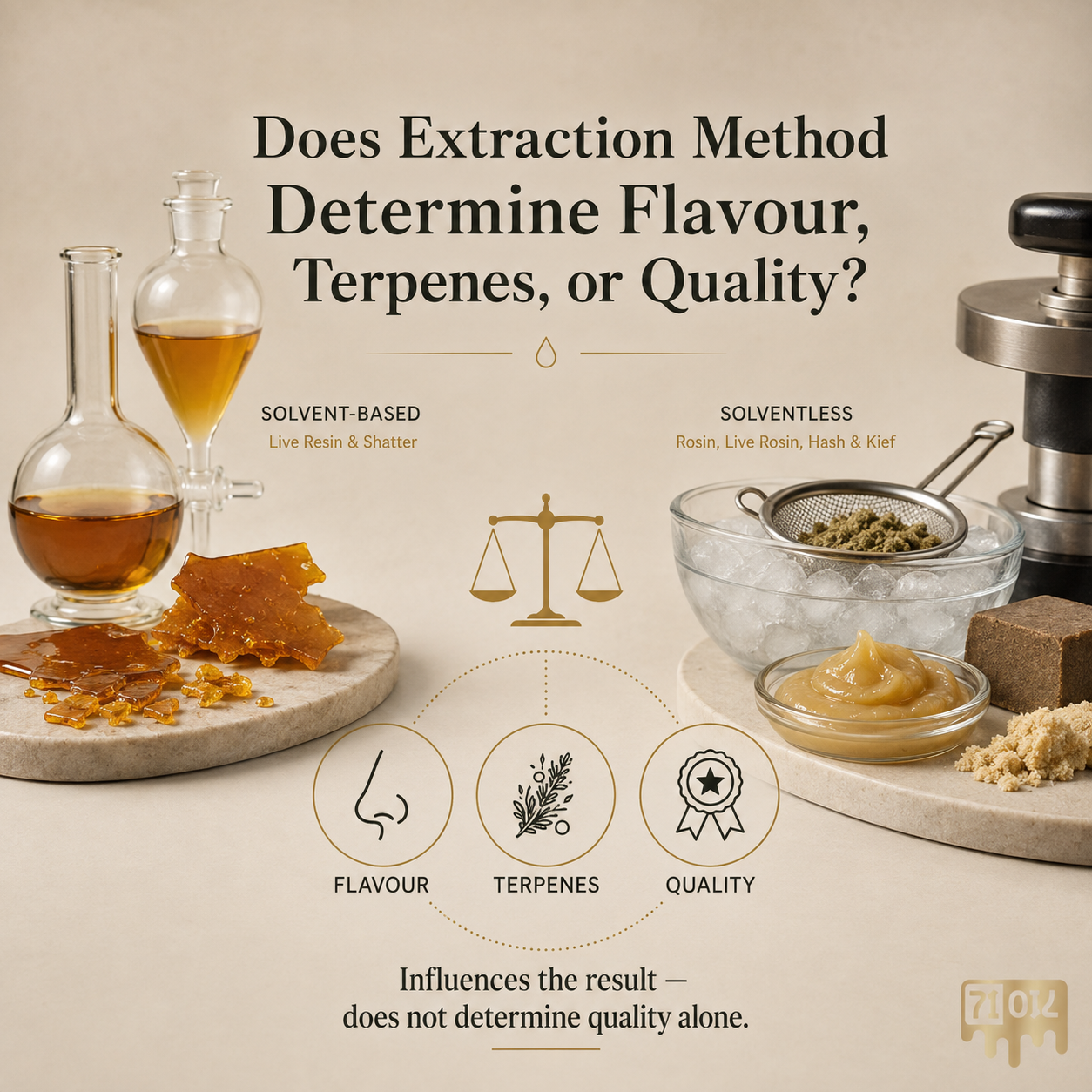
Extraction method can influence the chemical and aromatic profile of a concentrate, but it is only one part of the final result.
- Quality and condition of the starting material
- Harvest and post-harvest handling
- Processing conditions
- Refinement and formulation
- Packaging and storage conditions
- Product age
A 2024 comparative study of hemp extraction procedures found that hydrodistillation, supercritical CO2, and ethanol extraction produced substantially different cannabinoid and terpene profiles. That supports a more useful conclusion: extraction method can influence composition, but the finished profile still depends on the specific process and material.
Some concentrates are specifically positioned around terpene-rich or full-spectrum characteristics. If you want to understand that terminology separately from this comparison, read 71 Oil’s guide to HTFSE, or high-terpene full-spectrum extract.
Extraction method can influence the finished product, but it does not determine quality on its own.
Is Solventless Better Than Solvent-Based?
No. Neither category is universally better.
A better comparison starts with the characteristics of the specific product. Depending on what matters to the consumer, useful factors may include product format, flavour and aroma profile, strain identity, cannabinoid content, ingredients, level of refinement, intended use, producer information, price, and available batch-specific testing.
For some consumers, the production method itself is an important preference. Others may be looking for a particular resin, distillate, rosin, or vape formulation.
The production method can be a valid preference, but it should not replace product-specific checks. Use it as one piece of information rather than the entire decision.
Explore the 71 Oil Cannabis Concentrates & Extracts hub for more guides on extract terminology and concentrate formats.
What Should Canadian Adults Check Before Comparing a Concentrate?
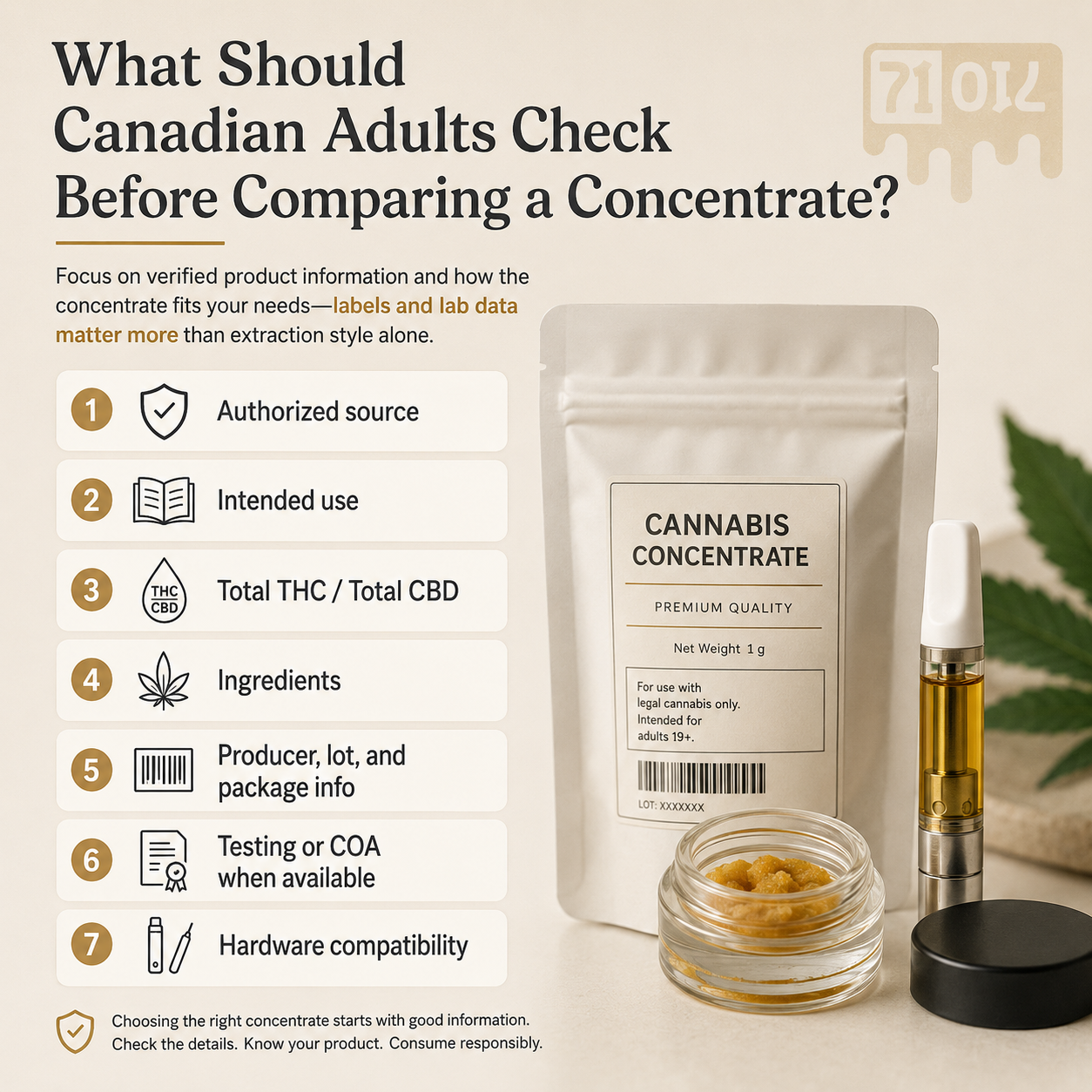
The product label and verified product information generally tell you more than the words “solvent-based” or “solventless” alone.
Authorized source
Health Canada advises adults who choose cannabis to buy through an authorized legal source. Legal cannabis products must meet Cannabis Act and regulatory requirements for product quality, packaging, and labelling, and Health Canada notes that legal products are tested for harmful levels of contaminants and for THC/CBD accuracy.
Intended use
Check how the product is intended to be used. Different cannabis extracts may be formulated for different formats. If an extract is sold in a vape cartridge or integrated device, follow the manufacturer’s instructions and use compatible hardware.
Total THC and Total CBD
Health Canada’s cannabis product label guidance explains how Total THC and Total CBD information appears on legal cannabis products. Use these figures to understand cannabinoid content, but do not treat a higher THC number as proof of higher quality.
Ingredients and product description
Review the ingredients where they are required and check the extract or formulation description. These details can help distinguish products that may use similar strain names or concentrate terminology.
Producer, lot, and package information
Check the licence-holder or producer information, net quantity, lot number, and package details. Product-specific identifiers are more useful than assumptions based only on the extraction category.
Testing or COA information when genuinely available
If legitimate batch-specific testing or a Certificate of Analysis is available, review what it actually covers. Do not assume that every product has a public COA, and do not treat a general “lab-tested” statement as proof of a specific result unless documentation supports it.
Hardware compatibility for vape extracts
For products formulated for vaping, confirm the cartridge or device format and follow the manufacturer’s compatibility instructions. 71 Oil’s 510 cartridges can be compared by strain, product format, and extract description rather than extraction method alone.
Potency and Responsible Adult Use
Cannabis concentrates can contain high levels of THC. Health Canada’s lower-risk cannabis guidance notes that higher-THC cannabis products are associated with greater risks of impairment and adverse effects.
Extraction method does not remove those considerations. Legal-age adults who choose to use cannabis should avoid driving or operating machinery while impaired, store cannabis securely away from children and pets, and follow applicable federal, provincial, and territorial rules.
Frequently Asked Questions
What is the difference between solvent-based and solventless concentrates?
Solvent-based concentrates use an extraction medium during processing. Solventless concentrates rely mainly on physical or mechanical separation, water and ice, heat, or pressure without an added chemical extraction solvent as the primary medium. The distinction describes processing, not overall safety or quality.
What are the two main production categories of cannabis concentrates?
For this consumer-facing comparison, the two broad production categories are solvent-based and solventless. Solvent-based methods use an extraction medium; solventless methods rely mainly on physical or mechanical separation. Live resin and shatter are common solvent-based examples, while kief, hash, rosin, and live rosin are common solventless examples.
Is rosin solventless?
Yes. Rosin is generally categorized as a solventless cannabis concentrate because it is produced without an added chemical extraction solvent as the primary separation medium. Product-specific quality still depends on the starting material, processing, handling, and finished formulation.
Is live resin solventless?
No. Live resin is generally considered a solvent-based extract. It is commonly produced from fresh-frozen cannabis material using an extraction medium. Live resin should not be confused with live rosin, which belongs to the solventless category.
Does solventless mean a concentrate is safer or purer?
No. Solventless describes a production approach, not a safety or purity certification. The individual product’s composition, potency, production controls, storage, intended use, and verified product information still matter.
Do solvent-based concentrates contain solvents in the final product?
Not necessarily. A solvent may be used during processing, but that does not establish the residual-solvent content of the finished product. Only product- or batch-specific evidence can support a specific residual-solvent claim.
Is CO2 extraction considered solvent-based?
For this consumer-facing comparison, yes. CO2 is used as the extraction medium, so it belongs with extraction-medium methods. Technically, many cannabis CO2 systems use supercritical-fluid extraction, in which carbon dioxide under controlled temperature and pressure is used to separate compounds from plant material.
Which is better: solventless or solvent-based concentrates?
Neither is universally better. Compare the individual product’s intended use, cannabinoid content, ingredients, flavour and aroma profile, extract description, producer information, formulation, price, and verified testing information when available.
Choose the Product, Not Just the Extraction Label
Understanding solvent-based vs. solventless concentrates makes cannabis terminology easier to navigate, but extraction method is only one part of a product.
Solvent-based products are not automatically lower quality because an extraction medium was used. Solventless products are not automatically safer, purer, stronger, or more flavourful because an added chemical extraction solvent was not used as the primary separation medium.
When comparing legal cannabis concentrates, focus on the individual product: its label, intended use, Total THC and Total CBD, ingredients, producer information, formulation, and verified testing information when available.
Continue exploring the 71 Oil Cannabis Concentrates & Extracts guides to learn more about specific extraction methods and concentrate terminology. If you are comparing extract-based vape formats, you can also browse 71 Oil 510 cartridges by strain and product format.
Resources Used
- Health Canada — Guide on Composition Requirements for Cannabis Products
- Health Canada — How to Read and Understand a Cannabis Product Label
- Health Canada — Reduce Your Risk: Choose Legal Cannabis
- Health Canada — Cannabis: Lower Your Risks
- Justice Canada — Cannabis Regulations, Section 101.1
- Justice Canada — Cannabis Regulations, Section 101.3
- BC Cannabis Stores — Cannabis Concentrates 101
- Lazarjani et al. — Processing and Extraction Methods of Medicinal Cannabis
- Effect of Hemp Extraction Procedures on Cannabinoid and Terpenoid Composition
- Cannabis Extraction Technologies: Impact of Research and Value Addition in Latin America
0 Responses