

How to Read a Cannabis Vape Product Label in Canada
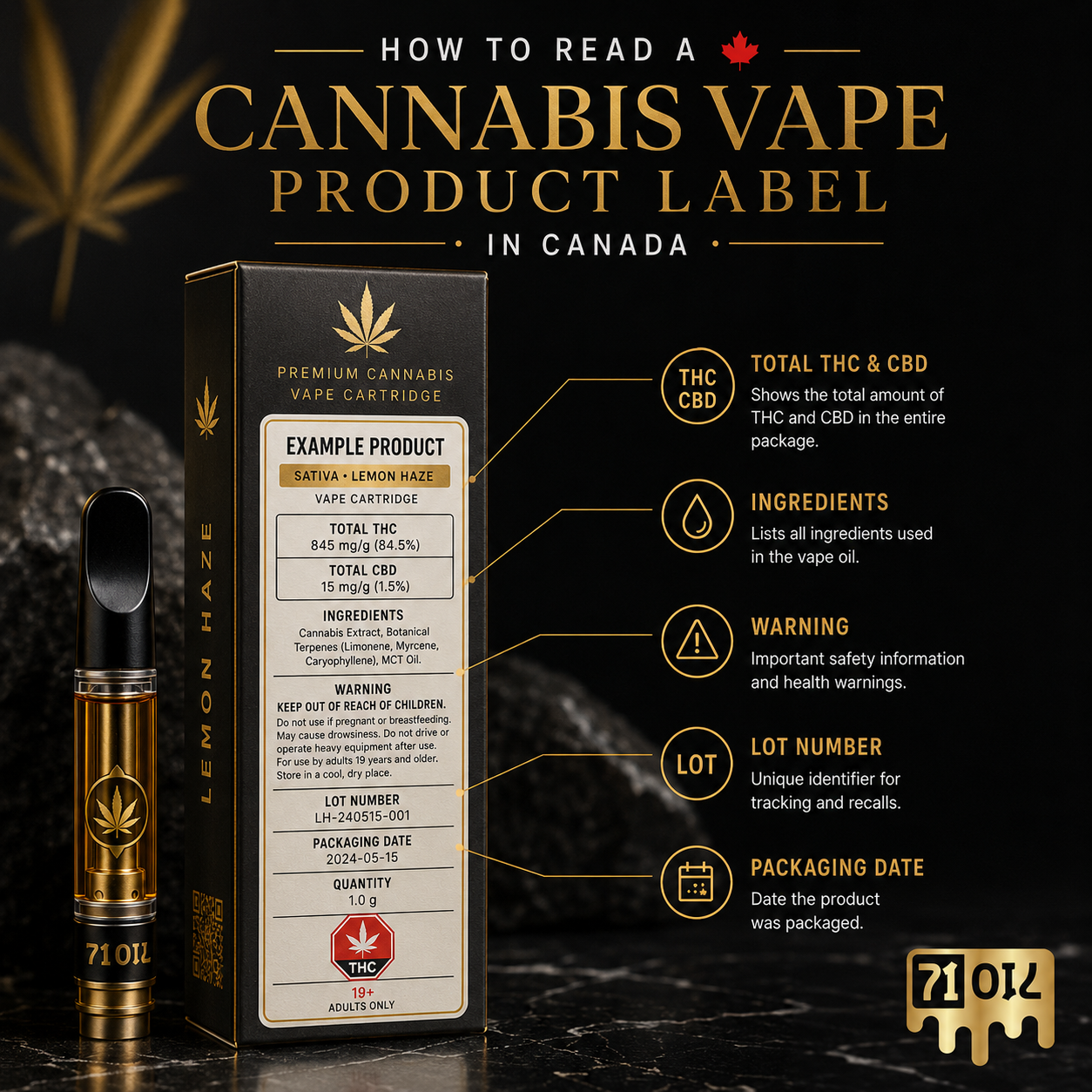
Learning how to read a cannabis vape label in Canada starts with separating regulated product information from optional strain or marketing details. Health Canada’s consumer label guide identifies vape liquids as cannabis extracts and explains the required information found on legal cannabis packaging, including Total THC, Total CBD, product class, warnings, lot and packaging information, storage guidance, and manufacturer details.
For adults comparing a vape cartridge or disposable cannabis vape, the label is most useful when you read the regulated information first and use optional details such as strain names or terpene profiles as additional context. A label can help you understand what the product is and what it contains, but it does not guarantee a particular effect or make cannabis vaping risk-free.
| Quick Answer: What Should You Look for on a Canadian Cannabis Vape Label?
Check the product class, Total THC, Total CBD, ingredient list, net quantity, mandatory health warning, standardized cannabis symbol where required, excise stamp where applicable, lot number, packaging date, recommended storage conditions, and licence-holder information. Strain names, terpene profiles, expiry dates, and QR-linked information may be optional. |
In This Guide
- What information should you check on a cannabis vape label?
- Are cannabis vape liquids considered cannabis extracts in Canada?
- How do you read Total THC and Total CBD?
- What does the ingredient list tell you?
- What do the THC symbol and excise stamp mean?
- What does the health warning mean?
- Why check the lot number and packaging date?
- What do storage conditions and manufacturer information tell you?
- Are strain names and terpene profiles required?
- What can a QR code or COA add?
- What does a cannabis vape label not guarantee?
- How should you compare two cannabis vape labels?
- Does a cannabis vape label show battery compatibility?
- Quick cannabis vape label checklist
- Frequently Asked Questions
- Read the label before comparing the marketing
- Resources Used
Key Takeaways
- Vape liquids are classified as cannabis extracts in Health Canada’s current consumer label guidance.
- For cannabis extracts intended for inhalation, Total THC and Total CBD are displayed as concentrations in mg/g.
- Cannabis extracts require an ingredient list, and applicable food allergens must also be identified.
- The standardized cannabis symbol and excise stamp have specific regulatory meanings and exceptions; neither should be interpreted loosely.
- Strain names, terpene profiles, expiry dates, and some QR-linked information can be optional, so they should not outweigh the regulated label details.
What Information Should You Check on a Cannabis Vape Label?
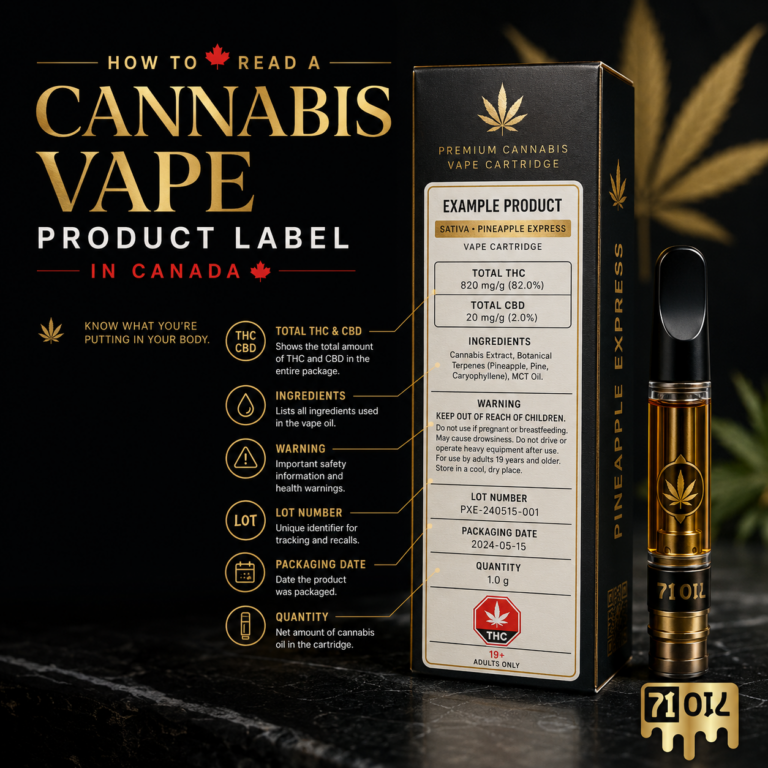
Canadian cannabis packaging is dense because several pieces of information must appear in a limited space. The fastest way to read a vape label is to start with the regulated fields that identify the product, cannabinoid content, ingredients, traceability, and required warnings.
| Label element | Status | What it helps you understand |
|---|---|---|
| Product class | Required | Confirms the regulated cannabis class; vape liquids fall under cannabis extracts. |
| Total THC | Required | Shows the labelled THC concentration for an inhaled cannabis extract. |
| Total CBD | Required | Shows the labelled CBD concentration for an inhaled cannabis extract. |
| Ingredient list | Required for extracts | Shows the ingredients used in the cannabis extract. |
| Net quantity | Required | Shows how much cannabis extract is in the package or immediate container. |
| Health warning | Required | Provides a mandatory cannabis health-risk message. |
| Standardized cannabis symbol | Required above threshold | Appears when THC exceeds the regulatory threshold. |
| Excise stamp | Generally required | Indicates applicable cannabis excise duty/stamping requirements; defined exceptions exist. |
| Lot number | Required | Provides traceability for a specific product lot. |
| Packaging date | Required on the applicable immediate-container label | Shows when the product was packaged; it is not automatically an expiry date. |
| Storage conditions | Required | Provides manufacturer-labelled storage conditions intended to maintain product quality. |
| Manufacturer / licence-holder contact | Required | Provides contact details for product concerns or quality issues. |
| Strain name | Optional | May identify a cultivar or strain, but it is not a core mandatory label field. |
| Terpene profile | Optional | May add compositional context but is not mandatory. |
| QR code / COA access | Optional | May provide additional product information, including a COA or composition details. |
Health Canada’s current label guidance is the primary source for the consumer-facing requirements summarized above. Its more detailed packaging and labelling guide explains the class-specific presentation rules.
Are Cannabis Vape Liquids Considered Cannabis Extracts in Canada?
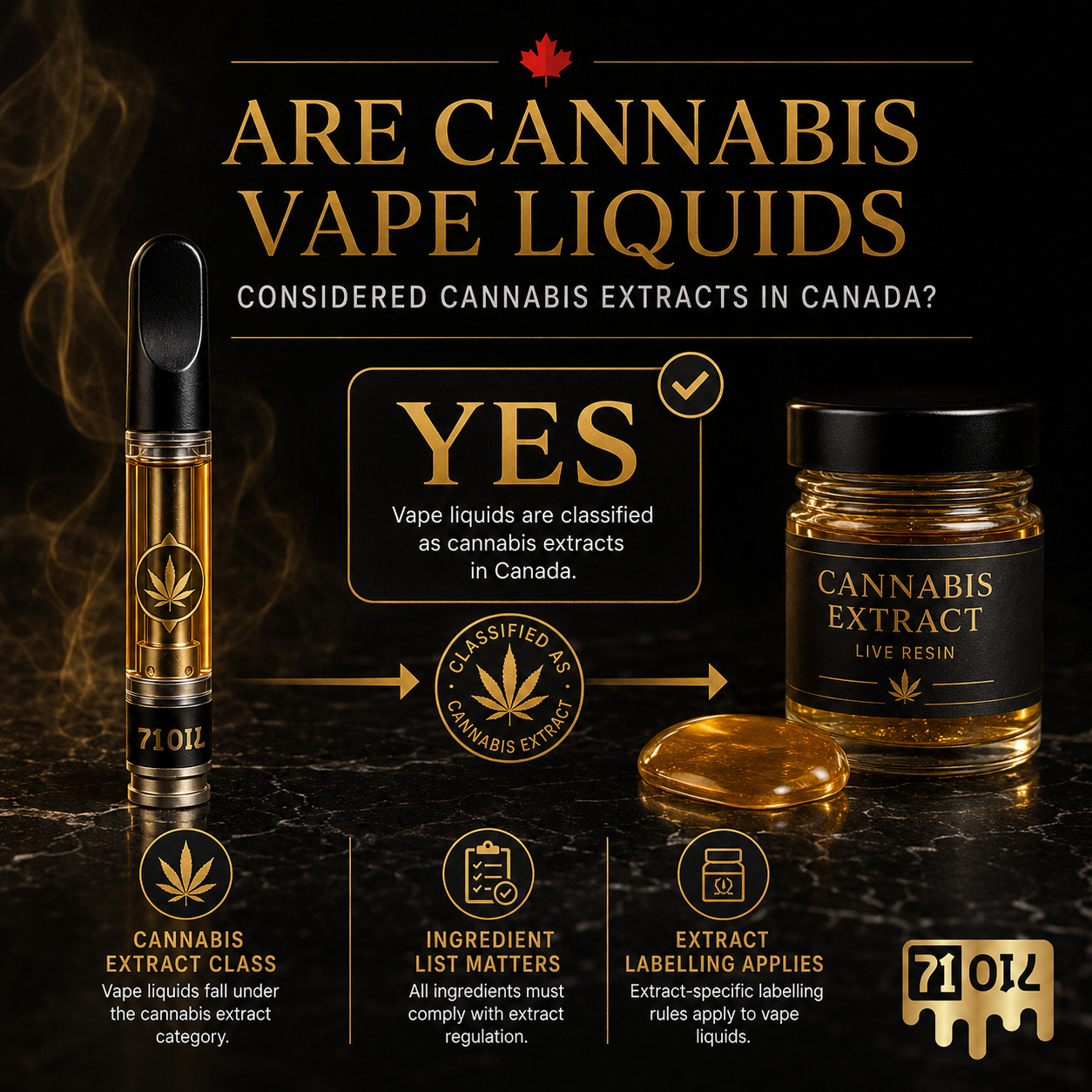
Yes. Health Canada lists vape liquids within the cannabis extract product class, alongside products such as oils, tinctures, kief, hash, resin, rosin, wax, and shatter.
That classification matters because cannabis-extract labelling rules apply. For a vape product, the label may therefore include the extract’s net weight, Total THC, Total CBD, ingredients, product identity, intended use, and applicable allergen information.
If you want broader context on extract terminology before comparing vape labels, read What Are Cannabis Concentrates and Extracts? and the 71 Oil guide to HTFSE.
How Do You Read Total THC and Total CBD on a Cannabis Vape Label?
For cannabis extracts intended for inhalation, Health Canada’s detailed packaging guide specifies Total THC and Total CBD in milligrams per gram (mg/g) on the principal display panel. That is the format most directly relevant to cannabis vape liquids.
Read the unit as carefully as the number. A concentration in mg/g is not the same thing as a total package amount in milligrams or a per-unit value used for another product class. Comparing two vape labels only makes sense when the products and units are comparable.
| Do not use THC as a quality score
A higher Total THC value does not prove better hardware, fuller flavour, greater terpene content, better manufacturing quality, or a predictable experience. It is one product-composition value, not an overall product rating. The label can show cannabinoid concentration and required product information, but it cannot predict one fixed personal response. See what can affect how a cannabis vape feels. A label can verify important product details, but “premium” requires a broader comparison. See how to evaluate cannabis quality beyond the label alone. |
For more background on intoxication and why response varies, see Do Cannabis Vapes Get You High? Keep deeper cannabinoid and terpene interpretation separate from this label-reading guide to avoid overlapping search intent.
What Does the Ingredient List Tell You?
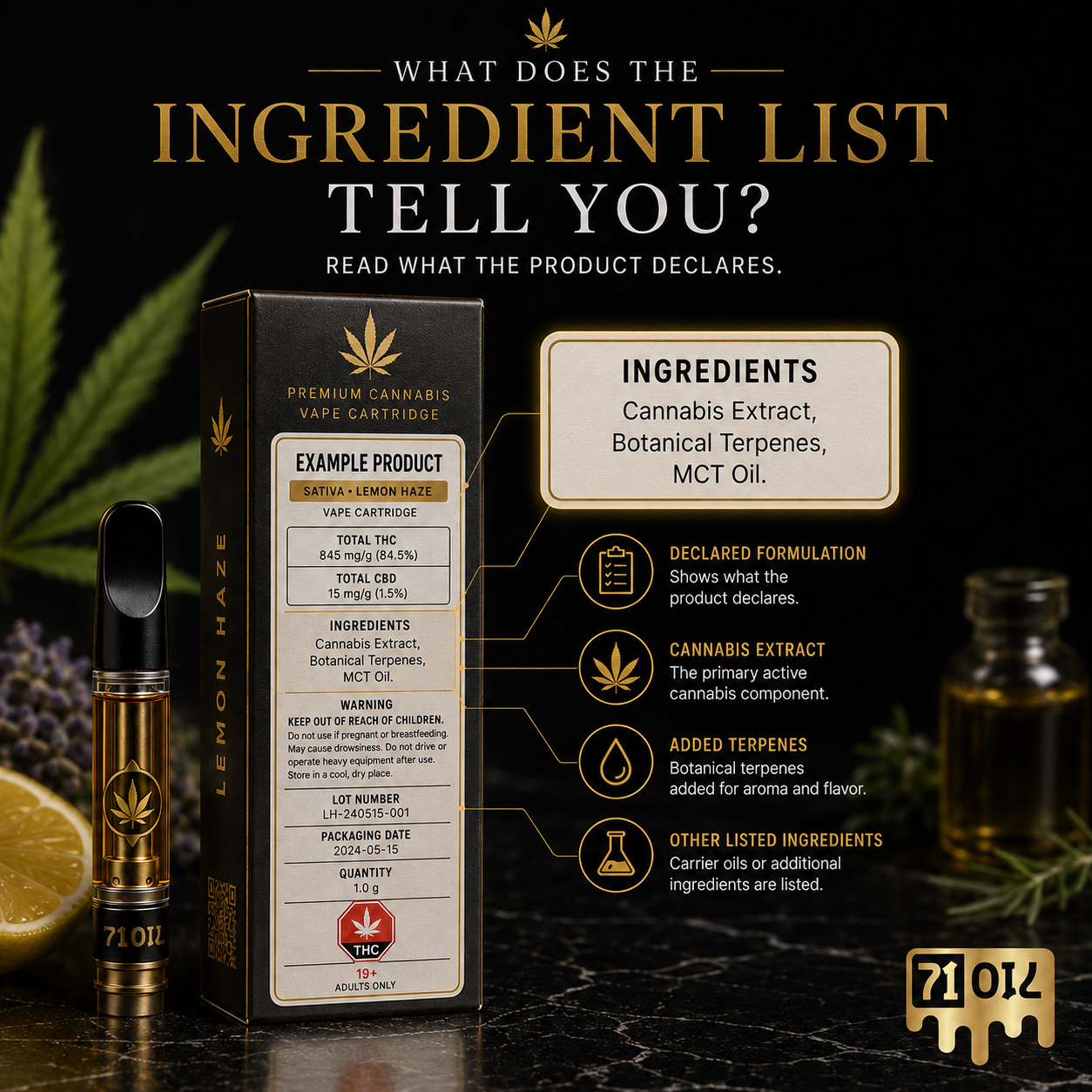
Cannabis extracts require an ingredient list. Health Canada’s packaging guidance says cannabis-extract ingredients must be identified by their common or chemical name and generally listed in descending order by weight before they are combined to form the final product. Ingredients at 1% or less can follow specific ordering rules, and flavouring agents may be listed at the end.
Extract terminology adds context beyond cannabinoid numbers. Learn how to compare distillate and full-spectrum cannabis vapes using extract type, ingredients, cannabinoids, and other product information.
The label also needs to identify a food allergen present in a cannabis extract, except where it is present only because of cross-contamination. This makes the ingredient section useful when comparing actual formulation differences rather than relying only on a strain name or front-of-package description.
| What the ingredient list does not prove
A shorter ingredient list is not automatically a higher-quality, safer, or “cleaner” product. The list tells you what is declared in the formulation; it should be read alongside the rest of the verified product information. |
What Do the THC Symbol and Excise Stamp Mean?
Standardized Cannabis Symbol
The standardized cannabis symbol is required on the front of products containing more than 10 micrograms of THC per gram. Because the rule has a threshold, it is not accurate to say that every legal cannabis product must display the red THC symbol.
Cannabis Excise Stamp
The cannabis excise stamp is another regulated-market indicator. Health Canada says the stamp indicates that the product came from a Health Canada licence holder, while the Canada Revenue Agency explains that excise stamps confirm applicable federal excise duty has been paid. Provincial and territorial stamps use different colours.
Certain low-THC and prescription cannabis products are exceptions to the general cannabis excise-stamp requirement. For adult-use purchasing, Health Canada recommends using authorized legal cannabis sources and provides a list of provincial and territorial authorized retailers.
What Does the Health Warning on a Cannabis Vape Package Mean?
All cannabis products must carry a mandatory health warning message in a yellow box on the front of the label. Health Canada explains that these warnings communicate important information about the effects and risks of cannabis, and the federal warning set was updated in early 2025.
The package also needs to display “KEEP OUT OF REACH OF CHILDREN / TENIR HORS DE LA PORTÉE DES ENFANTS.” Treat these warnings as regulated product information rather than optional copy.
| Important
Legal packaging does not mean cannabis vaping is harmless or risk-free. The label helps identify regulated product information; it does not remove the health risks associated with cannabis use or inhalation. |
Why Should You Check the Lot Number and Packaging Date?
Lot Number
The lot number supports traceability. If there is a quality issue, complaint, or recall, it helps identify the specific production lot involved. Health Canada also tells consumers to include the lot number and packaging date when contacting the manufacturer about a product problem or unwanted side effect.
Packaging Date
The label identifies when the product was packaged. However, a packaging date is not the same as an expiry date. Health Canada lists packaging date among required information, while an expiry date may be added when the required stability data exist.
Do not convert the packaging date into a universal “freshness score” or shelf-life rule for every cannabis vape. Product-specific stability, packaging, formulation, and manufacturer guidance matter.
What Do Storage Conditions and Manufacturer Information Tell You?
Recommended Storage Conditions
The label needs to state recommended storage conditions, which can address temperature, light, humidity, or other conditions intended to maintain product quality. Health Canada’s consumer label guidance specifically identifies storage conditions as required product information.
Follow the labelled instructions and device guidance rather than assuming every cartridge or disposable should be stored the same way.
Manufacturer / Licence-Holder Contact Information
The label includes the manufacturer’s name, telephone number, and email address. Those details provide a direct route for reporting a product problem, quality issue, or unwanted side effect. The lot number and packaging date help identify the product when you make contact.
Is the Strain Name or Terpene Profile Required on a Cannabis Vape Label?
Not necessarily. Health Canada’s packaging and labelling guide permits additional product information when it is compliant and not false, misleading, or deceptive. Examples include a strain name, terpene profile, other cannabinoid content, product-form information, formulation information, and directions for use.
That creates an important distinction for product comparison: Total THC, Total CBD, class, warnings, traceability, and other required fields are regulated label information; strain and terpene details can be optional context.
| Do not infer guaranteed effects
A strain name, indica/sativa label, terpene name, flavour descriptor, or THC number should not be used to promise a specific mood, medical result, or identical experience for every consumer. |
What Can a QR Code or COA Add?
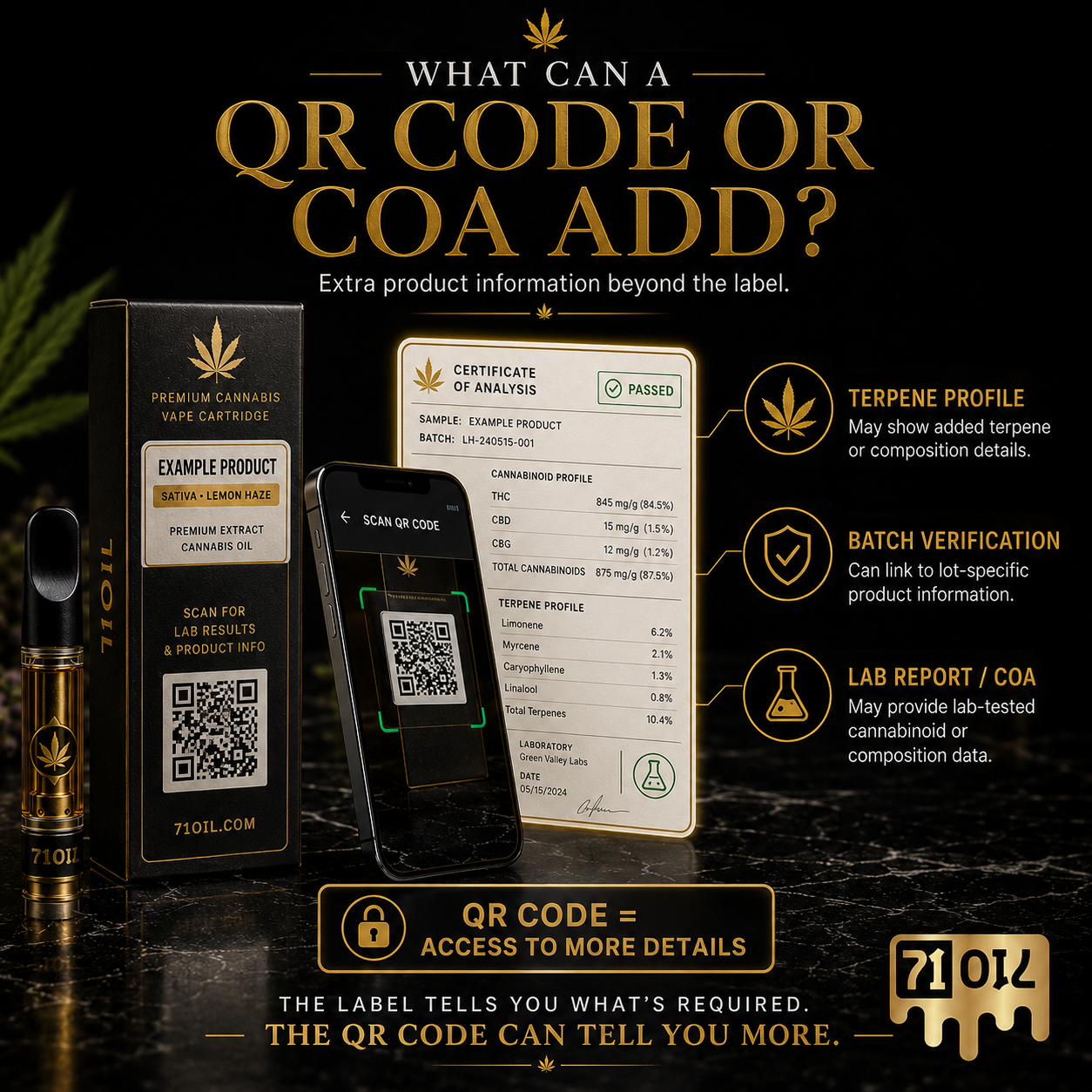
Health Canada allows up to two bar codes, including QR codes, on cannabis packaging. Its detailed guide says QR codes may be used for inventory and tracking or to provide consumers with additional information such as a terpene profile, certificate of analysis (COA), or additional composition information.
Required label information still has to appear on the label itself. If a QR code links to a COA, check that the document corresponds to the correct product and lot or batch before using it as supporting information.
A QR code by itself does not prove that every marketing statement has been independently verified. A dedicated COA guide should own the deeper search intent around test panels, batch matching, and document interpretation.
What a Cannabis Vape Label Does Not Guarantee
A label is useful because it standardizes key product information. It should not be stretched into claims it was never designed to support.
| Label information | What it does not guarantee |
|---|---|
| Total THC | A specific effect, intensity, or experience for every person |
| Total CBD | A therapeutic or medical result |
| Strain name | Predictable effects or identical chemistry across all products |
| Terpene profile | Guaranteed mood, health, or medical effects |
| Packaging date | A universal expiry date or quality score |
| Ingredient list | That inhalation is risk-free |
| Legal-market packaging | That cannabis vaping is harmless |
| High cannabinoid concentration | Higher overall product quality |
| QR code or COA | That every marketing claim is verified |
| Cartridge format | Compatibility with every battery or device |
How Should You Compare Two Cannabis Vape Labels?
Use the same sequence for both products so that optional marketing details do not crowd out the regulated information.
- Confirm the product class and intended use. Make sure you are comparing similar inhaled cannabis-extract formats rather than assuming all cannabis oils or devices are interchangeable.
- Compare Total THC and Total CBD. For inhaled extracts, compare the mg/g concentrations and confirm the products use comparable formats.
- Read both ingredient lists. Look for actual formulation differences and applicable allergen information.
- Check net quantity. Confirm how much cannabis extract is in each package or immediate container before comparing size or value.
- Review lot, packaging, and storage details. Use them for traceability and handling rather than turning them into unsupported quality guarantees.
- Separate required facts from optional product descriptions. Consider strain, terpene, flavour, and other voluntary information only after you understand the regulated fields.
Before comparing product names, the 71 Oil guide to weed carts, THC carts, and vape cartridges can help clarify common cartridge terminology.
Adults comparing cartridge formats can also browse the current 71 Oil 510 Cartridges collection by strain and size. Product-page information should be read separately from the regulated Canadian label requirements described in this guide.
Does a Cannabis Vape Label Tell You Whether a Cartridge Fits Your Battery?
Not necessarily. A cannabis label primarily identifies the cannabis product and required product information. It should not be treated as proof that a cartridge will work with every vape battery.
Device specifications vary. Confirm the connection type, cartridge dimensions, voltage or power requirements, charging method, airflow, and compatibility in the manufacturer’s instructions. The 71 Oil FAQ contains current compatibility and troubleshooting information, while product-specific hardware instructions should remain the primary reference.
Quick Cannabis Vape Label Checklist
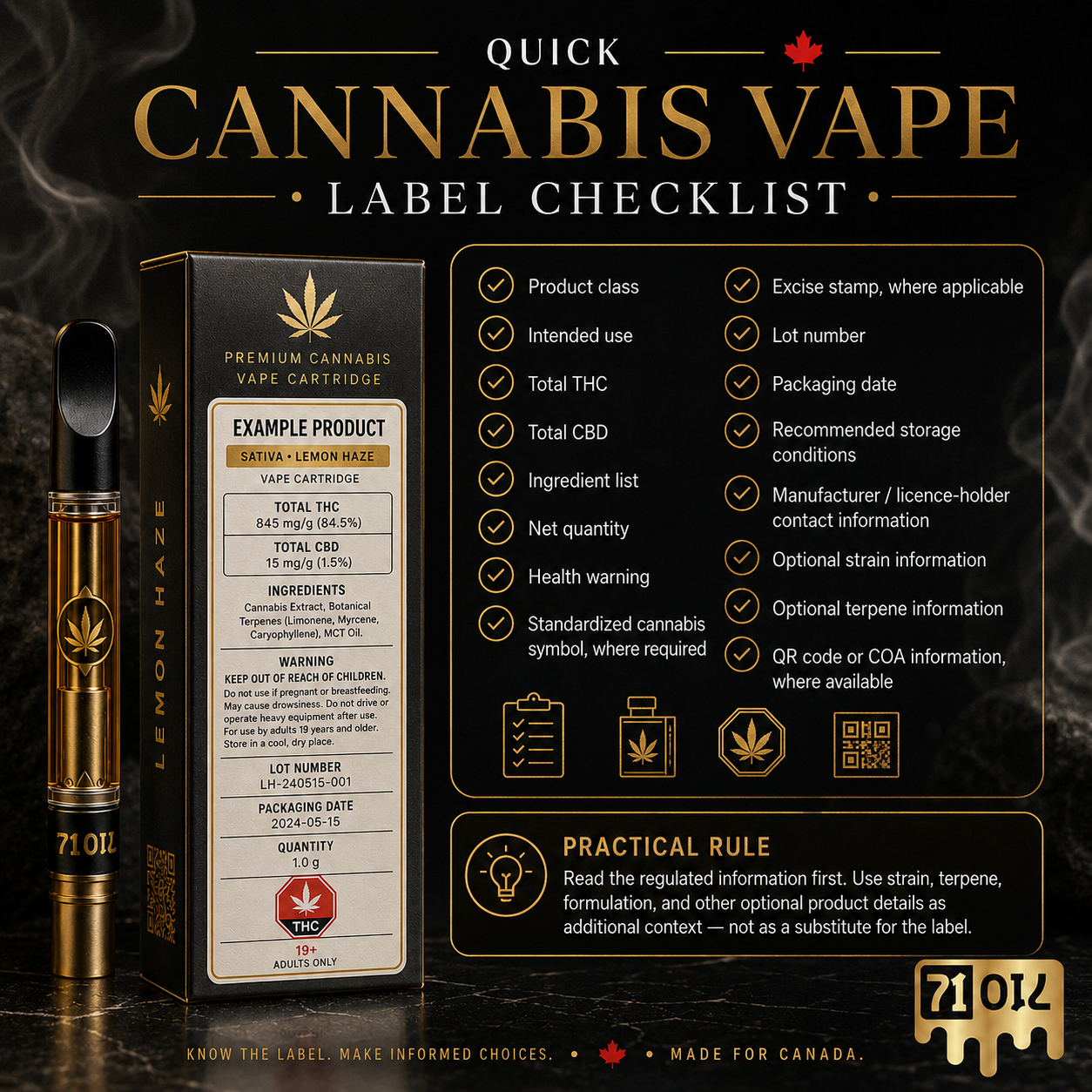
Before comparing a Canadian cannabis vape product, check:
- Product class
- Intended use
- Total THC
- Total CBD
- Ingredient list
- Net quantity
- Health warning
- Standardized cannabis symbol, where required
- Excise stamp, where applicable
- Lot number
- Packaging date
- Recommended storage conditions
- Manufacturer / licence-holder contact information
- Optional strain information
- Optional terpene information
- QR code or COA information, where available
| Practical rule
Read the regulated information first. Use strain, terpene, formulation, and other optional product details as additional context – not as a substitute for the label. |
Frequently Asked Questions
What does Total THC mean on a cannabis vape label?
For cannabis extracts intended for inhalation, Total THC is the labelled THC concentration the extract could yield, expressed in mg/g. Health Canada’s packaging guide uses the same mg/g format for Total CBD. Check the units when comparing products and do not assume a higher number guarantees a particular experience.
Are ingredients required on cannabis vape labels in Canada?
Yes. Vape liquids fall within the cannabis extract class, and Health Canada requires cannabis extracts to carry an ingredient list. Applicable food allergens in a cannabis extract must also be identified, except where present only because of cross-contamination.
Are cannabis vape liquids considered cannabis extracts in Canada?
Yes. Health Canada explicitly lists vape liquids among examples of cannabis extracts. That classification determines which cannabis-extract labelling requirements apply to the product.
Is the packaging date the same as an expiry date?
No. The packaging date tells you when the product was packaged. An expiry date is separate and may be added when the required stability data support one. Do not treat the packaging date as a universal expiry rule.
Are terpene profiles required on cannabis vape labels?
No. Health Canada’s detailed packaging guidance lists a terpene profile as optional product information. It can add compositional context, but it is not one of the core mandatory label fields.
Is a strain name required on a Canadian cannabis product label?
No. Health Canada identifies a cannabis strain name as optional information. A product may include one, but the regulated label still relies on required product, cannabinoid, warning, traceability, and manufacturer information.
What does the red THC symbol mean?
The standardized cannabis symbol is required when a cannabis product contains more than 10 micrograms of THC per gram. The threshold is why the symbol should be described as appearing “where required,” rather than as a feature on every legal cannabis product.
Does an excise stamp mean a cannabis product is legal?
The stamp is an important regulated-market indicator. Health Canada says it shows the product came from a licence holder, and the CRA says it confirms applicable excise duty has been paid. Defined exceptions exist for certain low-THC and prescription products, so consumers should also use authorized legal sources.
Read the Label Before Comparing the Marketing
A Canadian cannabis vape label gives adults a structured way to compare products without relying on a strain name, flavour description, or headline THC number alone.
Start with the regulated information: product class, Total THC, Total CBD, ingredients, quantity, warnings, lot information, packaging date, storage conditions, and manufacturer details. Then use optional strain, terpene, formulation, or QR-linked information to add context.
No single label field determines overall product quality or guarantees a particular experience. For broader responsible-use guidance, continue with Cannabis Vaping Tips for Responsible Adult Use. Adults comparing product formats can browse 71 Oil 510 Cartridges or the 71 Oil Shop.
| Adult-use note
Cannabis is intended for adults who meet the legal age requirement in their province or territory. Cannabis use can cause impairment and carries health risks. Follow product information and applicable laws, do not drive while impaired, and keep cannabis away from children and pets. |
Resources Used
- Health Canada – How to read and understand a cannabis product label – Primary consumer-facing source for THC/CBD, product class, ingredients, warnings, lot information, packaging date, storage, manufacturer details, and optional information.
- Health Canada – Packaging and labelling guide for cannabis products – Detailed source for cannabis-extract label requirements, mg/g THC/CBD presentation for inhaled extracts, ingredients, QR codes, optional strain/terpene information, and expiry-date rules.
- Health Canada – Reduce your risk: Choose legal cannabis – Official legal-source and product-selection context.
- Health Canada – Authorized cannabis retailers by province and territory – Official directory context for legal non-medical cannabis retail channels.
- Canada Revenue Agency – Excise stamps: Information for consumers – Official explanation of cannabis excise-stamp purpose, duty-paid meaning, and stamp identification.
- Health Canada – Cannabis accessories for inhalation – Supporting terminology and risk context for cannabis vaping accessories and inhalation.
Source note: Regulatory statements were checked against current Government of Canada guidance on 14 August 2026. Government guidance can change, so recheck these sources during future substantive refreshes.
0 Responses