

Distillate vs. Live Resin: What Should Buyers Compare?
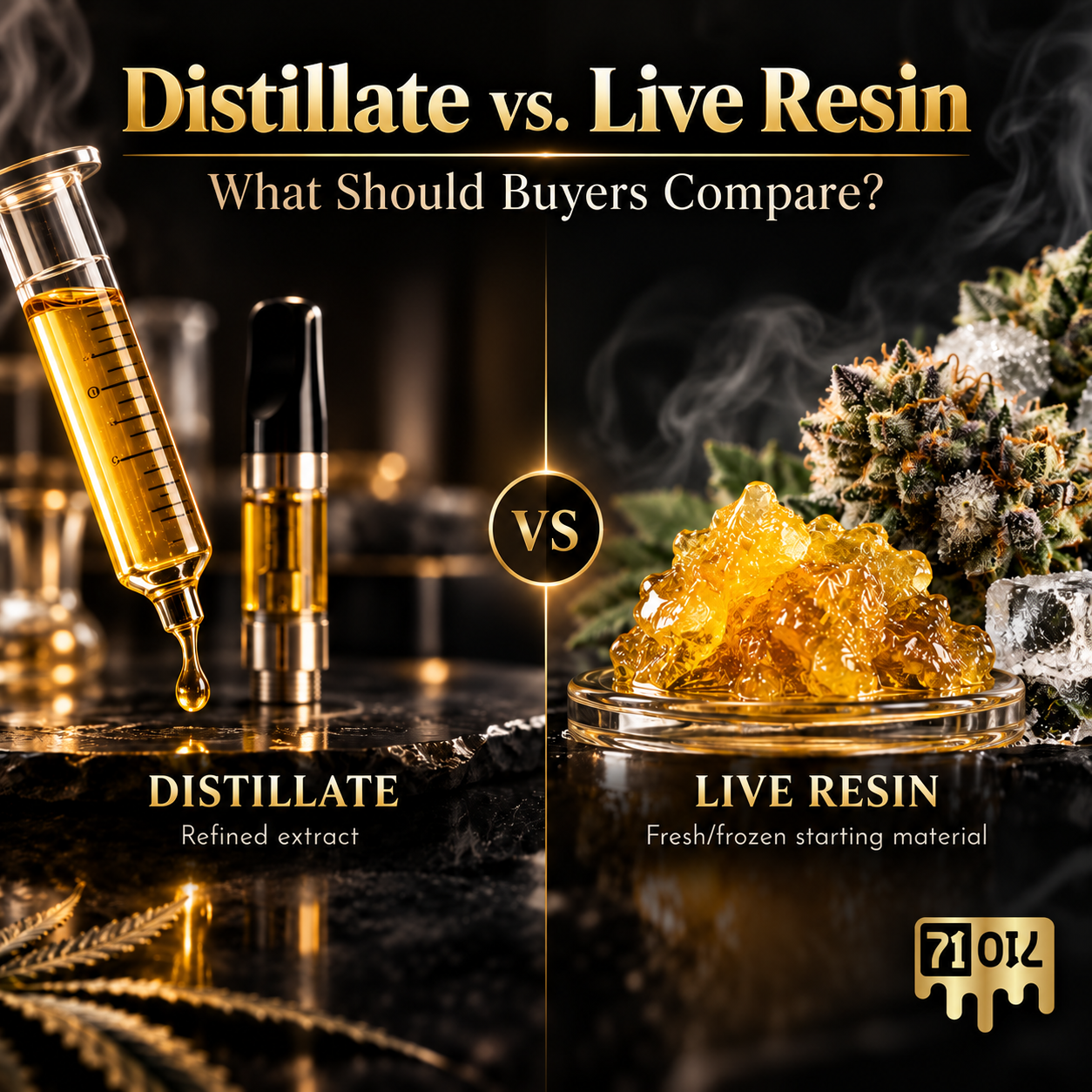
If you are comparing distillate vs. live resin, the first thing to know is that the two terms do not describe the same characteristic. Distillate mainly tells you about extensive downstream refinement. Live resin mainly tells you about fresh or freshly harvested cannabis that is frozen before conventional drying and curing, followed by a generally solvent-based extraction process.
Neither term alone tells you which product is stronger, more terpene-rich, purer, safer, more flavourful, or higher quality. For legal-age adults in Canada, the more useful comparison is the finished product: Total THC and Total CBD, ingredients, extract description, terpene information when available, intended use, hardware format, and other verified label details.
TL;DR: Distillate vs. Live Resin
Distillate is an extensively refined cannabis extract category, while live resin generally uses fresh or freshly harvested cannabis frozen before conventional drying and curing and is typically produced through solvent-based extraction. Neither term alone proves potency, terpene level, flavour, purity, safety, or quality. Compare the finished product and its label.
| Comparison | Distillate | Live Resin |
|---|---|---|
| What the term mainly describes | Extensive downstream refinement and separation | Fresh/frozen starting material plus generally solvent-based extraction context |
| Starting material | Can vary; the term does not define one starting material | Fresh or freshly harvested cannabis frozen before conventional drying and curing |
| Terpene / aroma context | Refinement can reduce or change the original aromatic profile; finished products may still contain terpenes or flavouring agents | The process is used partly to retain aromatic compounds, but final terpene content remains product-specific |
| Cannabinoid concentration | Can be highly concentrated, but no universal THC number follows from the term | Product-specific; do not assume a universal THC range |
| Vape use | Can be formulated for 510 cartridges or all-in-one devices | Can be formulated for 510 cartridges or all-in-one devices |
| Do not assume | Pure THC, terpene-free, stronger, safer, or better | More terpenes, stronger, safer, more natural, or better |
For the broader terminology framework, see What Are Cannabis Concentrates and Extracts?.
In This Guide
- What cannabis distillate means
- What live resin means
- Why distillate and live resin are not exact opposites
- What buyers should compare between distillate and live resin
- Distillate vs. live resin vape carts
- Whether live resin is stronger than distillate
- Whether live resin always has more terpenes
- Which is better: distillate or live resin
- Frequently asked questions
- Compare the finished product, not just the extract name
What Is Cannabis Distillate?
Cannabis distillate is a highly refined cannabis extract produced after an initial extraction step. Further separation and refinement concentrate selected cannabinoid fractions while reducing or removing many other components from the starting extract. In other words, “distillate” is mainly a refinement term.
That distinction matters because the word does not tell you everything about the material that came before distillation. It does not establish one upstream extraction method, one starting material, one THC percentage, or one terpene formulation. A finished distillate vape may also contain terpenes or permitted flavouring agents, depending on its formulation and label information.
For the full definition and refinement context, read What Is Cannabis Distillate? The separate distillate vs. full-spectrum cannabis vape guide explains extract-profile breadth rather than live-resin starting material.
What Is Live Resin?
Live resin is generally made from fresh or freshly harvested cannabis that is frozen before conventional drying and curing, then processed using a solvent-based extraction method. The word “live” refers to the starting material and post-harvest handling. It is not a separate quality grade.
BC Cannabis Stores describes live concentrates as products made from cannabis that is frozen before extraction and describes live resin as a solvent-based extract made from fresh-frozen material. This processing approach is used partly to limit changes to volatile aromatic compounds that can occur during drying and curing.
That does not mean every live resin product has the same terpene percentage, cannabinoid concentration, flavour intensity, or finished formulation. “Live resin” also does not automatically mean full-spectrum. Product-specific information still matters.
For a dedicated explainer, read What Is Live Resin? For the process distinction, see Solvent-Based vs. Solventless Cannabis Concentrates.
Why Distillate and Live Resin Are Not Exact Opposites
The strongest way to understand this comparison is to separate two questions: how extensively the extract was refined, and what starting material or processing approach it used.
Distillate answers the refinement question. The term tells you that an extract went through substantial downstream separation and refinement.
Live resin answers the starting-material and process question. The term tells you that fresh or freshly harvested cannabis was frozen before conventional drying and curing and that the extract was generally produced through a solvent-based process.
Because the terms describe different dimensions, they should not be reduced to a simple “basic versus premium” hierarchy. Some finished vape products may also use blended formulations. A front-facing product name may not reveal the full formula, which is why the ingredient list, extract description, and verified product information are more useful than assumptions.
This is also why live resin and live rosin need a separate comparison: both can use fresh/frozen material, but their processing methods differ.
What Should Buyers Compare Between Distillate and Live Resin?
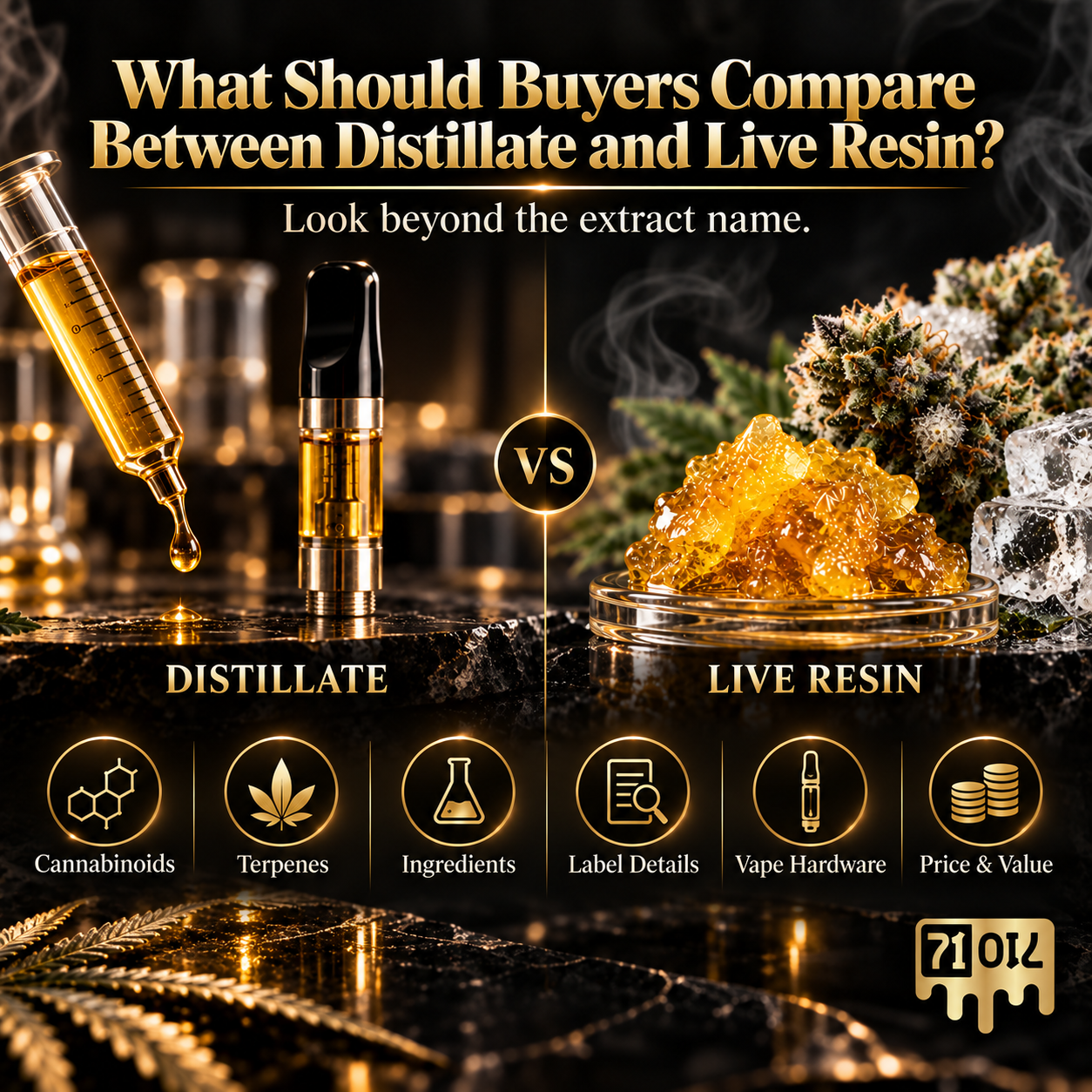
1. Total THC and Total CBD
Health Canada’s packaging and labelling guide requires Total THC and Total CBD information on cannabis products. For cannabis extracts intended for inhalation, the values are displayed as concentrations in milligrams per gram (mg/g).
Use those product-specific values instead of assuming that every distillate is stronger than every live resin. Distillate can contain highly concentrated cannabinoids, but the word itself does not provide a guaranteed THC percentage. Live resin products also vary. A higher THC number is not a complete quality score and does not establish terpene content, flavour quality, hardware quality, or suitability.
2. Ingredients and Formulation
Health Canada’s consumer label guidance states that cannabis extract labels require an ingredient list, with ingredients listed in descending order by weight. Its composition guidance permits categories such as carrier substances, flavouring agents, and substances needed to maintain product quality or stability, subject to the applicable rules.
That makes the ingredient list one of the most useful checks in a distillate-vs.-live-resin comparison. Do not assume that distillate is always terpene-free. Do not assume that live resin is always additive-free. Read what the finished product actually declares.
3. Terpene Information, Flavour, and Aroma
Terpenes are aromatic compounds that contribute to cannabis flavour and aroma. Extensive refinement can reduce or change the original terpene profile of an extract. Finished distillate formulations may still contain terpenes or permitted flavouring agents.
Live-resin processing starts from fresh/frozen material partly to preserve more of the aromatic character present before conventional drying and curing. That explains the process goal, but it does not guarantee a specific terpene percentage or a particular flavour result in every product.
When terpene data is available, prefer product- or batch-specific information. A generic strain profile is not the same as verified data for the finished vape. Flavour and aroma should also remain descriptive rather than being turned into claims about a “better,” “richer,” or guaranteed experience.
4. Extract Description and Processing Context
Check whether the product identifies distillate, live resin, full-spectrum extract, HTFSE, live rosin, or a blend. These names do not all describe the same characteristic.
For example, distillate mainly describes refinement. “Live” terminology relates to starting material and processing. Full-spectrum language describes a broader extract-profile concept. HTFSE emphasizes a high-terpene full-spectrum extract profile. Use the 71 Oil concentrates and extracts guide when the terminology starts to overlap.
5. Vape Hardware and Product Format
Extract type and device format are separate product decisions. A 510-thread cartridge and an all-in-one vape can contain similar extract categories even though the hardware is different. The words “cart,” “pen,” or “disposable” do not tell you whether the liquid inside is distillate, live resin, or another formulation.
When hardware information is available, compare the actual format, intended use, device condition, compatibility requirements, and manufacturer instructions. Do not infer coil material, voltage, heating design, or other technical specifications unless the manufacturer provides them.
6. Product Source and Label Details
Health Canada’s label guide identifies other information that helps adults verify and trace a legal cannabis product, including product class, net quantity, storage conditions, lot number, packaging date, manufacturer contact information, intended use where required, and the ingredient list for cannabis extracts.
These details do not make cannabis risk-free, but they provide a stronger basis for comparison than informal claims such as “clean,” “pure,” “premium,” or “more natural.” Health Canada also prohibits false or misleading cannabis promotion about characteristics such as potency, purity, quality, safety, and health effects.
For a step-by-step walkthrough, see How to Read a Cannabis Vape Product Label in Canada.
7. Price and Value
Retail price is product-specific and can vary by brand, extract amount, hardware format, retailer, province or territory, and current promotions. Do not assume live resin is always more expensive or that a higher-priced vape is automatically higher quality. Compare the actual price with net quantity, extract formulation, label details, and hardware rather than treating price as a quality grade.
Distillate vs. Live Resin Vape Carts: What Actually Changes?
When the comparison moves from extracts in general to vape cartridges, the main extract differences stay the same. Distillate is still a refinement category. Live resin is still a fresh/frozen starting-material and processing category. What changes is the need to evaluate the hardware and finished formulation together.
Two cartridges can use the same 510-thread connection but contain very different extracts. Two live-resin cartridges can also differ from each other in cannabinoid concentration, terpene information, ingredients, net quantity, hardware, and manufacturer instructions. The same is true for two distillate cartridges.
The useful question is therefore not simply “Which cart type is better?” It is “What does this specific product contain, what does the label confirm, and is the hardware appropriate for the intended use?”
Is Live Resin Stronger Than Distillate?
Not necessarily. There is no reliable universal rule that makes live resin stronger or weaker than distillate. Distillate can contain highly concentrated cannabinoid fractions, but finished live-resin products can also contain substantial THC. The category name is not a potency measurement.
For Canadian inhaled extracts, compare the labelled Total THC and Total CBD values in mg/g. Those numbers provide product-specific information; the words “distillate” and “live resin” do not.
Does Live Resin Always Have More Terpenes Than Distillate?
No. Live-resin processing is associated with fresh/frozen starting material and is used partly to retain aromatic compounds, but the final terpene profile still depends on the cultivar, extraction, formulation, packaging, storage, and product age. A finished distillate vape may also contain terpenes.
If terpene content matters to your comparison, look for product- or batch-specific information rather than assuming the extract name answers the question.
Which Is Better: Distillate or Live Resin?
Neither is universally better. They prioritize and describe different aspects of an extract. Distillate emphasizes extensive refinement. Live resin emphasizes fresh/frozen starting material and a generally solvent-based extraction approach.
A useful decision depends on what can be verified about the individual product: cannabinoid concentration, ingredients, extract description, terpene information when available, intended use, hardware format, traceability information, and manufacturer instructions. Treat the extract name as one data point, not the final quality verdict.
Frequently Asked Questions
What is the main difference between distillate and live resin?
Distillate mainly describes extensive downstream refinement. Live resin mainly describes fresh or freshly harvested cannabis that is frozen before conventional drying and curing and then generally processed through solvent-based extraction. The terms describe different aspects of an extract.
Is live resin stronger than distillate?
Not necessarily. Compare the specific products’ Total THC and Total CBD values rather than assuming one extract category is always stronger.
Does live resin always have more terpenes?
No. Fresh/frozen processing is used partly to retain aromatic compounds, but the final terpene content varies by cultivar, processing, formulation, packaging, storage, and product age.
Is distillate always terpene-free?
No. Extensive refinement can reduce or change the original terpene profile, but finished distillate formulations may contain terpenes or permitted flavouring agents. Check the ingredient list and product-specific information.
Is live resin always full-spectrum?
No. “Live resin” describes starting material and processing context; it does not by itself prove a full-spectrum finished formulation. Review the product description and ingredients.
Can distillate and live resin both be used in vape cartridges?
Yes, when the finished product is specifically formulated and labelled for that hardware and intended use. Extract type and device format are separate product characteristics.
What should Canadian adults compare on two vape labels?
Compare Total THC, Total CBD, ingredients, extract description, net quantity, intended use, lot and packaging information, manufacturer details, and terpene information when available. Then check the hardware and manufacturer instructions separately.
Compare the Finished Product, Not Just the Extract Name
Distillate and live resin are useful product terms, but they answer different questions. Distillate tells you about substantial refinement. Live resin tells you about fresh/frozen starting material and a generally solvent-based extraction approach. Neither term, by itself, establishes potency, terpene level, flavour quality, purity, safety, or overall quality.
For a broader look at the category, continue to the 71 Oil Cannabis Concentrates & Extracts guide. If you are comparing two specific vape products, use our Canadian cannabis vape label guide to check the regulated product details before making assumptions from the extract name.
Adult-use note: Cannabis is for legal-age adults where legally available. Cannabis use can cause impairment and carries health risks. Follow product information and applicable laws, never drive while impaired, and keep cannabis products away from children and pets.
Resources Used
- Health Canada – How to Read and Understand a Cannabis Product Label
- Health Canada – Packaging and Labelling Guide for Cannabis Products
- Health Canada – Guide on Composition Requirements for Cannabis Products
- Health Canada – Promotion of Cannabis: Prohibitions and Permissions
- BC Cannabis Stores – Cannabis Concentrates 101
- BC Cannabis Stores – What Does Full-Spectrum Cannabis Mean?
- 71 Oil – What Is Cannabis Distillate?
- 71 Oil – What Is Live Resin?
- 71 Oil – What Are Cannabis Concentrates and Extracts?
- 71 Oil – Solvent-Based vs. Solventless Cannabis Concentrates
- 71 Oil – Distillate vs. Full-Spectrum Cannabis Vapes
- 71 Oil – Live Resin vs. Live Rosin
- 71 Oil – How to Read a Cannabis Vape Product Label in Canada
Source check: Official Canadian guidance and the referenced 71 Oil content cluster were rechecked during the strict final audit on 21 September 2026. Recheck government guidance during future substantive updates.
0 Responses