

Live Resin vs Live Rosin: What Is the Difference?
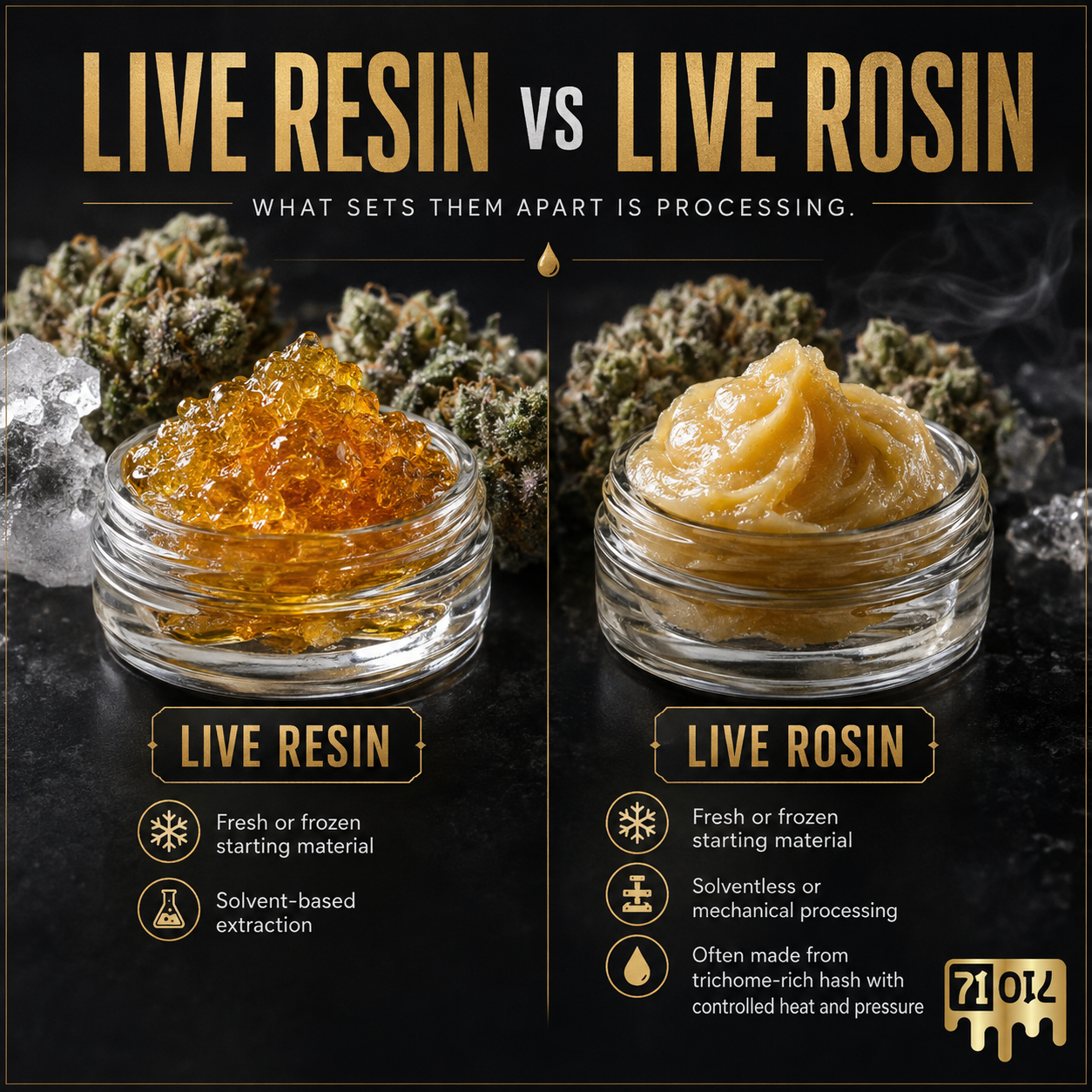
Live resin vs. live rosin comes down mainly to processing. Both commonly use fresh or frozen cannabis rather than conventionally dried and cured material. Live resin is generally produced with solvent-based extraction, while live rosin uses solventless or mechanical processing, commonly involving trichome-rich hash followed by controlled heat and pressure.
Those names explain starting material and broad process. They do not, by themselves, prove safety, purity, potency, terpene content, flavour quality, or overall product quality.
TL;DR: Live Resin vs Live Rosin
| Live resin and live rosin commonly start with fresh or frozen cannabis. The main difference is processing: live resin is generally made with solvent-based extraction, while live rosin uses solventless or mechanical processing, often with hash followed by controlled heat and pressure. Texture, cannabinoid content, terpene profile, ingredients, and product format can still vary. Neither category is universally better. |
|---|
In This Guide
- Live Resin vs Live Rosin: Key Differences
- What Does “Live” Mean in Live Resin and Live Rosin?
- What Is Live Resin?
- What Is Live Rosin?
- How Do the Processing Methods Differ?
- Do Live Resin and Live Rosin Have Different Textures?
- Does One Preserve More Terpenes or Flavour?
- Is Live Resin Stronger Than Live Rosin?
- Is Live Rosin Better or Safer Than Live Resin?
- Live Resin vs Live Rosin in Vape Cartridges
- What Should Canadian Adults Check Before Buying Live Resin or Live Rosin?
- Which Is Better: Live Resin or Live Rosin?
- Frequently Asked Questions
Live Resin vs Live Rosin: Key Differences
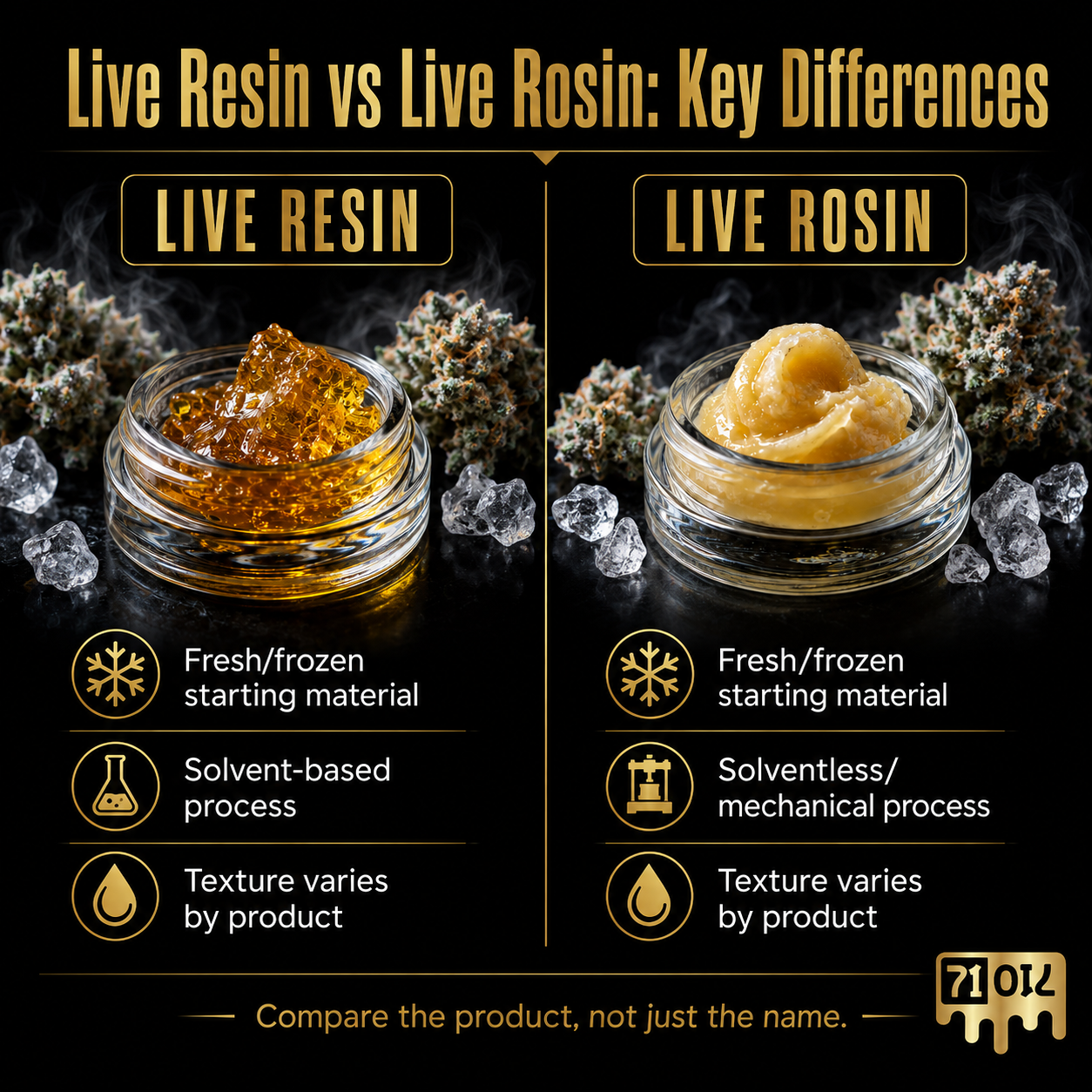
The simplest comparison separates the shared “live” starting-material concept from the different processing methods.
| Comparison | Live Resin | Live Rosin |
|---|---|---|
| What “live” refers to | Commonly fresh or frozen cannabis material | Commonly fresh or frozen cannabis material, or hash made from it |
| Primary process | Usually solvent-based extraction | Solventless or mechanical processing |
| Solvent use | Commonly uses a hydrocarbon extraction medium in controlled licensed processing | No added chemical extraction solvent is used as the primary separation medium |
| General process | Extraction followed by product-specific refinement or formulation | Trichome-rich material or hash is processed and pressed with controlled heat and pressure |
| Texture | Can vary widely by product and post-processing | Can vary widely by product and post-processing |
| Vape use | Some products are formulated for cartridges or disposables | Some products are formulated for cartridges or disposables |
| What to check | Intended use, Total THC/CBD, ingredients, product format, lot/package information, storage | The same product-specific information |
| What the name does not prove | Safety, purity, potency, terpene level, quality, or device compatibility | Safety, purity, potency, terpene level, quality, or device compatibility |
Texture, colour, clarity, and THC percentage are not reliable quality grades on their own. Compare the individual product label and verified product information.
What Does “Live” Mean in Live Resin and Live Rosin?
In concentrate terminology, “live” commonly refers to fresh or frozen cannabis used instead of conventionally dried and cured flower. BC Cannabis Stores explains that live products such as live resin and live rosin use cannabis frozen after harvest rather than going through the usual drying and curing stage.
Drying, curing, freezing, processing, packaging, and storage can all influence the final aromatic profile. However, “live” does not guarantee a specific terpene percentage, stronger flavour, or better product.
It also does not identify the extraction method. “Live” describes starting-material handling; resin and rosin describe different processing paths. For the broader terminology framework, see 71 Oil’s guide to cannabis concentrates and extracts.
What Is Live Resin?
Live resin is generally a solvent-based cannabis extract made from fresh or frozen cannabis material. Licensed processors commonly use a controlled hydrocarbon extraction process to separate selected cannabinoids, terpenes, and other resin components.
The extract may then be refined or formulated for the intended product, so live resin can appear in different textures and in some vape formats. The name does not establish the exact cannabinoid profile, terpene level, ingredients, residual-solvent profile, or quality of a particular product.
For a deeper look at fresh-frozen starting material, texture, terpene positioning, vape formats, and label checks, read our full guide to live resin.
What Is Live Rosin?
Live rosin is a solventless cannabis concentrate made from fresh or frozen material, commonly through a trichome-rich hash stage followed by controlled heat and mechanical pressure.
In cannabis-industry use, “solventless” generally means that an added chemical extraction solvent is not used as the primary separation medium. Water and ice may still be used during trichome or hash preparation. The term does not automatically mean pure, chemical-free, full-spectrum, additive-free, safer, or higher quality.
How Do the Processing Methods Differ?
Live resin generally uses solvent-based extraction: a controlled extraction medium separates selected compounds from fresh or frozen plant material, after which the extract may be refined or formulated.
Live rosin uses a mechanical or solventless route. Fresh or frozen material is commonly processed into trichome-rich material or hash, which is then pressed with controlled heat and pressure.
Process category can influence the finished composition, but starting material, handling, process controls, refinement, formulation, packaging, storage, and product age also matter.
Do Live Resin and Live Rosin Have Different Textures?
They can, but texture is not a fixed difference. Both live resin and live rosin can appear in different consistencies depending on processing, post-processing, formulation, handling, and storage.
Texture names describe physical consistency more than quality. A lighter colour does not automatically mean cleaner or better, and a darker product is not automatically lower quality.
Does One Preserve More Terpenes or Flavour?
Neither process guarantees a higher terpene level or better flavour in every product.
Both categories are associated with fresh or frozen starting material, which avoids the conventional drying and curing stage. BC Cannabis Stores connects this handling with retaining more aromatic character, but the final profile still depends on the cultivar, harvest condition, freezing and storage, processing, refinement, formulation, packaging, and product age.
If terpene data is provided, compare the actual product information rather than assuming that live resin or live rosin has a fixed terpene advantage. Neither term automatically means full-spectrum. For separate terpene-focused terminology, see 71 Oil’s guide to HTFSE.
Is Live Resin Stronger Than Live Rosin?
Not necessarily. Resin versus rosin does not determine potency.
Health Canada requires legal cannabis product labels to display Total THC and Total CBD. Those values provide a better basis for comparing cannabinoid content than the category name. A higher Total THC number also does not prove higher manufacturing quality, stronger flavour, greater terpene content, or a better product.
Is Live Rosin Better or Safer Than Live Resin?
No. Live rosin is not universally better or safer because it is solventless, and live resin is not automatically lower quality because a solvent is used during processing.
“Solventless” describes a production approach, not a safety or purity certification. For legal Canadian cannabis extracts, Health Canada sets requirements related to product class, composition, ingredients, contaminants, packaging, and labelling. These rules create a regulated framework, but they do not make cannabis use risk-free.
Live Resin vs Live Rosin in Vape Cartridges
Both live resin and live rosin can appear in vape products, but not every concentrate is formulated for a cartridge or disposable device.
Check that the product is specifically intended for inhalation and follow the hardware format identified by the manufacturer. Do not assume that a concentrate sold for another purpose can be placed into a vape cartridge.
Adults comparing cartridge formats can browse 71 Oil 510 cartridges by strain, size, extract profile, and hardware format after reviewing the product-specific information.
What Should Canadian Adults Check Before Buying Live Resin or Live Rosin?
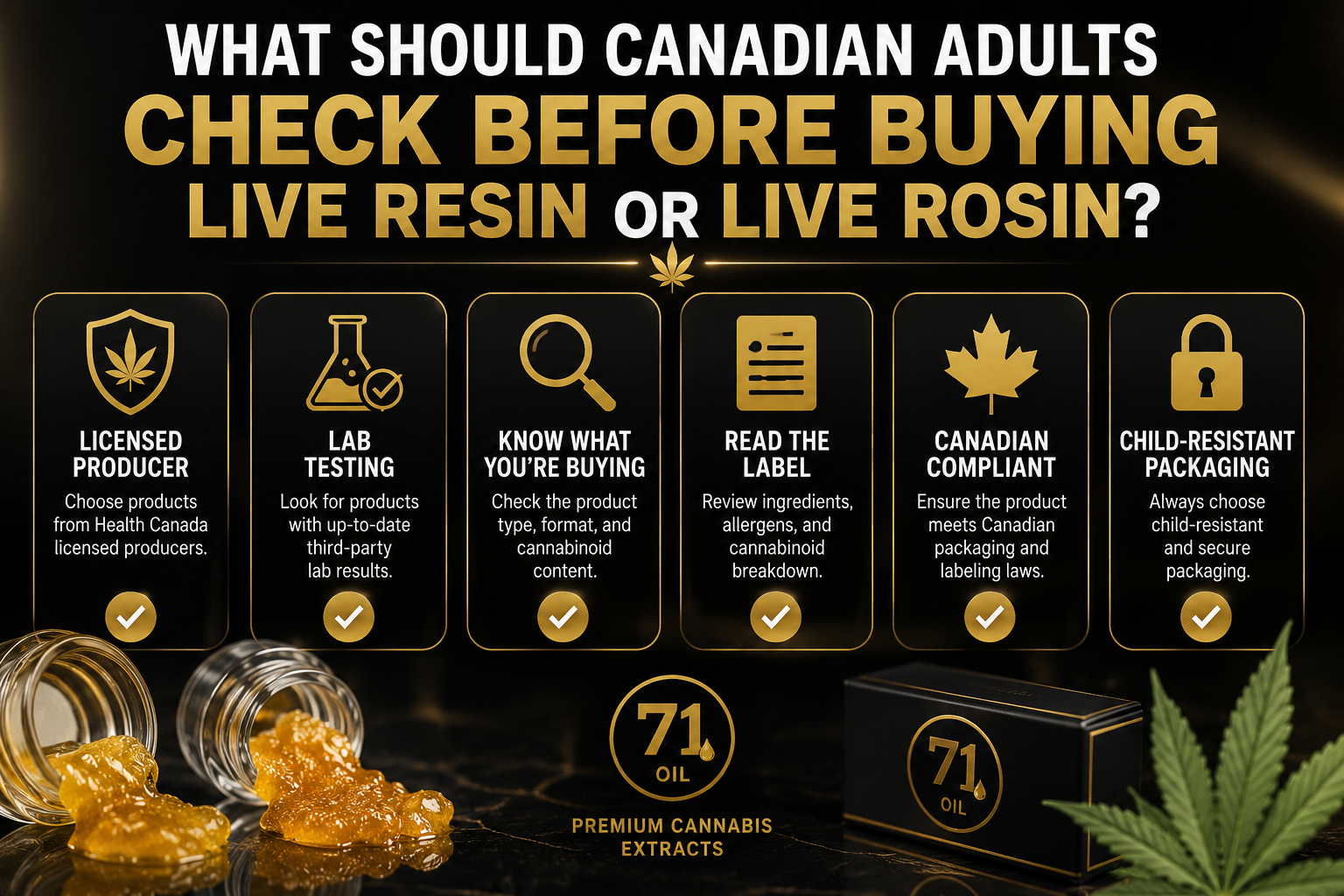
The legal product label usually tells you more than the words “live resin” or “live rosin” alone.
- Authorized source. Buy through a retailer authorized in the applicable province or territory. Check the excise stamp where required and make sure the package is intact.
- Product class and intended use. Confirm how the product is meant to be used. Do not assume every cannabis extract fits the same format.
- Total THC and Total CBD. Use the required label values to compare cannabinoid content, not as a complete quality score.
- Ingredients. Ingredient lists are required for cannabis extracts. Review the finished formulation rather than relying only on the resin or rosin name.
- Net quantity and format. Compare the amount and whether the product is a jarred concentrate, cartridge, disposable device, or another format.
- Lot number, packaging date, and licence-holder information. These details identify the specific product and manufacturer.
- Storage conditions. Follow the package guidance for temperature, light, humidity, and other storage factors.
- Terpene, testing, or compatibility information when available. Review verified product-specific details and follow hardware instructions for vape products.
For more foundational definitions, continue through the 71 Oil Cannabis Concentrates & Extracts hub.
Which Is Better: Live Resin or Live Rosin?
Neither is universally better. The useful question is which specific product better matches the comparison criteria that matter to you.
If avoiding an added chemical extraction solvent as the primary separation medium is important, live rosin may align with that preference. If you are comparing a specific live resin strain, texture, or vape formulation, review that product directly.
Useful factors include processing preference, flavour and aroma description, ingredients, strain identity, Total THC and Total CBD, verified terpene information, product format, current price, storage requirements, and hardware compatibility. Price is product- and market-specific, so one category should not be treated as always more expensive or better value.
Frequently Asked Questions
What is the difference between live resin and live rosin?
The main difference is processing. Both commonly use fresh or frozen cannabis. Live resin is generally made with solvent-based extraction, while live rosin uses solventless or mechanical processing, commonly involving trichome-rich hash followed by controlled heat and pressure. Neither name alone proves potency, purity, safety, terpene content, or quality.
What does “live” mean in live resin and live rosin?
“Live” commonly means fresh or frozen cannabis is used instead of conventionally dried and cured flower. It describes starting-material handling, not the extraction method. Both live resin and live rosin can therefore be “live” while using different processing approaches. The term does not guarantee a specific terpene percentage or flavour intensity.
Is live rosin solventless?
Yes. Live rosin is generally categorized as solventless because an added chemical extraction solvent is not used as the primary separation medium. It commonly involves trichome-rich material or hash from fresh or frozen cannabis followed by controlled heat and mechanical pressure. Solventless does not automatically mean safer, purer, stronger, or better.
Is live resin solvent-based?
Generally, yes. Live resin is commonly produced from fresh or frozen cannabis using a solvent-based extraction process, often involving a hydrocarbon extraction medium in licensed production. The finished extract may be refined or formulated further, so the name does not tell you its exact ingredients, cannabinoid content, or quality.
Is live resin stronger than live rosin?
Not necessarily. Resin versus rosin does not determine potency. Compare the Total THC and Total CBD on the individual product label instead of relying on the category name. Higher THC also does not automatically mean better quality, stronger flavour, more terpenes, or a better fit for a particular adult consumer.
Which is better: live resin or live rosin?
Neither is universally better. Live rosin may suit someone who prefers a solventless production category, while live resin may be preferred for a particular extract profile, strain, texture, or vape formulation. Compare cannabinoid values, ingredients, intended use, terpene information when available, storage guidance, format, and price.
Does solventless mean live rosin is safer or purer?
No. “Solventless” describes the processing approach and is not a safety or purity certification. Legal Canadian cannabis products are subject to regulatory requirements, but cannabis use still carries risks. Product-specific composition, labelling, manufacturing controls, storage, and verified testing information are more useful than broad assumptions about the term.
Can live resin and live rosin both be used in vape cartridges?
Some products are specifically formulated for cartridges or disposable vape devices, but not every live resin or live rosin concentrate is suitable for vaping hardware. Check the intended use, ingredients, product format, and manufacturer instructions. Use a concentrate in a cartridge only when the product information identifies it as suitable for that format.
Compare the Product, Not Just the Name
Live resin and live rosin share a fresh or frozen starting-material concept, but their processing methods differ. Live resin is generally solvent-based; live rosin is generally solventless and mechanically processed.
That difference is useful, but it is not a quality ranking. Start with the label: check intended use, Total THC and Total CBD, ingredients, product format, lot and package information, storage guidance, and verified product details.
Continue exploring the 71 Oil Cannabis Concentrates & Extracts guides for more extraction terminology. If you are comparing extract-based vape formats, you can also browse 71 Oil 510 cartridges by strain, size, extract profile, and hardware format.
Cannabis is intended for legal-age adults where legally available. Cannabis use can cause impairment and carries health risks. Follow applicable laws and product information, do not drive while impaired, and keep cannabis away from children and pets.
Resources Used
- Health Canada — Guide on Composition Requirements for Cannabis Products
- Health Canada — How to Read and Understand a Cannabis Product Label
- Health Canada — Packaging and Labelling Guide for Cannabis Products
- BC Cannabis Stores — Cannabis Concentrates 101: Extracting the Facts on Inhalable Concentrates
0 Responses