

What Does Full-Spectrum Cannabis Extract Mean?
Full-spectrum cannabis extract is an industry term generally used for extracts intended to retain or represent a broader range of cannabis-derived compounds than a highly refined extract focused mainly on selected cannabinoids. Depending on the product, that broader profile may include multiple cannabinoids, terpenes, and other cannabis-derived constituents.
The important part is what the term does not tell you. Full-spectrum is not a separate federal cannabis product class in Canada, and the name alone does not prove a specific THC level, extraction method, terpene percentage, safety profile, or quality grade.
That is why adults comparing full-spectrum cannabis products should look beyond the front-of-package description and review the finished product: its regulated label, ingredients, cannabinoid values, intended use, extract description, and any product- or batch-specific information the producer provides.
| TL;DR Full-spectrum generally describes a broader extract profile rather than one standardized formula. It does not automatically mean stronger, safer, solventless, or higher quality. In Canada, the legal product class is cannabis extract; full-spectrum is a product-description term whose exact meaning depends on the finished product and the evidence supporting the claim. |
In This Guide
Jump to a section:
- What Does “Full-Spectrum” Actually Describe?
- Is Full-Spectrum an Official Cannabis Product Class in Canada?
- What Compounds May Be Present in a Full-Spectrum Extract?
- Full-Spectrum vs. Distillate: What Changes?
- Are Live Resin, Rosin, and HTFSE Automatically Full-Spectrum?
- Does Full-Spectrum Mean Solventless?
- Does Full-Spectrum Mean Stronger, Better, Safer, or More Natural?
- What Does “Full-Spectrum Blend” Mean?
- What Should Canadian Adults Check on a Full-Spectrum Cannabis Product?
- Frequently Asked Questions
- Compare the Finished Product, Not Just the Label Term
What Does “Full-Spectrum” Actually Describe?
Cannabis extract terminology can describe different features of a product. Some terms refer to processing, some to starting material, some to refinement, and others to the intended chemical profile of the extract.
Full-spectrum belongs mainly in the extract-profile category. The term is commonly used when a producer wants to describe an extract as retaining or representing a wider range of cannabis-derived compounds instead of concentrating almost entirely on one selected cannabinoid fraction.
There is no single composition that every product labelled full-spectrum must share. Different starting materials, extraction systems, post-processing steps, and formulations can change which compounds remain and in what amounts. For that reason, it is more accurate to treat full-spectrum as a profile description that needs product-specific support, not as a universal chemical specification.
| Term | What It Mainly Describes | What It Does Not Prove |
|---|---|---|
| Full-spectrum | Extract profile or breadth of retained/represented cannabis compounds | Exact composition, potency, safety, extraction method, or quality |
| Distillate | Downstream refinement and separation | A fixed THC level, upstream extraction method, or overall quality |
| Live | Starting material, usually fresh or frozen rather than conventionally dried | Solventless processing, potency, or full-spectrum status by itself |
| Solventless | Production approach that does not use an added chemical extraction solvent as the primary separation medium | Broader extract profile, higher purity, or greater safety |
| HTFSE | High-Terpene Full-Spectrum Extract – an industry term emphasizing a terpene-rich full-spectrum profile | One standardized terpene percentage, potency, or universal formulation |
For the broader terminology map, see What Are Cannabis Concentrates and Extracts?.
Is Full-Spectrum an Official Cannabis Product Class in Canada?
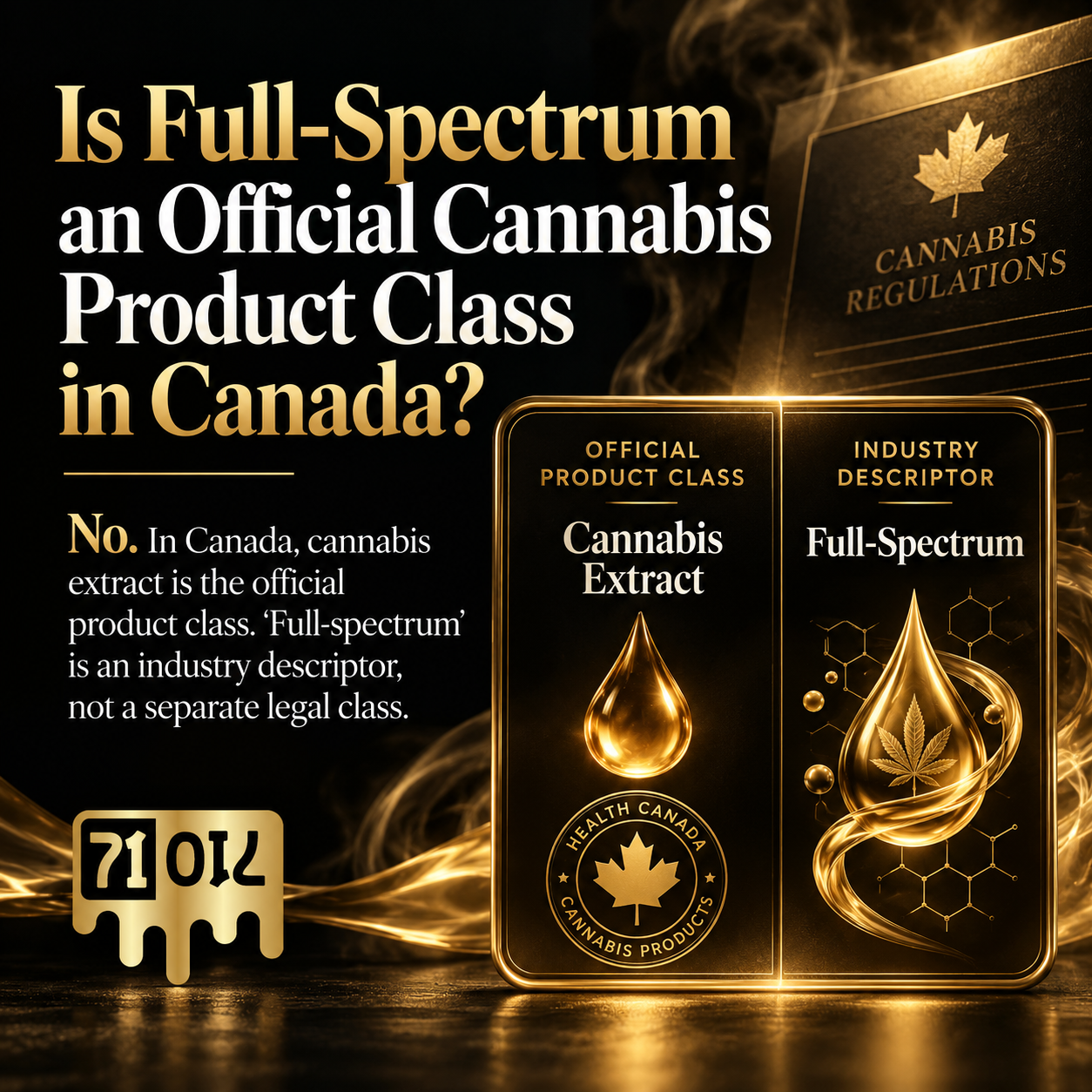
No. Health Canada regulates cannabis through defined product classes. Its current composition guidance includes cannabis extracts as a regulated class, with rules based on formulation and intended use. Full-spectrum is not listed as a separate federal cannabis class in that guidance.
This distinction matters because a legal product can be a cannabis extract and also be marketed or described as full-spectrum. The regulated class tells you which federal requirements apply. The full-spectrum wording gives additional product-positioning context, but it does not replace the regulated class or the information required on the label.
BC Cannabis Stores provides one useful Canadian retail framework. It describes full-spectrum products as products intended to resemble the source cultivar more closely and sets its own criteria for how it classifies full-spectrum and full-spectrum blend products. That framework is useful for understanding retail terminology, but it should not be presented as a universal federal definition.
| 71 OIL NOTE: Use the regulated label as the factual baseline. Treat full-spectrum as an additional extract description whose meaning should be supported by product-specific information. |
What Compounds May Be Present in a Full-Spectrum Extract?
A full-spectrum product may contain a broader combination of cannabis-derived constituents than a highly refined cannabinoid fraction, but the actual profile remains product-specific.
- Cannabinoids: THC and CBD may be present along with other cannabinoids, depending on the starting material and processing.
- Terpenes: these aromatic compounds can contribute to the product’s aroma and flavour profile. Their presence and concentration should be confirmed from product-specific information when available.
- Other plant-derived constituents: some full-spectrum descriptions also refer to additional naturally occurring cannabis compounds. Their presence should not be assumed without supporting product data.
The phrase full-spectrum should therefore not be translated into “every compound from the plant is present in the original ratio.” Processing changes the material. Some compounds may be reduced, removed, transformed, separated, or later combined during formulation.
The more useful question is not whether a product contains an abstract idea of the whole plant. It is whether the producer clearly explains the extract type and whether the finished-product information supports that description.
Full-Spectrum vs. Distillate: What Changes?
Full-spectrum and distillate describe different extract goals. Full-spectrum terminology focuses on a broader extract profile. Distillate describes extensive refinement and separation that concentrates selected cannabinoid fractions.
| Comparison Point | Full-Spectrum Extract | Cannabis Distillate |
|---|---|---|
| Main idea | Broader extract-profile positioning | Extensive refinement of selected cannabinoid fractions |
| Cannabinoid profile | Product-specific; may include multiple cannabinoids | Product-specific; often centred on selected cannabinoids |
| Terpenes | May be retained or otherwise represented, depending on the product | May be reduced during refinement; finished products can be formulated with terpenes |
| THC level | Must be checked on the individual label | Must be checked on the individual label |
| Solventless? | Not established by the term | Not established by the term |
| Quality ranking | No automatic advantage | No automatic disadvantage |
Neither description is a complete quality score. A full-spectrum product is not automatically more flavourful, safer, stronger, or better made. A distillate product is not automatically more potent or more consistent. The finished formulation, legal source, ingredients, cannabinoid values, hardware where relevant, storage, and product-specific evidence still matter.
For the dedicated comparison, read Distillate vs. Full-Spectrum Cannabis Vapes: What Should Buyers Compare? For the refined-extract definition, see What Is Cannabis Distillate?.
Are Live Resin, Rosin, and HTFSE Automatically Full-Spectrum?
Not all related extract terms describe the same thing, so they should not be treated as interchangeable.
Live Resin
The word live mainly describes the starting material. Live resin is generally made from cannabis that is fresh or frozen rather than conventionally dried and cured. That starting-material choice can support a different aromatic profile, but the word live by itself does not create a universal full-spectrum specification.
For the dedicated explanation, see What Is Live Resin?.
Rosin and Live Rosin
Rosin primarily describes a solventless production approach based on controlled heat and pressure. Live rosin combines a live or fresh-frozen starting-material concept with a solventless rosin process. Neither word alone proves that a finished product meets one universal full-spectrum definition.
HTFSE
HTFSE stands for High-Terpene Full-Spectrum Extract. The name explicitly places it within full-spectrum terminology and emphasizes a terpene-forward profile. Even so, HTFSE is an industry term rather than one standardized federal formulation. Exact cannabinoid content, terpene content, ingredients, and finished-product composition still need to be verified for the individual product.
For the specific category, read What Is HTFSE? High-Terpene Full-Spectrum Extract Explained.
Does Full-Spectrum Mean Solventless?
No. Full-spectrum and solventless describe different product characteristics.
Full-spectrum describes extract-profile positioning. Solventless describes a production approach in which an added chemical extraction solvent is not used as the primary separation medium. A full-spectrum product can be produced through different extraction approaches, and a solventless product is not automatically full-spectrum simply because no extraction solvent was used.
The same rule applies in reverse: an extraction method does not establish a complete quality verdict. Starting material, processing controls, formulation, storage, testing information, and the finished label all affect what adults can actually verify about a product.
For the process distinction, see Solvent-Based vs. Solventless Cannabis Concentrates.
Does Full-Spectrum Mean Stronger, Better, Safer, or More Natural?
No single one of those conclusions follows from the words full-spectrum.
Stronger: Potency depends on the actual cannabinoid values of the finished product. In Canada, adults should compare the labelled Total THC and Total CBD rather than using extract terminology as a shortcut for strength.
Better: Full-spectrum and distillate are different extract approaches, not universal quality grades. A broader profile may be relevant to flavour, aroma, or product positioning, but that does not make every full-spectrum product superior to every refined extract.
Safer: Full-spectrum is not a safety certification. Cannabis can cause impairment and carries health risks. Product source, composition, manufacturing controls, intended use, hardware condition where applicable, and individual circumstances remain relevant.
More natural: Natural is a broad marketing word unless it is tied to a specific verifiable product attribute. A finished extract has still been processed and formulated. The useful comparison is what the product contains, how it is described, and what the label and supporting information can verify.
What Does “Full-Spectrum Blend” Mean?
The phrase full-spectrum blend is not a single federal product class. Its meaning can depend on the retailer or producer using it.
BC Cannabis Stores, for example, uses full-spectrum blend for products composed primarily of a full-spectrum extract with at least one other non-full-spectrum input, such as distillate or botanical terpenes. BC Cannabis Stores also distinguishes these products from those that meet its own full-spectrum retail criteria.
That is a useful reminder not to stop at the word full-spectrum. If a product uses blend language, check the ingredient list and product description to understand what has been combined. Other retailers or producers may use the terminology differently.
What Should Canadian Adults Check on a Full-Spectrum Cannabis Product?
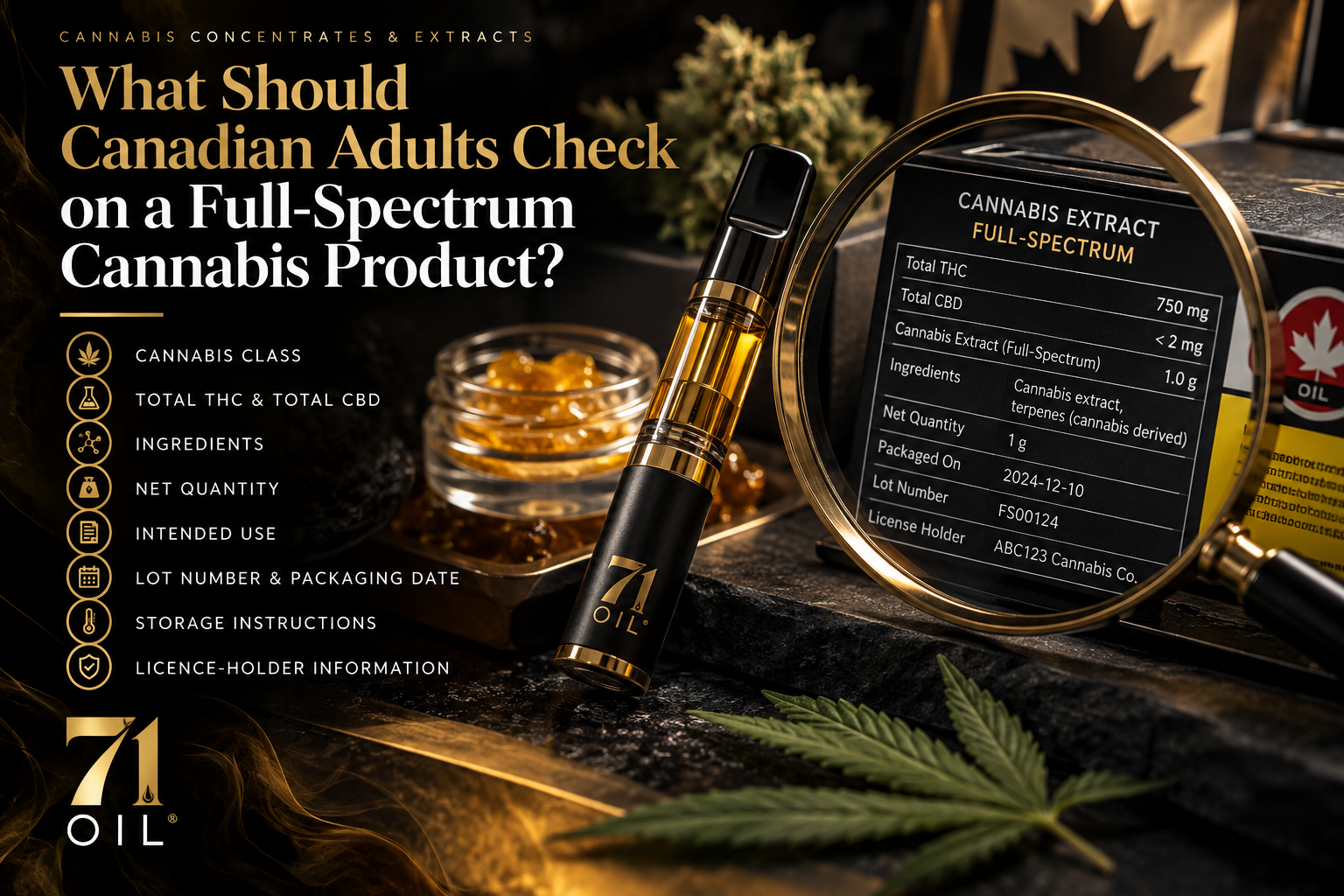
The regulated package gives adults a more reliable comparison framework than the extract name alone. Health Canada requires legal cannabis products to carry standardized information, with additional requirements that depend on the product class.
| Check | Why It Matters | What It Does Not Guarantee |
|---|---|---|
| Legal source / excise stamp | Helps verify that the product came through Canada’s regulated system, subject to applicable exceptions | That the product is risk-free or the right choice for every adult |
| Total THC and Total CBD | Shows labelled cannabinoid quantity or concentration | A fixed effect, ideal dose, or quality score |
| Product identity and intended use | Clarifies what the product is and how it is represented to be used | Compatibility with every device or accessory |
| Ingredient list | Required for cannabis extracts and shows declared ingredients in descending order by weight | That a short ingredient list proves purity or superiority |
| Extract description | Helps distinguish full-spectrum, distillate, live resin, HTFSE, blends, and other terms when provided | That the marketing term has one universal composition |
| Lot number and packaging date | Supports traceability and product identification | A universal expiry date or freshness guarantee |
| Storage guidance | Shows manufacturer recommendations for maintaining product quality | That improper storage cannot damage the product |
| Licence-holder information | Provides a regulated contact point for product questions or quality issues | That brand statements replace official label information |
| Optional terpene / batch data | Can provide additional product-specific context when supplied | That every producer reports the same fields or testing format |
For vape products, check the hardware format separately from the extract type. A cartridge, disposable, or pod description tells you about the device format; it does not tell you whether the extract is distillate, HTFSE, live resin, or another formulation.
For a step-by-step label walkthrough, read How to Read a Cannabis Vape Product Label in Canada.
Frequently Asked Questions
What does full-spectrum cannabis extract mean?
Full-spectrum cannabis extract is an industry term generally used for extracts intended to retain or represent a broader range of cannabis-derived compounds, such as multiple cannabinoids and terpenes. Exact composition varies by product. In Canada, full-spectrum is not a separate federal cannabis product class.
Is full-spectrum cannabis stronger than distillate?
Not automatically. Distillate can contain highly concentrated cannabinoids, while full-spectrum products can also contain substantial THC. Compare the specific product’s labelled Total THC and Total CBD instead of assuming potency from the extract name.
Is full-spectrum the same as live resin?
No. Full-spectrum describes extract-profile positioning, while live resin primarily describes an extract made from fresh or frozen cannabis material. A live resin product may be positioned as full-spectrum, but the word live by itself does not establish that claim.
Is HTFSE full-spectrum?
HTFSE stands for High-Terpene Full-Spectrum Extract, so the term explicitly uses full-spectrum positioning. However, HTFSE is an industry term rather than one standardized federal formulation. Check the individual product for cannabinoid, terpene, ingredient, and extract information.
Does full-spectrum mean solventless?
No. Full-spectrum describes an extract profile, while solventless describes a production approach. A full-spectrum product can be made using different extraction methods, and a solventless product is not automatically full-spectrum.
Is full-spectrum cannabis safer or higher quality?
The term does not prove either. Full-spectrum is not a safety or quality certification. Compare the legal source, label, ingredients, cannabinoid values, product-specific information, storage, hardware where relevant, and other verifiable details.
What does “full-spectrum blend” mean?
The meaning can vary by seller or producer. BC Cannabis Stores uses the term for products made primarily with a full-spectrum extract plus at least one non-full-spectrum input, such as distillate or botanical terpenes. Check the specific product description and ingredient list rather than assuming a universal definition.
How can you compare two full-spectrum cannabis vapes in Canada?
Compare the legal source, Total THC and Total CBD, ingredients, extract description, net quantity, product identity and intended use, lot and packaging information, storage guidance, optional terpene or batch details, and the hardware format. Do not use full-spectrum as a stand-alone quality score.
Compare the Finished Product, Not Just the Label Term
Full-spectrum is useful when it helps explain how an extract is positioned, but it is only one part of the finished product. It does not create a universal formula and does not answer every question about potency, process, ingredients, hardware, safety, or quality.
A better comparison starts with the regulated label and then adds product-specific information: extract type, cannabinoid values, ingredients, formulation, intended use, optional terpene or batch data, and hardware details where relevant.
For legal-age adults comparing cannabis products in Canada, that approach keeps the focus on information that can be checked rather than assumptions attached to one marketing term.
| RESPONSIBLE ADULT USE Cannabis is intended for legal-age adults where legally available. Cannabis use can cause impairment and carries health risks. Follow the product information and applicable laws, never drive after consuming cannabis, and keep cannabis products away from children and pets. |
Resources Used
- Health Canada – How to read and understand a cannabis product label
- Health Canada – Packaging and labelling guide for cannabis products
- Health Canada – Guide on composition requirements for cannabis products
- Health Canada – Reduce your risk: Choose legal cannabis
- BC Cannabis Stores – What Does Full-Spectrum Cannabis Mean?
Source check completed: 29 September 2026.
0 Responses