

How Canadians Consume Cannabis: Smoking, Vaping, Edibles, and Changing Habits
Cannabis consumption trends Canada now spans a much broader mix of formats.
Smoking remains the most commonly reported method, but vaping and edibles are established parts of the landscape, while beverages, oral oils, concentrates, and topicals have widened the range of products people encounter in legal retail.
Health Canada’s 2024 Canadian Cannabis Survey reported that 69% of people who consumed cannabis used smoking as a method, 57% reported eating cannabis, and 37% reported vaporizing with a vape pen or e-cigarette. Health Canada: 2024 Canadian Cannabis Survey
Longer-term product data shows the change more clearly.
Among people who reported cannabis use in the previous 12 months, vape pen or cartridge use increased from 16% in 2018 to 37% in 2024.
Edible cannabis increased from 41% to 55%, while cannabis beverages rose from 4% to 21%. Reported dried-flower use remained the most common product type, but it decreased from 82% to 63% over the same period.
Together, these cannabis consumption trends in Canada point to diversification rather than the replacement of one format by another.
Modern cannabis culture is increasingly shaped by product type, label information, legal sourcing, hardware knowledge, and the way adults compare different forms of cannabis, not only by strain names or dried flower.
The Canadian Cannabis Survey (CCS) and Canadian Substance Use Survey (CSUS) are different surveys. The 2024 CCS is based on respondents aged 16+ and provides the detailed product-format time series used in this article. The 2025 CSUS covers people aged 15+ and provides newer broad prevalence and frequency data. The CCS was piloted in 2017 and has been conducted annually since 2018. All 71 Oil guidance remains directed to adults of legal age where cannabis is legally available.
In This Guide
- The latest snapshot of cannabis consumption in Canada
- Why smoking still leads while reported product use changes
- How cannabis vaping became a major product format
- Why edibles are now part of the mainstream mix
- Beverages, oils, concentrates, and other formats
- How legal retail changed product comparison
- What may be driving changing habits
- Why product format does not equal risk level
- What the trends mean for modern cannabis culture
- Frequently asked questions
Key Takeaways
- Smoking remains the leading reported consumption method, but adults now encounter a much broader range of cannabis products than they did in 2018.
- Vape pens and cartridges were reported by 37% of past-12-month cannabis consumers in the 2024 CCS, up from 16% in 2018.
- Reported use of edibles and cannabis beverages also increased, showing that non-flower formats are now common parts of legal-market product choice.
- The 2025 CSUS found past-12-month cannabis prevalence at 32%, unchanged from 2023, so format diversification is a distinct trend from overall prevalence.
- No product format should be treated as automatically safe or risk-free. Legal sourcing, label literacy, and responsible adult-use decisions still matter.
The Latest Snapshot: How Canadians Consume Cannabis
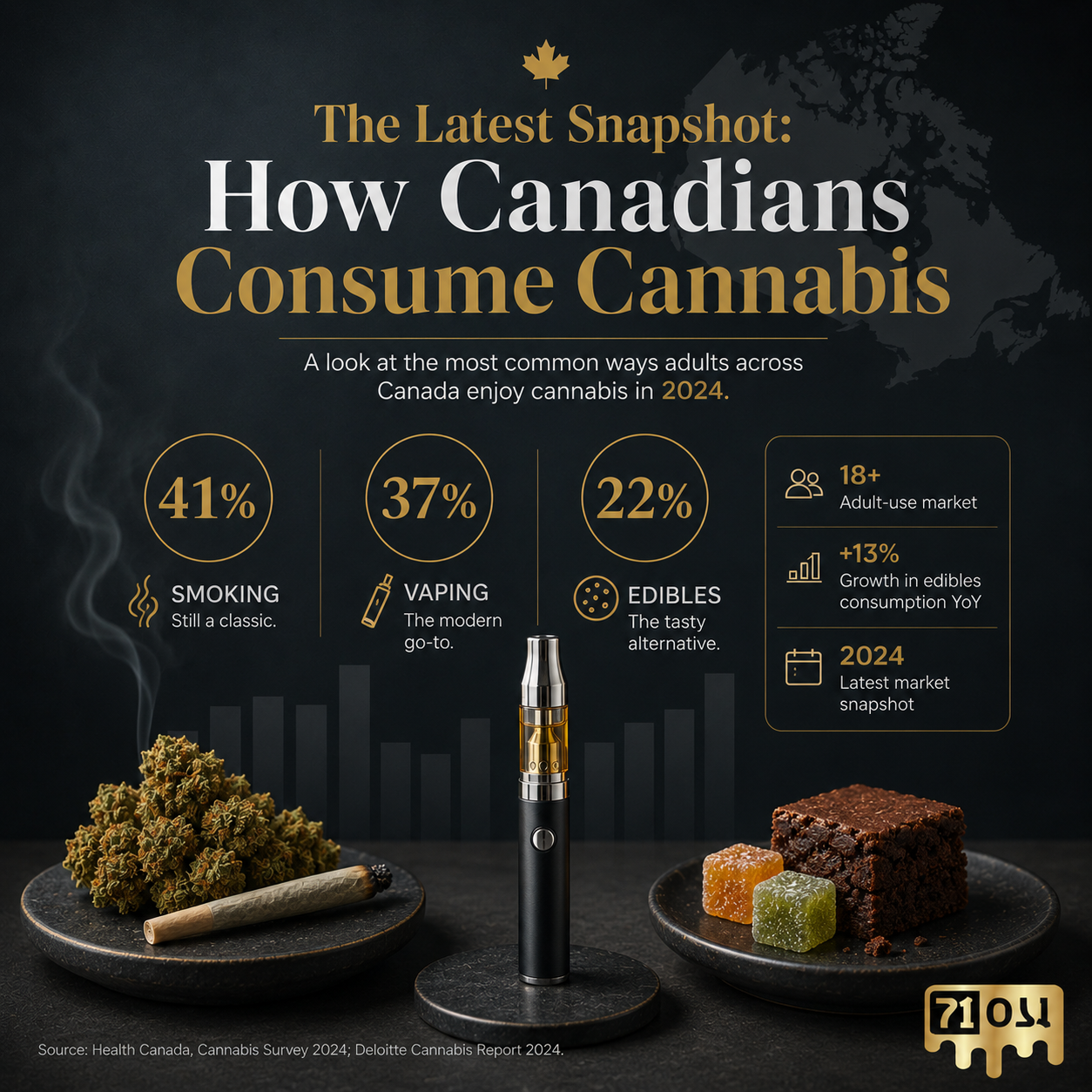
There are two useful ways to describe cannabis consumption: by method and by product type. They overlap, but they are not identical.
For example, a person may smoke dried flower, eat an edible, and use a vape cartridge within the same 12-month period. Health Canada allows respondents to select more than one answer in its product-use questions.
In the 2024 Canadian Cannabis Survey, smoking was the most common reported method at 69%. Eating cannabis followed at 57%, while vaporizing with a vape pen or e-cigarette was reported by 37%. Health Canada: method-of-consumption findings
The survey also reported that 37% of past-12-month cannabis consumers used vape pens or cartridges as a product type.
Cannabis consumption patterns are only one part of the broader picture. Canadian surveys also provide insight into how public attitudes toward cannabis have changed since legalization.
The two 37% figures come from separate survey questions — one about method of consumption and one about products consumed, so they should not be treated as the same measurement.
Cannabis Products Used Among Past-12-Month Cannabis Consumers, 2018 vs. 2024
| Product type | 2018 | 2024 |
Direction |
|---|---|---|---|
|
Dried flower/leaf |
82% |
63% |
Down |
|
Edible cannabis |
41% |
55% |
Up |
|
Vape pens/cartridges |
16% |
37% |
Up |
|
Cannabis beverages |
4% |
21% |
Up |
|
Hashish/kief |
26% |
16% |
Down |
|
Concentrates/extracts |
19% |
13% |
Down |
Source: Health Canada, Canadian Cannabis Survey 2024. Percentages are among people who consumed cannabis in the past 12 months.
Respondents could select more than one product type, so these figures are not market shares and do not add to 100%. View the full 2024 survey summary
Dried flower still leads the product list, but it was reported by a smaller proportion of past-year cannabis consumers in 2024 than in 2018.
Over the same period, vape pens and cartridges, edibles, and beverages were reported by larger proportions of consumers.
Smoking Still Leads, but Reported Product Use Has Changed
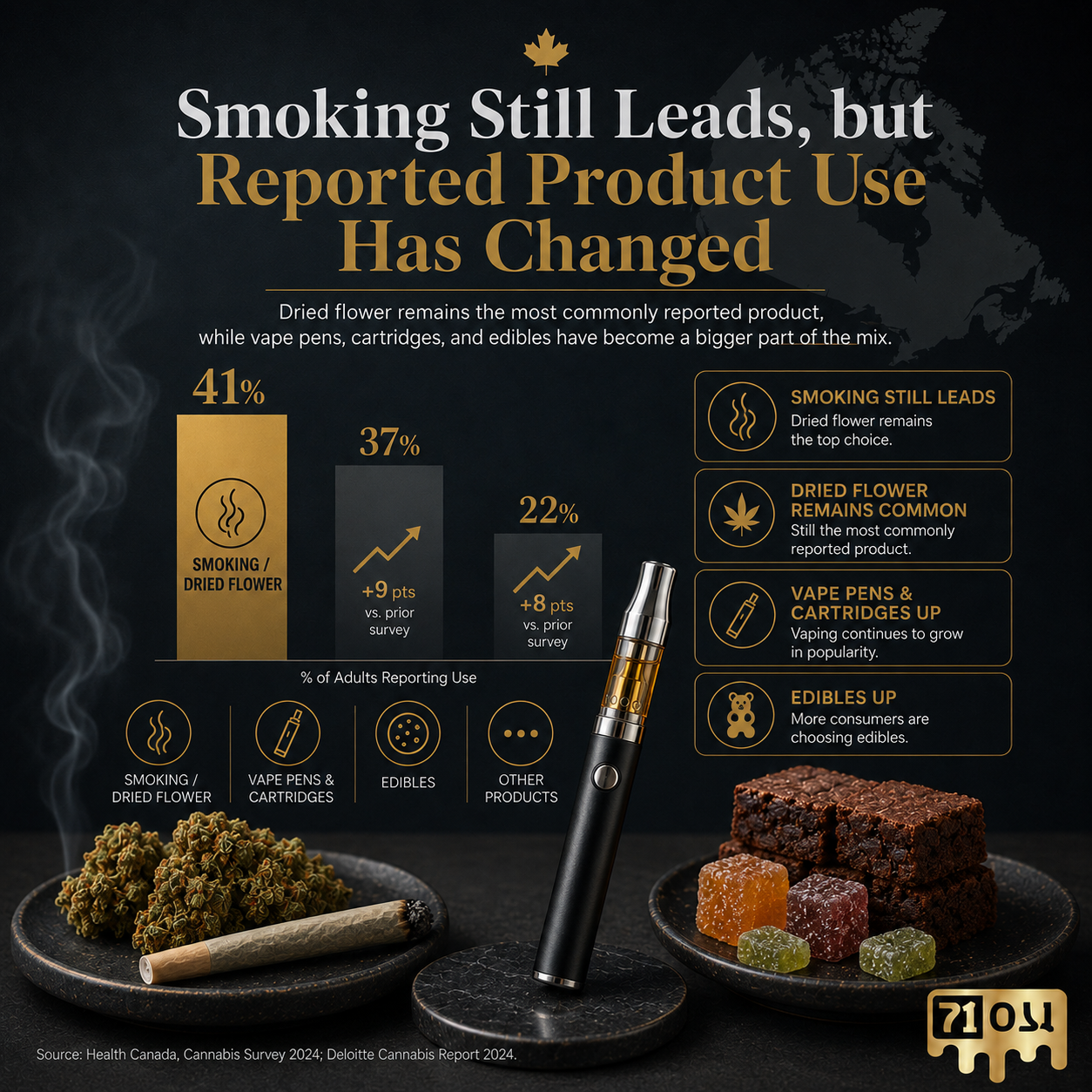
Smoking remains the most commonly reported way to consume cannabis in Canada. Dried flower therefore remains culturally and commercially important, even as other formats have become more widely used.
Among people who consumed cannabis in the previous 12 months, reported dried flower or leaf use decreased from 82% in 2018 to 63% in 2024.
Health Canada also describes the proportion of people reporting smoking cannabis as being on a longer-term decline, even though smoking remained the leading method in 2024. Health Canada: 2024 product-use trends
This does not mean consumers simply replaced smoking with one alternative. Many people report using more than one product type.
The more accurate picture is a legal market in which flower, edibles, vapes, oral oils, beverages, and extracts can all appear within the same consumer landscape.
Cannabis Vaping Has Become a Major Product Format
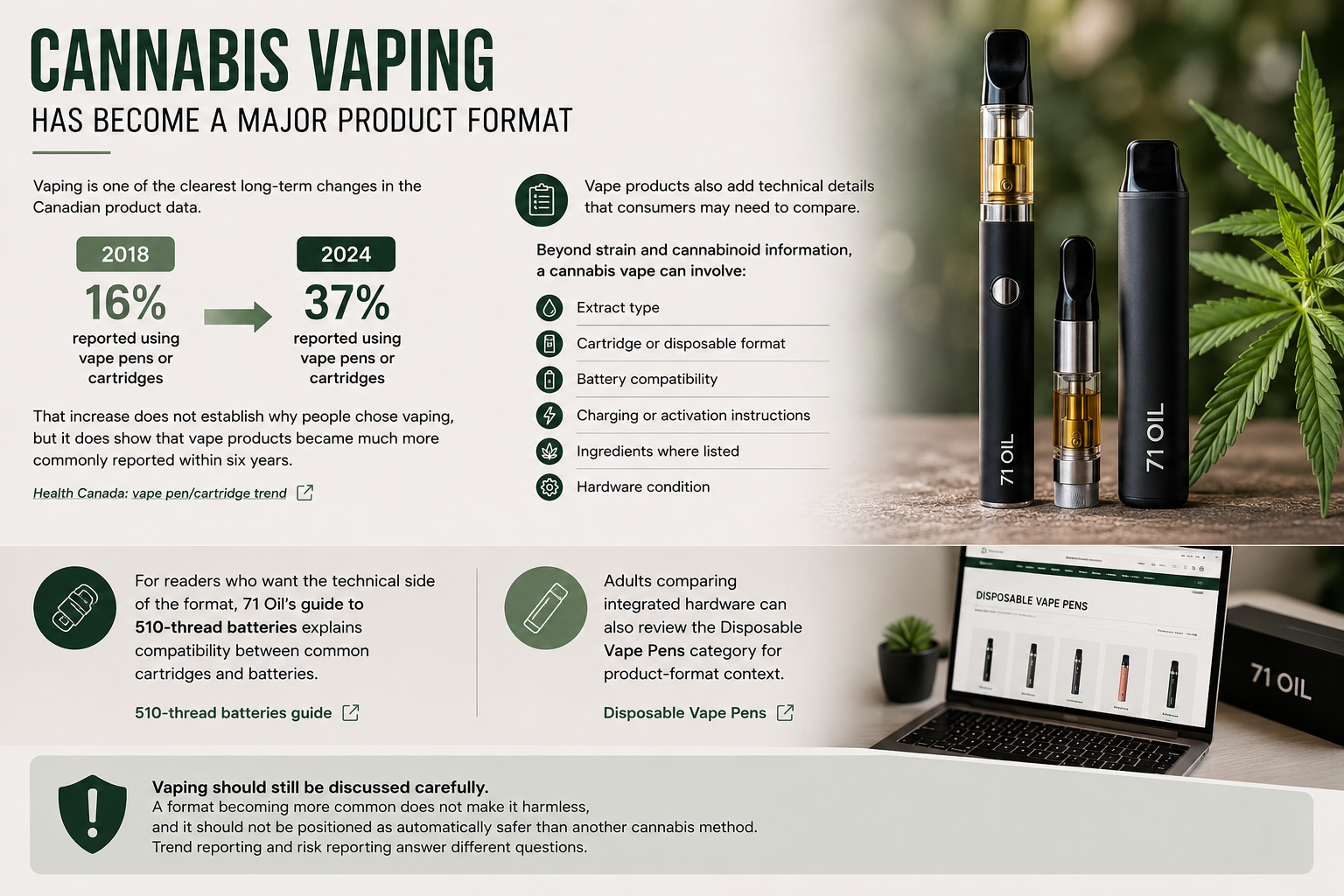
Vaping is one of the clearest long-term changes in the Canadian product data. In 2018, 16% of people who consumed cannabis in the past year reported using vape pens or cartridges. By 2024, 37% reported using them.
That increase does not establish why people chose vaping, but it does show that vape products became much more commonly reported within six years. Health Canada: vape pen/cartridge trend
Vape products also add technical details that consumers may need to compare. Beyond strain and cannabinoid information, a cannabis vape can involve extract type, cartridge or disposable format, battery compatibility, charging or activation instructions, ingredients where listed, and hardware condition.
For readers who want the technical side of the format, 71 Oil’s guide to 510-thread batteries explains compatibility between common cartridges and batteries.
Adults comparing integrated hardware can also review the Disposable Vape Pens category for product-format context.
Vaping should still be discussed carefully. A format becoming more common does not make it harmless, and it should not be positioned as automatically safer than another cannabis method. Trend reporting and risk reporting answer different questions.
Edibles Are Now a Mainstream Part of the Market
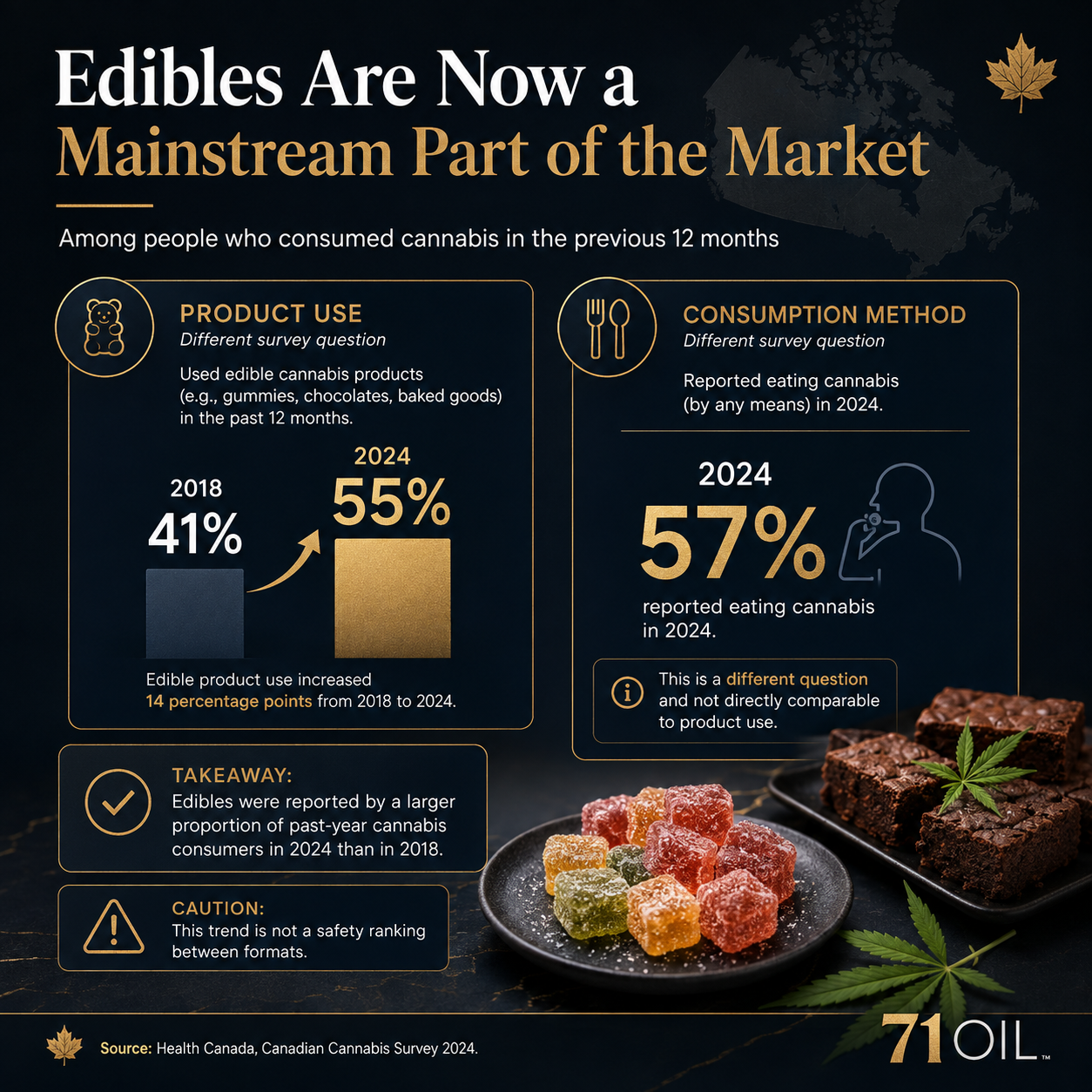
Edible cannabis has also become a common part of Canadian consumption. The 2024 CCS reported edible product use at 55% among people who consumed cannabis in the previous 12 months, up from 41% in 2018.
In a separate question about consumption method, 57% reported eating cannabis in 2024. Health Canada: Canadian Cannabis Survey 2024
The increase in reported edible use is another sign that cannabis culture is not centred only on inhaled products. Legal retail now presents formats that differ substantially in how they are labelled, used, and compared.
That does not make edibles a direct substitute for smoking or vaping, and the trend should not be read as a safety ranking between formats. The useful takeaway is narrower: edibles were reported by a larger proportion of past-year cannabis consumers in 2024 than in 2018.
Beverages, Oils, Concentrates, and Other Formats Add More Choice
The change goes beyond vapes and edibles.
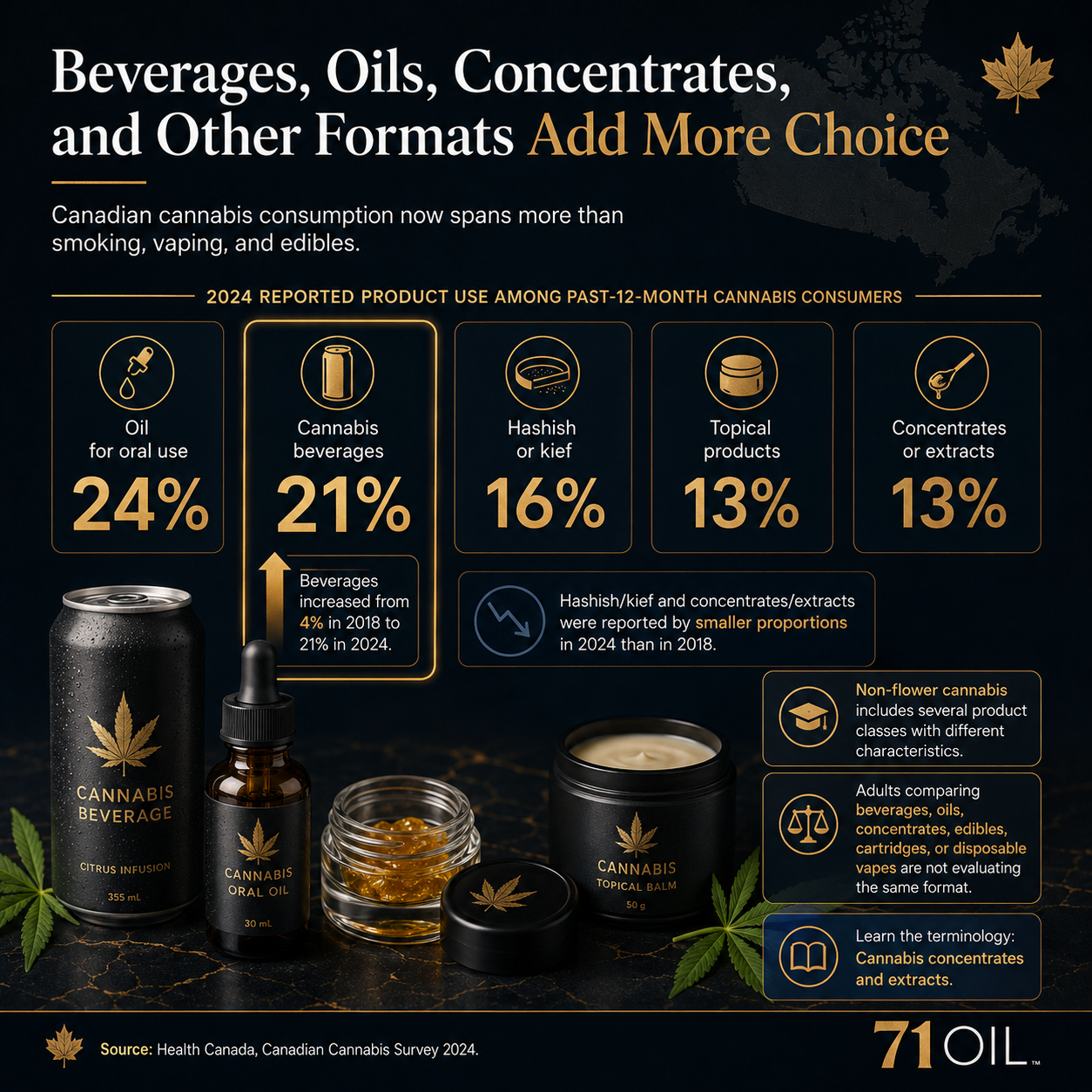
In 2024, 24% of past-12-month cannabis consumers reported using oil for oral use, 21% reported cannabis beverages, 16% reported hashish or kief, 13% reported topical products, and 13% reported concentrates or extracts such as wax, shatter, or budder.
Cannabis beverages stand out for long-term growth: reported product use increased from 4% in 2018 to 21% in 2024.
By contrast, hashish/kief and concentrates/extracts were reported by smaller proportions in 2024 than in 2018. Not every category is moving in the same direction. Health Canada: product types consumed
For readers unfamiliar with the terminology, 71 Oil’s guide to cannabis concentrates and extracts explains how concentrates, extracts, oils, and vape liquids differ as product categories.
That distinction matters because “non-flower cannabis” covers several formats with different product characteristics.
As the range of products grows, clear product information matters more. Adults comparing a beverage, edible, cartridge, disposable vape, oral oil, or concentrate are not evaluating the same format.
Product class, cannabinoid information, ingredients where applicable, hardware details, and label instructions can all become part of the comparison.
Why Legal Retail Changed the Way Cannabis Is Compared
Product diversification happened alongside another major shift: more cannabis is being obtained through legal sources.
In the 2024 CCS, 72% of people who consumed cannabis reported a legal purchase as their usual source, compared with 37% in 2019.
Illegal purchase sources were reported by 3% in 2024, down from 16% in 2019. Health Canada: legal-source trend
Legal sourcing changes what information is visible at the point of purchase. Regulated cannabis products are subject to Canadian packaging and labelling requirements.
Depending on product class, labels can include total THC and CBD, product quantity, lot number, packaging date, warning information, ingredients, and intended-use information. Health Canada: how to read a cannabis product label
That creates a different buying environment from one based mainly on informal names, unverified potency claims, or word-of-mouth descriptions.
Strain identity, flavour, aroma, convenience, and brand preference may still matter, but regulated product information gives adults another set of details to check.
What May Be Driving the Shift in Cannabis Habits
National survey data can show what changed, but it does not automatically prove why. Several developments may help explain why adults now encounter and compare a wider set of cannabis formats. These are context, not causal findings from the survey.
More legal product classes are available.
Canada expanded the regulated market beyond dried flower and oil. Rules for edible cannabis, cannabis extracts, and cannabis topicals came into force on October 17, 2019.
As these product classes entered legal retail, consumers had more categories available to compare. Health Canada: Regulations under the Cannabis Act
Practical requirements differ by format.
Different formats involve different preparation, storage, hardware, and use instructions. Those practical differences may influence how adults compare products, but the survey data used here does not establish convenience or portability as the cause of increased use in any category.
Product information has become part of the purchase.
Legal labels and retailer product pages give consumers structured information about cannabinoid content, product class, quantity, ingredients where required, and other details. That supports more direct comparison between formats.
Cannabis culture has become more product-literate.
As legal retail matured, the conversation expanded beyond strain names and flower quality into extract types, hardware, terpenes, product classes, labels, and source verification.
This connects back to the broader Cannabis Culture guide. Cannabis culture has not become only about products, but product literacy is now a more visible part of how cannabis is discussed in legal markets.
Product Format Does Not Equal Risk Level
A wider range of formats should not be interpreted as a ranking of which products are “best” or “safest.” Smoking, vaping, edibles, concentrates, and other forms of cannabis have different considerations, and legal status does not make cannabis risk-free.
For adults of legal age who choose to use cannabis, source and product information still matter. Health Canada recommends choosing legal cannabis and explains how to identify regulated products through features such as an excise stamp, standardized THC symbol, health warning messages, and child-resistant packaging where required. Health Canada: choose legal cannabis
Impairment also remains relevant regardless of format. Consumption trends can help explain how the market is changing, but they should not be used to encourage heavier use, rapid repeat consumption, or experimentation for maximum effect.
What These Trends Mean for Modern Cannabis Culture
The clearest cultural change is that adults now encounter a much wider set of cannabis formats than they did at the start of the 2018 comparison period used here. Flower remains important, but it exists alongside a more varied set of legal products.
For consumers, that means product literacy matters more. People may compare not only strain and THC content, but also whether a product is an edible, beverage, oral oil, cartridge, disposable vape, concentrate, or another format. Vape buyers may also compare extract type, hardware design, connection type, charging, and device instructions.
Clear information becomes more useful as those choices multiply. Adults need to know what product class they are looking at, which details are verified on the label, what hardware is required, and how one format differs from another before making a purchase decision.
The data also shows why “cannabis consumer” describes a broad group rather than one behaviour. A person who prefers flower, another who buys edibles, and another who uses cartridges can all participate in the same legal market while making very different product choices.
The newest broad national data reinforces that distinction. Health Canada’s 2025 Canadian Substance Use Survey reported past-12-month cannabis use at 32% among people aged 15+, unchanged from 2023, while daily or almost daily cannabis use was 9%. The broad prevalence picture was therefore relatively stable even as the detailed 2018–2024 product data shows substantial changes in which formats were reported. Health Canada: Canadian Substance Use Survey 2025
Frequently Asked Questions
What is the most common way Canadians consume cannabis?
Smoking remains the most commonly reported method in Health Canada’s 2024 Canadian Cannabis Survey. The survey reported smoking at 69%, followed by eating cannabis at 57% and vaporizing with a vape pen or e-cigarette at 37%.
Is cannabis vaping increasing in Canada?
Reported use of vape pens and cartridges increased over the 2018–2024 comparison period. Among people who consumed cannabis in the previous 12 months, use rose from 16% in 2018 to 37% in 2024.
Are edibles becoming more popular in Canada?
Reported edible cannabis use increased from 41% in 2018 to 55% in 2024 among past-12-month cannabis consumers in the Canadian Cannabis Survey.
Are Canadians moving away from smoking cannabis?
Smoking remains the leading reported method. However, reported dried-flower use was lower in 2024 than in 2018, while reported use of edibles, vape pens and cartridges, and cannabis beverages increased over the same comparison period.
What is the latest Canadian cannabis consumption data available?
Health Canada’s 2025 Canadian Substance Use Survey provides the newest broad national prevalence and frequency data. The most recent detailed national product-format time series used in this article comes from the 2024 Canadian Cannabis Survey.
Conclusion
Cannabis consumption in Canada is becoming more diverse. Smoking is still the most common reported method, but adults now encounter far more than dried flower alone.
Vape pens and cartridges, edibles, beverages, oral oils, concentrates, and other formats all contribute to the way cannabis is compared and discussed in the legal market.
These cannabis consumption trends in Canada make product knowledge increasingly important. Format, label information, extract type, hardware compatibility, legal sourcing, and responsible-use considerations all belong in the same conversation.
For more background on how this product-focused market developed, read What Is Cannabis Culture? From Counterculture to Legal Mainstream. To compare extract-based formats, continue with What Are Cannabis Concentrates and Extracts? or explore 71 Oil’s Disposable Vape Pens category for current product-format examples.
Resources Used
- Health Canada — Canadian Cannabis Survey 2024: Summary
- Health Canada — Health Canada releases new data on cannabis use in Canada
- Health Canada — Canadian Substance Use Survey 2025: Summary
- Health Canada — How to read and understand a cannabis product label
- Health Canada — Reduce your risk: Choose legal cannabis
- Health Canada — Regulations under the Cannabis Act
0 Responses