

Is Cannabis Socially Accepted in Canada?
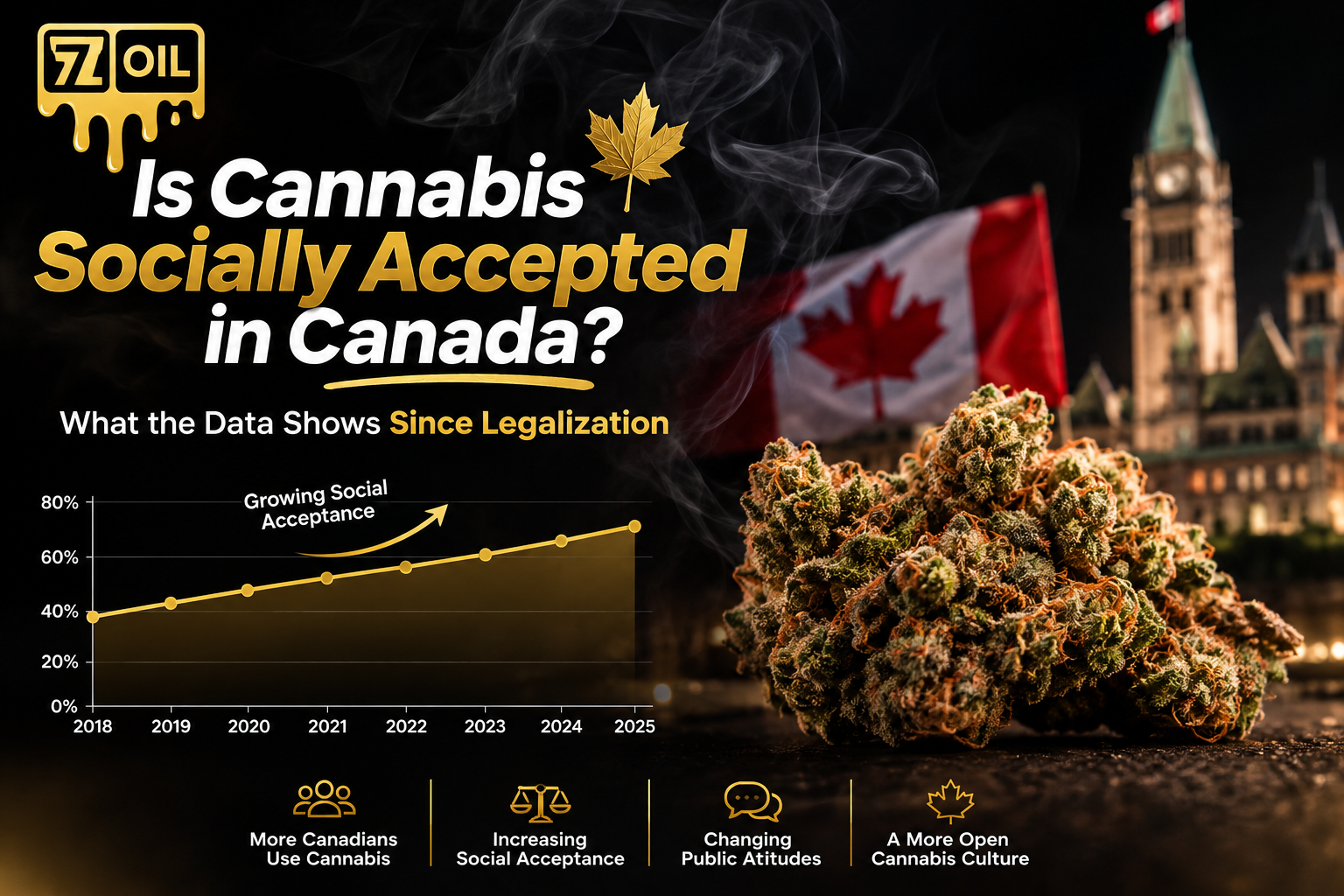
Cannabis social acceptance in Canada has increased since 2018, although acceptance is not universal.
Health Canada’s 2024 Canadian Cannabis Survey found that 56% of respondents considered regularly eating or drinking cannabis somewhat or completely socially acceptable. The figure was 53% for regularly smoking cannabis and 53% for regularly vaping cannabis. All three measures were higher than their 2018 levels.
Those numbers describe public attitudes. They do not mean cannabis is accepted in every household, workplace, building, community, or social setting. Social acceptance, legal status, perceived risk, and permission to use cannabis in a particular place are separate questions.
| Quick Answer: Is Cannabis Socially Accepted in Canada?
Cannabis is more socially accepted in Canada than it was in 2018. In 2024, 56% of respondents considered regular eating or drinking of cannabis socially acceptable, while 53% said the same about smoking and vaping cannabis. The longer-term trend shows greater acceptance, but national averages do not mean cannabis is universally accepted or appropriate in every setting. |
In This Guide
- What does cannabis social acceptance mean in Canada?
- How has cannabis acceptance changed since 2018?
- Is cannabis vaping socially accepted in Canada?
- Is smoking cannabis more socially accepted than vaping?
- Is cannabis as socially accepted as alcohol?
- Does greater acceptance mean Canadians think cannabis is harmless?
- Is cannabis stigma gone in Canada?
- Are cannabis use and social acceptance the same thing?
- Legal cannabis and social acceptance are not the same thing
- How does social acceptance fit into modern Canadian cannabis culture?
- What does changing acceptance mean for responsible adult use?
- Frequently asked questions
- What the data says about cannabis acceptance in Canada
Key Takeaways
- Social acceptance of regular cannabis use is higher than it was in 2018.
- Eating or drinking cannabis had the highest social-acceptability figure among the three cannabis formats measured in 2024, at 56%.
- Smoking and vaping cannabis were each considered socially acceptable by 53% of respondents.
- Alcohol remained more socially accepted than cannabis, at 76%.
- Acceptance has not increased every year. Eating/drinking and vaping cannabis both declined slightly from 2023 to 2024.
- Greater social acceptance does not mean cannabis is universally accepted or considered low risk.
- Legal status, social acceptance, setting-specific rules, and health or impairment risk should be considered separately.
What Does Cannabis Social Acceptance Mean in Canada?
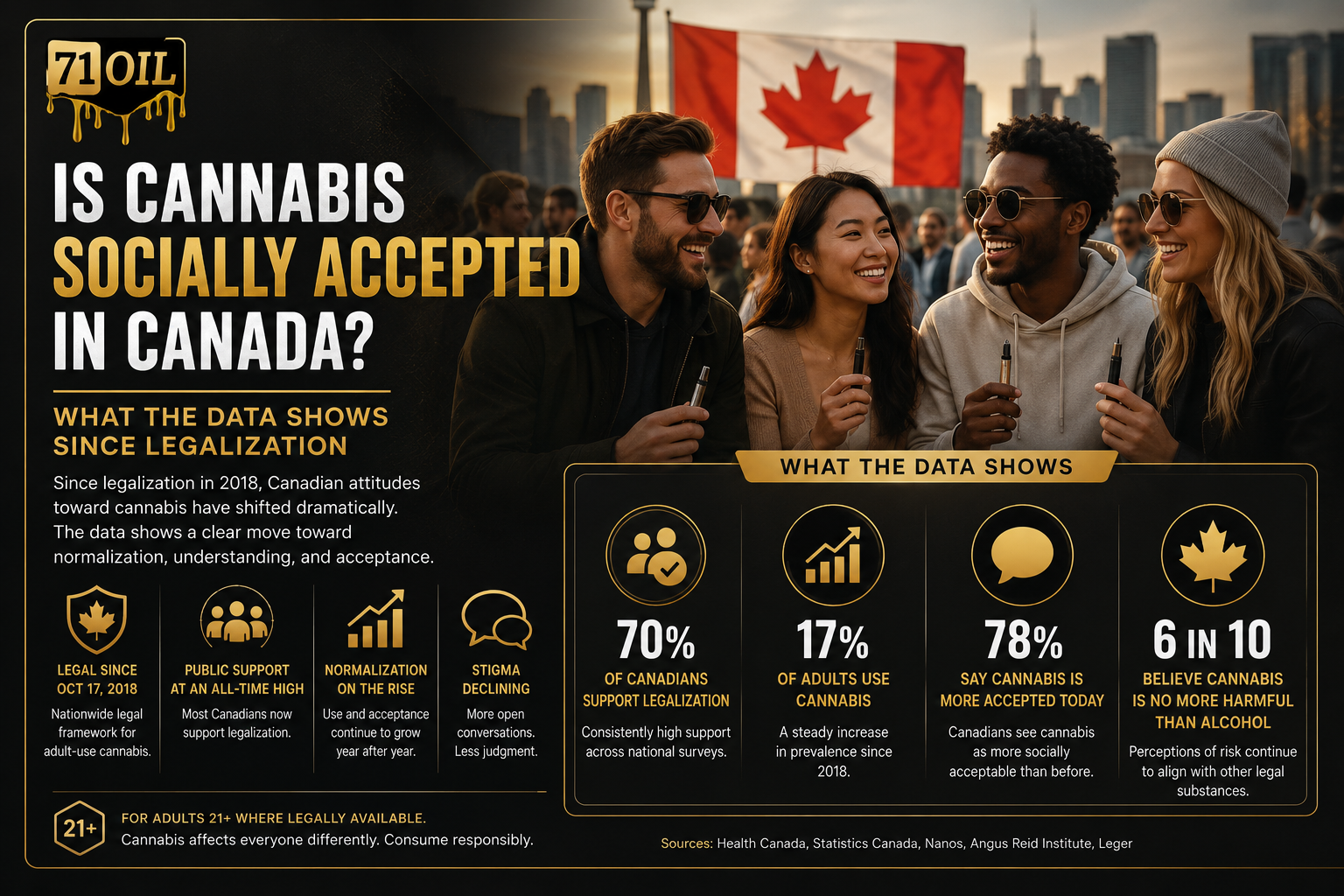
Social acceptance is about how people view a behaviour. It is not the same as legal status or actual cannabis use.
In the Canadian Cannabis Survey, Health Canada defines social acceptability using respondents who describe regular consumption as either “somewhat” or “completely” socially acceptable. The survey asks about different behaviours, including smoking, vaping, and eating or drinking cannabis.
A person can support legal cannabis access without personally approving of regular use. Someone can also consider cannabis generally socially acceptable while objecting to its use in a workplace, shared residence, vehicle, or another particular setting.
Similarly, social-acceptability percentages should not be read as cannabis-use rates. They measure attitudes rather than consumption behaviour.
For the consumption side of the picture, see How Canadians Consume Cannabis: Smoking, Vaping, Edibles, and Changing Habits.
Data Note: Who Was Surveyed?
The 2024 Canadian Cannabis Survey was based on responses from 11,666 people aged 16 years and older across all Canadian provinces and territories. The results were weighted by province or territory, age group, and sex at birth. Health Canada provides the survey methodology and sample details here.
Because 71 Oil writes for adults of legal age, the article uses the survey as population-level evidence about attitudes in Canada rather than implying that every respondent was legally eligible to purchase cannabis.
How Has Cannabis Acceptance Changed Since 2018?
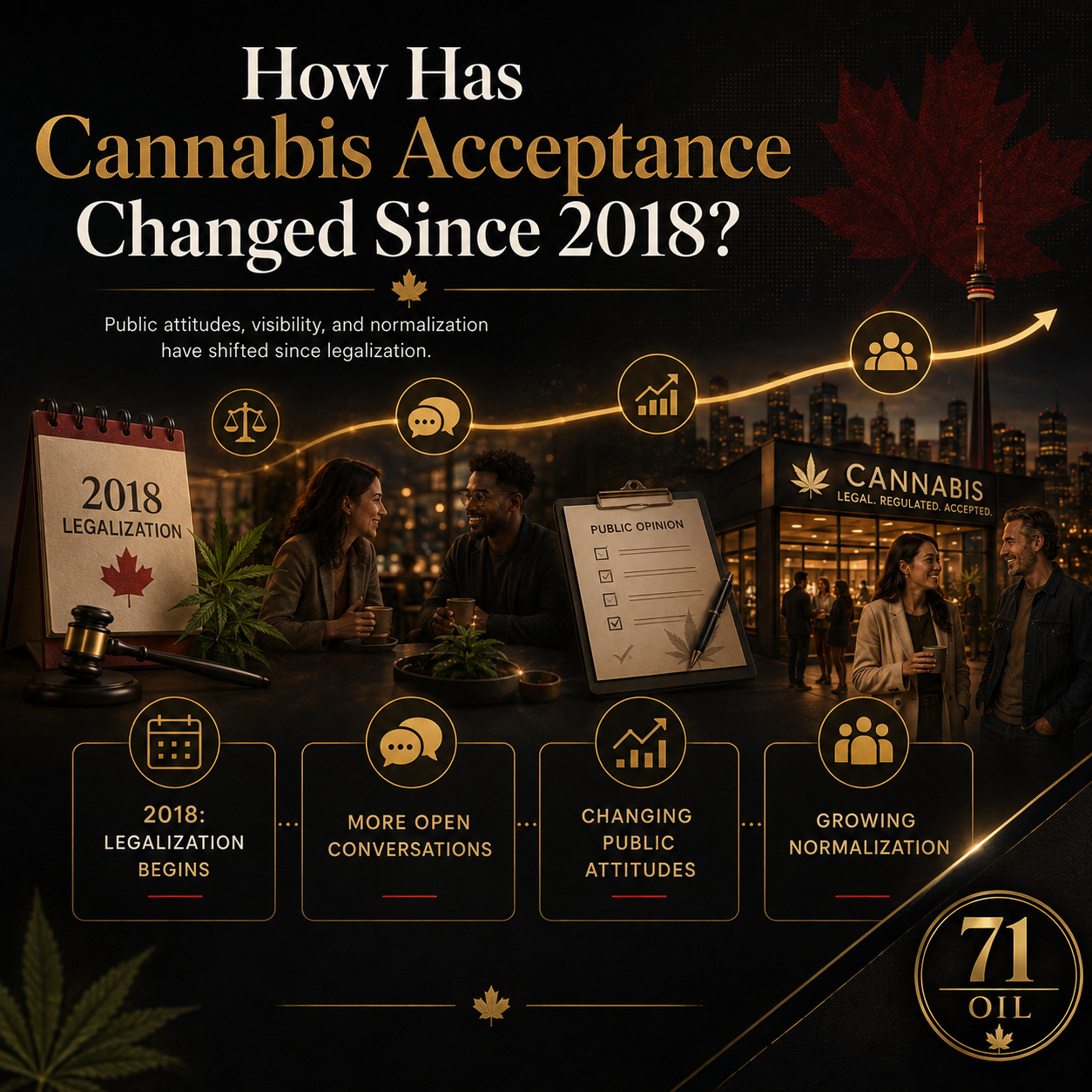
The overall direction since 2018 is clear: regular cannabis consumption is more socially accepted than it was at the beginning of the survey period.
| Regular Consumption Method | 2018 | 2024 | Change |
|---|---|---|---|
| Eating or drinking cannabis | 44% | 56% | +12 points |
| Vaping cannabis | 44% | 53% | +9 points |
| Smoking cannabis | 45% | 53% | +8 points |
Health Canada identified all three 2024 figures as significantly higher than their 2018 levels.
These changes occurred during Canada’s post-legalization period, but the survey does not establish that legalization alone caused every change in public attitudes.
The Trend Has Not Moved Up Every Year
It would be inaccurate to say cannabis becomes more socially accepted every year.
- eating or drinking cannabis decreased from 58% to 56%
- vaping cannabis decreased from 55% to 53%
- smoking cannabis moved from 54% to 53%
Health Canada identified the decreases for eating/drinking and vaping as statistically significant.
The more accurate conclusion is: Cannabis social acceptance has increased over the longer period since 2018, while year-to-year attitudes can still move in either direction.
Survey Methodology Changed in 2023
The longer-term trend also needs one methodological qualification.
Starting in 2023, Health Canada measured vaping cannabis through separate questions about vaping dried cannabis and vaping liquid or solid cannabis extracts, then combined them into the overall vaping figure. The survey wording around cannabis social acceptability also changed during this period. Health Canada documents the 2023 methodology changes here.
Health Canada therefore cautions that wording changes may have influenced responses. This makes the broad multi-year trend more useful than overinterpreting a one- or two-point annual movement.
Is Cannabis Vaping Socially Accepted in Canada?
About half of respondents considered regular cannabis vaping socially acceptable in 2024.
Health Canada reported a social-acceptability figure of 53% for vaping cannabis, compared with 44% in 2018.
The 2024 figure was slightly below the 55% recorded in 2023, but it remained meaningfully above the 2018 baseline.
This tells us how respondents viewed the behaviour socially. It does not show that vaping is accepted in every setting, nor does it establish anything about the relative health risk of vaping compared with other cannabis formats.
For trends in how Canadians actually consume cannabis, continue with How Canadians Consume Cannabis: Smoking, Vaping, Edibles, and Changing Habits.
Is Smoking Cannabis More Socially Accepted Than Vaping?
Not according to the headline 2024 national figures.
- 53% for regularly smoking cannabis
- 53% for regularly vaping cannabis
- 56% for regularly eating or drinking cannabis
Smoking and vaping were therefore tied in the 2024 national data, while eating or drinking cannabis was slightly higher. See the 2024 Canadian Cannabis Survey.
The figures are national averages. Individual attitudes can still differ based on the consumption method, setting, odour, personal experience, and other social factors.
Is Cannabis as Socially Accepted as Alcohol?
No. Alcohol remained more socially accepted than cannabis in the 2024 survey.
| Substance or Behaviour | Socially Acceptable in 2024 |
|---|---|
| Drinking alcohol | 76% |
| Eating or drinking cannabis | 56% |
| Smoking cannabis | 53% |
| Vaping cannabis | 53% |
| Using a nicotine e-cigarette | 46% |
| Smoking tobacco | 40% |
Health Canada’s results place cannabis below alcohol but above nicotine e-cigarettes and tobacco in this particular measure of social acceptability.
That comparison is about social attitudes only. It should not be interpreted as a ranking of safety or health risk.
Does Greater Acceptance Mean Canadians Think Cannabis Is Harmless?
No. Social acceptance and perceived risk measure different things.
In the 2024 Canadian Cannabis Survey, most respondents still perceived moderate or great risk from regular cannabis use, depending on the consumption method:
- 77% for regularly smoking cannabis
- 75% for regularly vaping dried cannabis
- 77% for regularly vaping liquid or solid cannabis extracts
- 65% for regularly eating or drinking cannabis
Health Canada also reported that 86% of respondents correctly identified that vaping cannabis can be harmful.
The important point is not that acceptance and risk perception conflict. They answer different questions.
Social acceptance asks whether a behaviour is considered acceptable. Perceived risk asks whether people believe regular use may cause harm.
Canadians can therefore become more accepting of cannabis use socially while still recognizing potential risks.
For detailed health information, see What Are the Main Health Risks of Vaping Cannabis?.
Is Cannabis Stigma Gone in Canada?
No. The national data supports increased acceptance, not the disappearance of stigma.
Even the highest cannabis social-acceptability figure in 2024 was 56%. That means the survey does not support claims that cannabis is universally accepted or that stigma has completely disappeared. Health Canada reports the national figures here.
Health Canada also found that social acceptability of cannabis and other substances was higher among respondents who had consumed cannabis in the previous 12 months than among those who had not.
Personal experience and social context can therefore be associated with different attitudes.
A more accurate description of modern Canadian cannabis culture is reduced stigma and greater normalization in some contexts, rather than the complete disappearance of stigma.
For the broader historical and cultural picture, see What Is Cannabis Culture? From Counterculture to Legal Mainstream.
Are Cannabis Use and Social Acceptance the Same Thing?
No.
Cannabis use measures behaviour. Social acceptance measures attitudes.
Someone can consider cannabis use socially acceptable without personally consuming cannabis. A person who uses cannabis can also believe that certain settings, frequencies, or forms of consumption are inappropriate.
The distinction matters because changes in cannabis-use patterns should not automatically be interpreted as changes in public approval.
The dedicated How Canadians Consume Cannabis guide covers how smoking, vaping, edibles, and other formats fit into current consumption trends without duplicating that analysis here.
Legal Cannabis and Social Acceptance Are Not the Same Thing
Legal status and social acceptance answer different questions.
| Concept | What It Answers |
|---|---|
| Legal status | Is the cannabis-related activity permitted under applicable law? |
| Social acceptance | Do people consider the behaviour socially acceptable? |
| Setting rules | Is cannabis use allowed in this particular workplace, residence, venue, building, or property? |
| Health and impairment risk | What risks may still apply even when cannabis use is legal or socially accepted? |
A legal activity can still be restricted in a particular setting.
A socially accepted activity can still carry health or impairment risks.
And behaviour accepted by one person or social group may not be accepted by another.
The practical distinction is: Legal does not automatically mean socially accepted everywhere, permitted everywhere, or risk-free.
How Does Social Acceptance Fit Into Modern Canadian Cannabis Culture?
Social acceptance is one part of the broader change in Canadian cannabis culture since legalization.
Cannabis is now discussed within a regulated adult-use environment alongside public-health information, labelled product formats, authorized retail, impairment concerns, and responsible-use education. The shift has made cannabis more visible in mainstream public discussion, but it has not erased the earlier history of prohibition, stigma, advocacy, and informal cannabis culture.
This article focuses specifically on attitudes and social acceptance.
For the broader history of legalization, counterculture, regulated retail, product education, and cultural change, read What Is Cannabis Culture? From Counterculture to Legal Mainstream. That page owns the wider cannabis-culture story rather than repeating it here.
Adults who want to understand regulated product information can also continue to How to Read a Cannabis Vape Product Label in Canada.
What Does Changing Acceptance Mean for Responsible Adult Use?
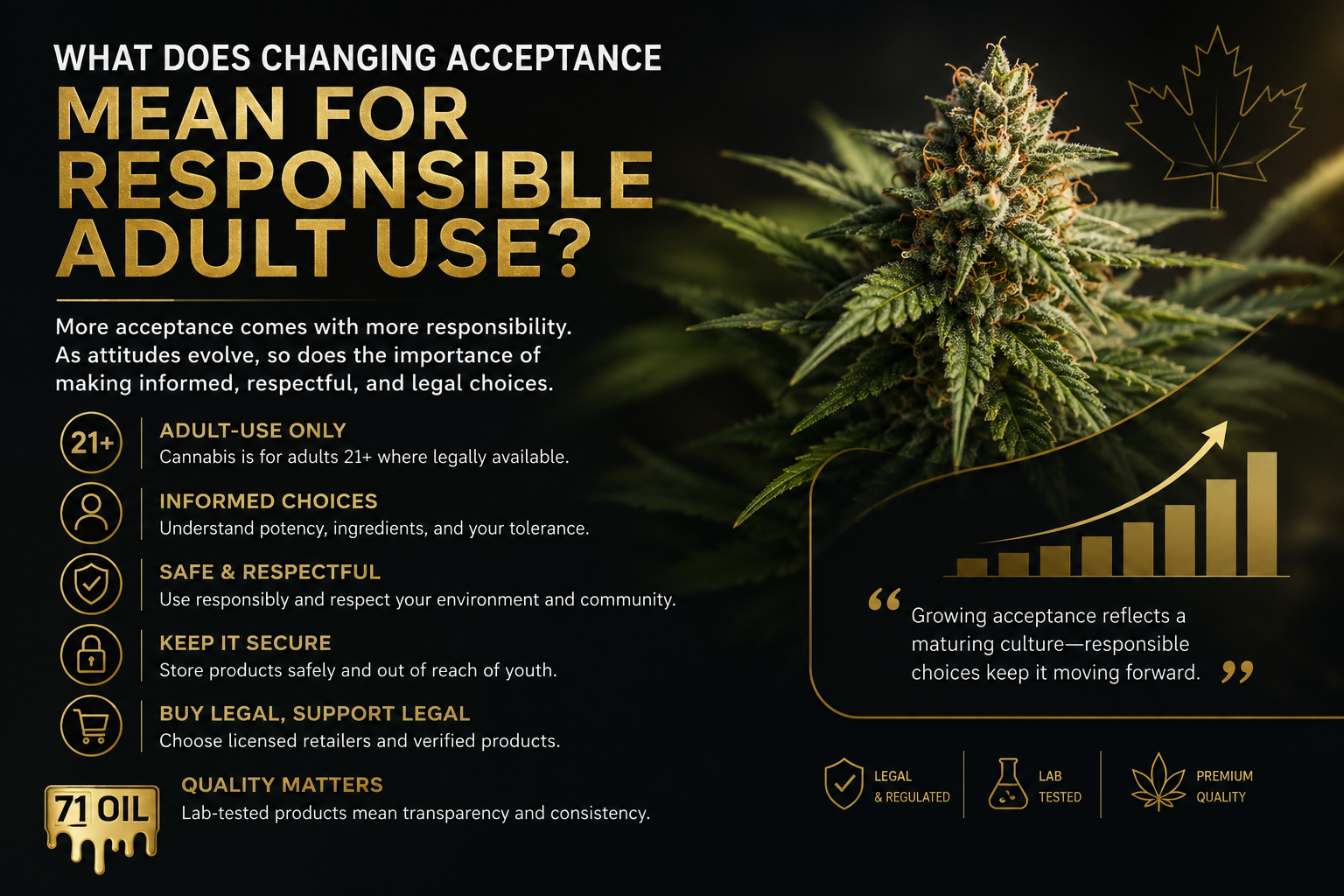
Social acceptance does not replace responsible-use decisions.
Adults who choose cannabis still need to consider impairment, applicable laws and property rules, product instructions, and the people sharing the surrounding space.
Health Canada’s 2024 survey found that 86% of respondents believed cannabis use impairs the ability to drive or operate a vehicle.
The important distinction is simple: Public acceptance describes attitudes. It does not provide permission to ignore impairment, product guidance, or setting-specific rules.
For detailed practical guidance, continue with Cannabis Vaping Tips for Responsible Adult Use.
Frequently Asked Questions
Is cannabis socially accepted in Canada?
Cannabis is more socially accepted in Canada than it was in 2018, but acceptance is not universal. In 2024, 56% of respondents considered regularly eating or drinking cannabis socially acceptable, while 53% said the same about smoking and vaping cannabis. Source: Health Canada
Has cannabis become more accepted since legalization?
Social-acceptability measures are higher than they were in 2018. Eating or drinking cannabis increased from 44% to 56%, vaping from 44% to 53%, and smoking from 45% to 53% by 2024. These changes occurred during the post-legalization period, but the survey does not establish that legalization alone caused them. Source: Health Canada
Is vaping cannabis socially accepted in Canada?
In 2024, 53% of respondents considered regular cannabis vaping somewhat or completely socially acceptable. That was higher than the 44% reported in 2018. Source: Health Canada
Is smoking cannabis more socially accepted than vaping?
Not in the 2024 headline figures. Regular smoking and regular vaping of cannabis were each considered socially acceptable by 53% of respondents. Source: Health Canada
Is cannabis as socially accepted as alcohol?
No. Regular alcohol consumption had a social-acceptability figure of 76% in 2024, compared with 56% for eating or drinking cannabis and 53% for smoking or vaping cannabis. Source: Health Canada
Does legalization mean cannabis stigma is gone?
No. The survey shows greater social acceptance over time, not universal approval. Health Canada also found different levels of social acceptability between respondents who had consumed cannabis in the previous 12 months and those who had not. Source: Health Canada
Does social acceptance mean cannabis is safe?
No. Social acceptance measures attitudes rather than safety. Most respondents in the 2024 Canadian Cannabis Survey still perceived moderate or great risk from regular cannabis use across the major consumption methods measured. Source: Health Canada
What the Data Says About Cannabis Acceptance in Canada
Cannabis is more socially accepted in Canada than it was in 2018, but the strongest conclusion from the data is a measured one.
In 2024, 56% of respondents considered regularly eating or drinking cannabis socially acceptable, while smoking and vaping were each at 53%. Those figures were all higher than their 2018 levels, although cannabis remained less socially accepted than alcohol. Health Canada provides the full survey results.
At the same time, substantial proportions of respondents continued to perceive moderate or great risk from regular cannabis use.
The data therefore describes a culture in which cannabis has become more socially normalized without becoming universally accepted or being viewed as risk-free.
For the broader picture, continue with How Canadians Consume Cannabis: Smoking, Vaping, Edibles, and Changing Habits or What Is Cannabis Culture? From Counterculture to Legal Mainstream.
Resources Used
- Health Canada – Canadian Cannabis Survey 2024: Summary – Primary source for social acceptability, perceived risk, cannabis knowledge, driving attitudes, and 2018-2024 trend data.
- Health Canada – Canadian Cannabis Survey 2023: Summary – Supporting source for the 2023 survey wording and methodology changes relevant to interpreting the trend.
- Government of Canada Open Data – Canadian Cannabis Survey 2024 Public Use Microdata File – Supporting source for survey population, sample size, age coverage, geography, and data documentation.
- Health Canada – Health Canada Releases New Data on Cannabis Use in Canada – Supporting overview of the 2024 Canadian Cannabis Survey and national context.
0 Responses