

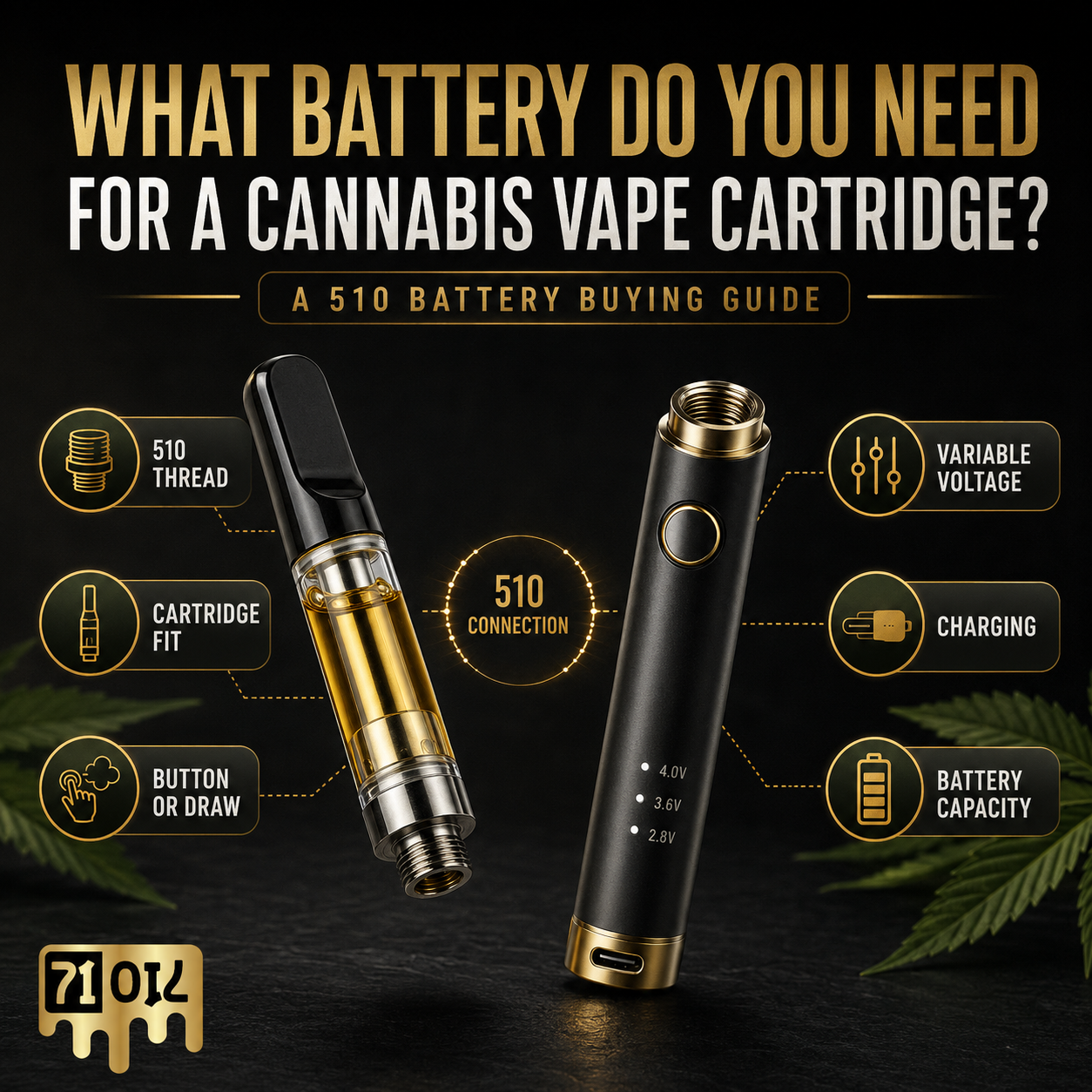
If you need a battery for a cannabis cartridge, start with the cartridge specifications rather than the battery features.
If your cartridge is identified as 510-thread, you need a compatible 510-thread battery that also matches the cartridge’s physical fit and operating requirements. Proprietary pods and integrated vape devices use different hardware and may not require a separate battery.
The connection is only the first check. Battery shape, cartridge clearance, activation method, adjustable settings, charging requirements, and battery condition can also affect whether a setup is appropriate.
This guide focuses specifically on how to choose a battery for a cannabis cartridge. For a basic explanation of the connection itself, see What Is a 510-Thread Battery?
In This Guide
Quick Battery Buying Checklist
Before choosing a battery, check these factors in order.
| Check | What to Confirm |
| Connection | Is the cartridge specifically identified as 510-thread? |
| Physical fit | Will the cartridge fit the battery body or recessed chamber? |
| Operating requirements | Does the battery support the cartridge manufacturer’s recommended settings? |
| Activation | Does the battery use a button, draw activation, or both? |
| Controls | Is the output fixed or adjustable? |
| Battery capacity | Is the capacity suitable for how you expect to use the device? |
| Charging | What charging method and specifications does the manufacturer require? |
| Condition | Is the battery undamaged and supported by clear instructions? |
Do not choose a battery based on thread type alone.
Start With the Cartridge Specifications
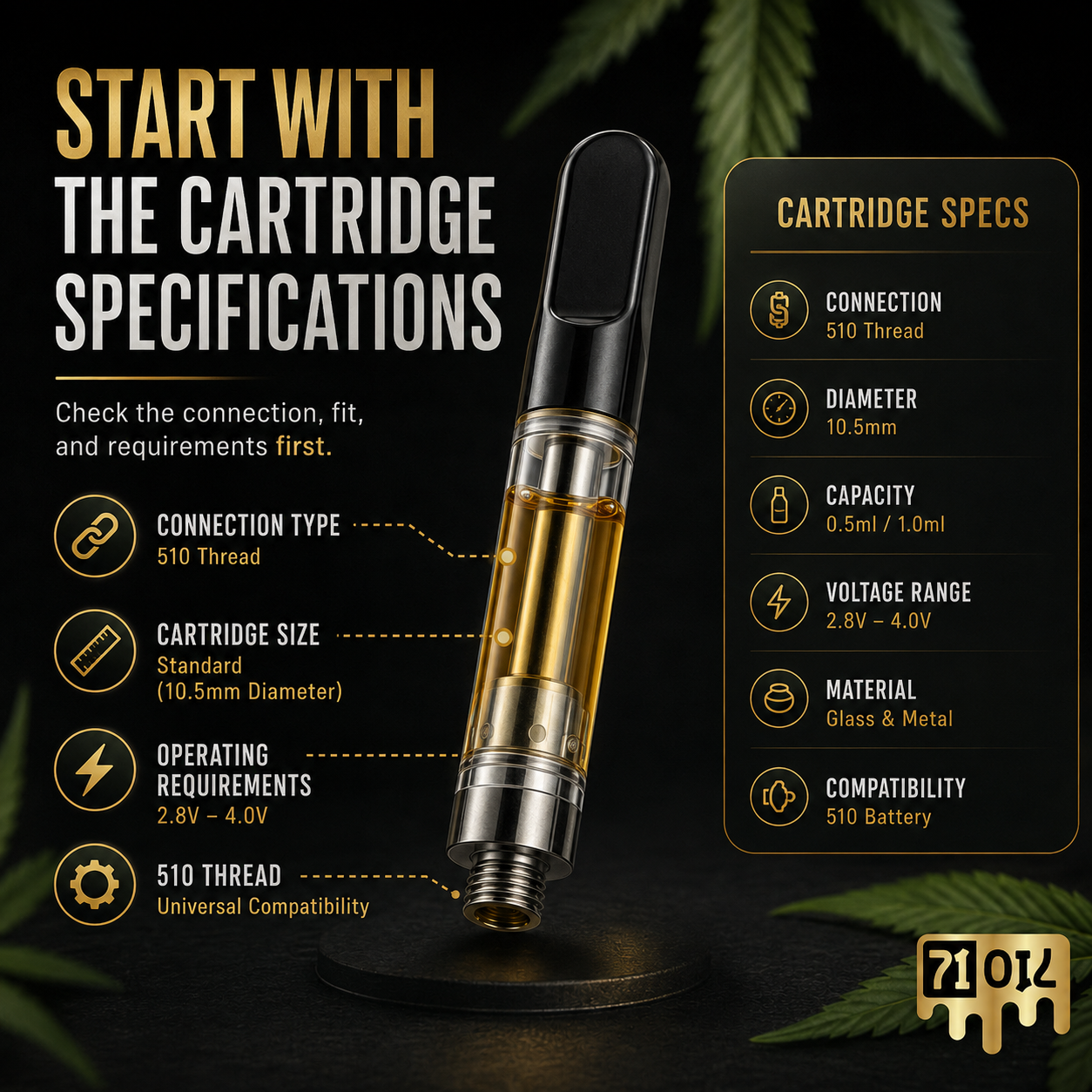
The cartridge should determine which batteries you consider.
Check the product page, packaging, or manufacturer information for the connection type and any stated operating requirements.
Confirm the Connection
If the cartridge is labelled 510-thread, begin with batteries designed for compatible 510 cartridges.
A proprietary pod or integrated device uses a different system and should be paired only with the hardware intended for that format.
If you are not sure what 510 threading means, the 71 Oil guide What Is a 510-Thread Battery? covers the connection and how it works.
Check the Recommended Operating Range
Some cartridge manufacturers specify how the cartridge should be operated.
If specifications are available, choose a battery capable of operating within those requirements.
Do not assume that a battery with more available power is automatically the better option. The appropriate operating setting depends on the cartridge and device specifications.
Check Cartridge Size and Battery Fit
Two products can use a 510 connection and still differ physically.
This matters most with batteries that partially or fully conceal the cartridge inside the battery body.
Before choosing one, compare:
- cartridge diameter
- cartridge height
- battery opening or chamber dimensions
- mouthpiece clearance
- connector position
- airflow around the cartridge
- adapter requirements
An exposed pen-style battery generally places fewer physical restrictions around the cartridge.
A recessed or concealed battery can provide a more enclosed setup, but the cartridge still needs sufficient clearance.
Never force a cartridge into a battery or overtighten it to compensate for a poor fit.
Button-Activated vs. Draw-Activated Batteries
Once connection and fit are confirmed, consider how you want the battery to operate.
Draw-Activated Battery
A draw-activated battery activates when the device detects airflow during inhalation.
This design generally provides a simpler control system because there may be no firing button.
The cartridge must still match the battery’s connection and operating requirements.
Button-Activated Battery
A button-operated battery requires manual activation.
Depending on the model, the button may also control functions such as:
- turning the battery on or off
- changing output settings
- activating preheat
- locking the device
Control sequences vary by manufacturer, so check the instructions for the specific battery.
Which Should You Choose?
Neither activation method is universally better.
Choose based on the cartridge requirements and how much manual control you want.
If simplicity is the priority, a compatible draw-activated model may be sufficient.
If you want access to adjustable controls, a button-operated battery may provide more options, depending on the device.
Fixed vs. Adjustable Batteries
The next decision is how much control you need over battery output.
Fixed-Output Batteries
Fixed-output batteries operate without requiring the user to select between multiple voltage settings.
They can provide a straightforward setup when their operating specifications are appropriate for the cartridge.
Adjustable Batteries
Adjustable batteries allow the user to select between available output levels.
This gives more control, but it also makes cartridge specifications more important.
Higher settings should not automatically be treated as better.
Use the manufacturer’s recommended operating range when one is provided.
Does Battery Capacity Matter?
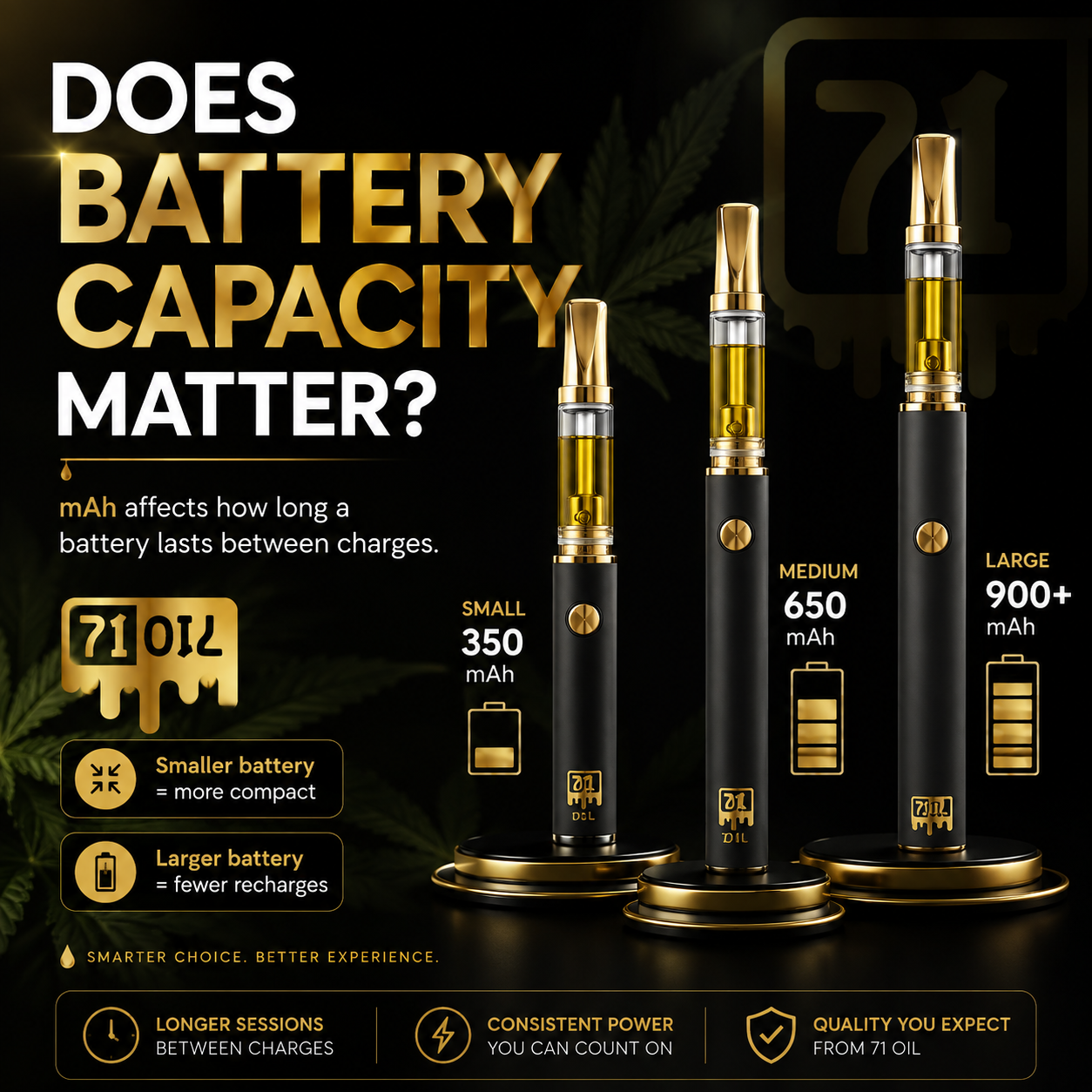
Battery capacity is commonly expressed in milliamp-hours (mAh).
The rating describes the battery’s electrical charge capacity. It does not measure the potency of a cannabis cartridge.
Under comparable conditions, a higher-capacity battery may provide longer operation between charges, but actual runtime depends on factors such as:
- power settings
- draw duration
- frequency of use
- battery age
- temperature
- cartridge and device characteristics
This means mAh should be treated as one buying consideration rather than the deciding factor.
Smaller Batteries
A smaller battery can produce a more compact cartridge setup and may be easier to carry.
Its capacity may also be lower, depending on the model.
Larger-Capacity Batteries
Higher-capacity batteries may require less frequent charging under comparable use.
However, a larger mAh rating does not compensate for poor cartridge compatibility or unsuitable operating specifications.
Prioritize compatibility and fit first, capacity second.
What Charging Method Should You Look For?
Charging systems vary between batteries.
Depending on the design, a battery may use USB-C, micro-USB, a threaded charger, or another manufacturer-specified charging system.
The fact that a cable physically fits a device does not by itself confirm that the charging equipment meets the battery’s requirements.
Check the manufacturer’s instructions for:
- charging method
- required voltage and current
- recommended charging time
- indicator-light behaviour
- replacement charger requirements
Do not modify a battery or charging system.
Battery Safety: What Should You Check?
Lithium-ion batteries require appropriate handling, charging, and storage.
Before using a battery, inspect its condition.
Do not continue using a lithium-ion battery that is:
- swollen
- dented
- visibly damaged
- showing damaged wrapping where applicable
- behaving abnormally
- repeatedly overheating
Follow the manufacturer’s charging and storage instructions.
Do not exceed the recommended charging time, and keep spare removable lithium-ion batteries protected so their terminals cannot contact coins, keys, or other metal objects.
Where relevant to the device being considered, consumers can also look for recognized product-safety certification information rather than assuming all batteries are manufactured to the same standards.
Battery precautions can reduce risk, but they do not make lithium-ion batteries or cannabis vaping risk-free.
Is Preheat Necessary?
Some 510 batteries include a preheat mode.
The feature warms the cartridge before normal activation.
Preheat is not a requirement for every cannabis cartridge, and its presence should not determine battery compatibility.
Use the feature only according to the battery and cartridge instructions.
If a cartridge is damaged, leaking, repeatedly overheating, or consistently failing to operate, do not repeatedly apply additional heat in an attempt to force it to work.
What Should Canadian Adults Check Before Choosing a Vape Battery?
Battery selection involves more than appearance or convenience.
1. Confirm the Cartridge Format
Determine whether the cartridge actually uses a 510 connection. Do this before comparing batteries.
2. Read the Product Instructions
Review the specifications supplied with both the battery and cartridge. Check connection, physical fit, operating requirements, charging instructions, adapters, and warnings.
3. Inspect the Battery
Do not use a battery that is damaged, swollen, dented, or otherwise showing signs of abnormal wear.
4. Follow Charging Instructions
Use charging equipment that meets the manufacturer’s specifications and do not exceed recommended charging times.
5. Avoid Modified Hardware
Do not modify vaping devices, batteries, or charging systems.
6. Choose Cannabis From a Legal Source
For adults who choose to consume cannabis, Health Canada recommends purchasing cannabis from legal sources authorized by a province or territory.
Legal cannabis products must meet Cannabis Act and regulatory requirements for product quality, packaging, and labelling.
Matching a 71 Oil Cartridge With a Battery
If a 71 Oil cartridge is identified as 510-thread, begin by looking for a compatible 510 battery.
Then check the individual cartridge and battery information for:
| Compatibility order: Connection → physical clearance → operating requirements → controls → charging instructions. |
The 71 Oil 510 Cart Batteries category can be used to review currently listed battery options, while the 510 Cartridges category contains cartridge-based products.
Do not assume every cartridge and battery pairing is interchangeable solely because both use a 510 connection.
Check the specifications for the individual products.
Common Battery-Buying Mistakes
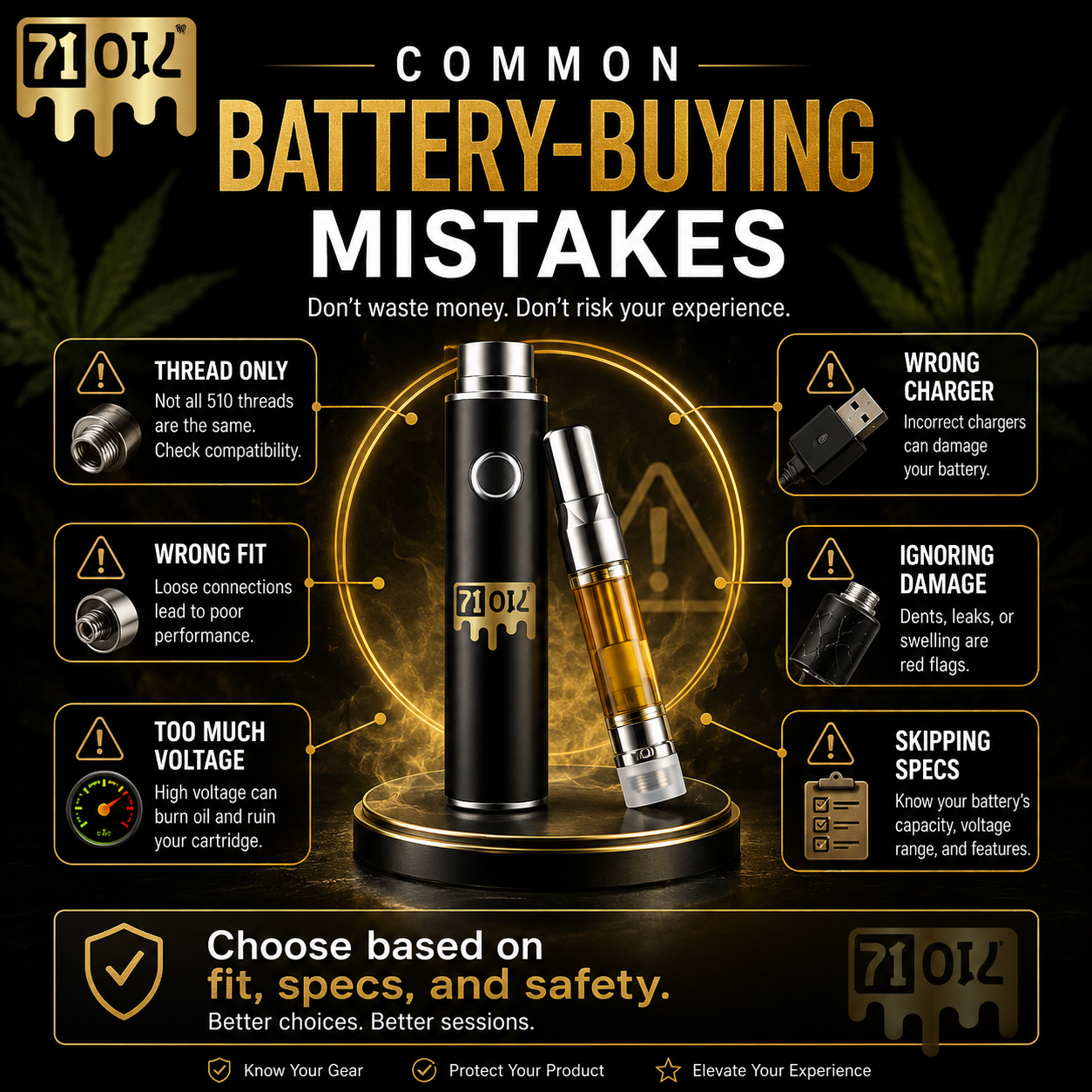
Choosing by Thread Type Alone
A 510 connection is the starting point, not the entire compatibility check. Physical dimensions and operating requirements can still differ.
Buying the Battery Before Checking the Cartridge
Identify the cartridge specifications first. That immediately narrows the range of batteries worth considering.
Assuming More Power Is Better
Maximum output is not a performance goal. Use settings appropriate for the cartridge according to the manufacturer’s instructions.
Ignoring Physical Dimensions
A cartridge can have the correct connection but still be unsuitable for a recessed battery chamber.
Choosing Based Only on mAh
Battery capacity matters, but connection, fit, controls, and charging requirements come first.
Using Unspecified Charging Equipment
A matching connector does not guarantee appropriate charging specifications. Follow manufacturer instructions.
Continuing to Use Damaged Hardware
Stop using batteries showing swelling, dents, significant damage, unusual heat, or other abnormal behaviour.
Frequently Asked Questions
How do I choose a battery for a cannabis cartridge?
Start with the cartridge specifications. Confirm its connection, physical dimensions, and operating requirements. Then compare battery activation, controls, capacity, charging method, and manufacturer instructions.
Is a button or draw-activated battery better?
Neither is automatically better. Draw-activated batteries can provide simpler operation, while button-operated batteries may offer additional controls depending on the model. Compatibility with the cartridge remains the first consideration.
Is a larger mAh battery better for a cannabis cartridge?
Not necessarily. A larger mAh rating indicates greater battery capacity and may provide more time between charges under comparable conditions. It does not improve cartridge compatibility or increase cannabis potency.
Do I need an adjustable battery?
Only if the cartridge specifications and your intended setup make adjustable output useful. A compatible fixed-output battery may also be suitable. Follow manufacturer specifications rather than assuming adjustable power is required.
Does every cartridge fit a concealed 510 battery?
No. Recessed and concealed batteries can have limits on cartridge diameter and height. Check the chamber dimensions and cartridge measurements before pairing them.
Can I use any charger that fits my vape battery?
Do not assume so. Follow the manufacturer’s charging specifications and use appropriate charging equipment with compatible electrical requirements.
How to Choose the Right Battery
A battery for a cannabis cartridge should be selected in this order:
- Connection
- Physical fit
- Operating requirements
- Activation and controls
- Battery capacity
- Charging requirements
- Battery condition
For a 510 cartridge, confirming the thread is only the first step.
The strongest setup is one where the cartridge and battery are designed to work within compatible physical and operating specifications.
Resources Used
- Health Canada — Cannabis accessories for inhalation — Guidance on vaping accessories, batteries, manufacturer instructions, charging, and risk reduction.
- Health Canada — Battery Safety: Lithium-Ion Batteries — Guidance on battery condition, charging, storage, damaged batteries, and compatible chargers.
- Health Canada — Vaping Product Safety — Guidance on lithium-ion batteries used in vaping devices, charging, storage, handling, and safety standards.
- Health Canada — Reduce Your Risk: Choose Legal Cannabis — Guidance for adults choosing cannabis through legal and authorized sources.
- Health Canada — Promotion of Cannabis: Prohibitions and Permissions — Canadian rules relevant to informational and brand-preference promotion.
0 Responses