

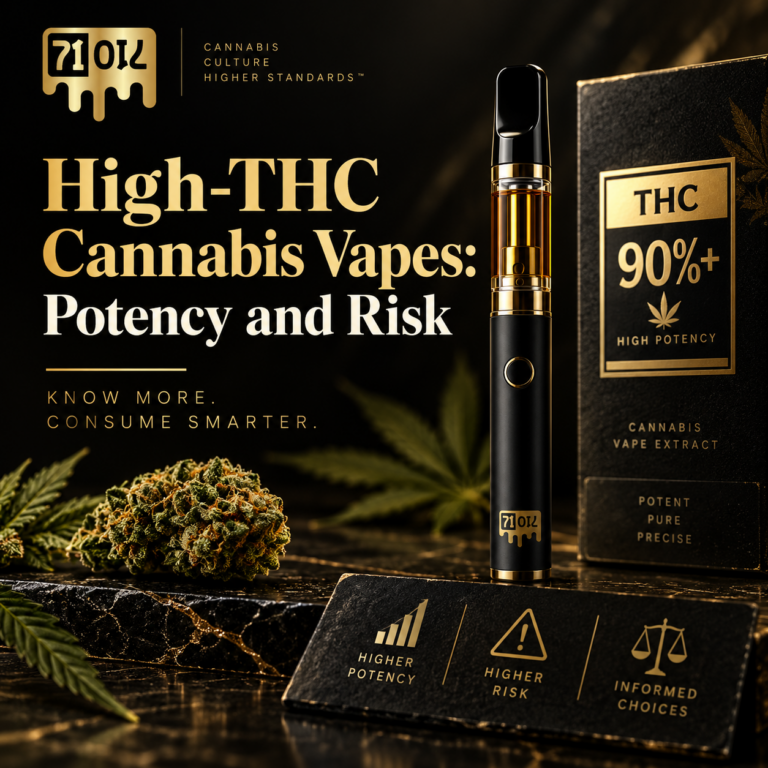
High-THC Cannabis Vapes: What Adults Should Know About Potency and Risk
High THC vape risks deserve careful attention because higher-THC cannabis vapes can increase the likelihood of stronger impairment and some adverse effects. Health Canada’s cannabis and mental health guidance advises adults to choose lower-THC products because higher THC is linked with greater risks to mental health and brain function. Frequency, amount inhaled, age, other substances, and individual sensitivity also matter.
| MEDICAL INFORMATION NOTICE: This article provides general education for legal-age adults. It is not medical advice and cannot predict how a specific person will respond to cannabis. |
In This Guide
Use the links below to jump directly to the section you want to read.
- Quick Answer: Why High-THC Vapes Require Extra Caution
- What Does “High THC” Mean in a Cannabis Vape?
- Why Can Cannabis Vapes Involve High THC Concentrations?
- What Can Higher THC Change?
- How Does Daily or Near-Daily Use Change the Risk Picture?
- Does High THC Mean More Lung Damage?
- Who May Need Extra Caution With High-THC Cannabis?
- How to Read THC Potency on a Canadian Vape Label
- How Can Adults Reduce Risk if They Choose to Use Cannabis?
- When Should Someone Seek Medical Help?
- Frequently Asked Questions
- Understanding THC Potency Without Treating Stronger as Better
- Resources Used
Quick Answer: Why Do High-THC Cannabis Vapes Require Extra Caution?
Higher THC can produce greater impairment and increase the likelihood of adverse effects such as anxiety, panic, paranoia, and overconsumption. Frequent exposure can also contribute to tolerance and dependence. Health Canada identifies higher THC and daily or near-daily use as separate risk factors. These risks are not identical for every adult, and a THC percentage does not tell you the exact dose delivered by one puff.
| What higher THC can change | What it does not prove |
|---|---|
| Greater potential for impairment and stronger intoxication | The exact effect one person will feel |
| Greater likelihood of some adverse effects | A fixed dose from one puff |
| Higher concern when combined with frequent use | That every high-THC product will cause the same outcome |
| More reason to watch tolerance and dependence patterns | That potency is a quality grade |
| Greater mental-health concern for some higher-risk groups | That THC percentage alone explains lung or device risk |
What Does “High THC” Mean in a Cannabis Vape?
THC potency describes the concentration of delta-9-tetrahydrocannabinol in a cannabis product. For cannabis extracts intended for inhalation in Canada, regulated labels display Total THC as a concentration in milligrams per gram (mg/g). A value of 100 mg/g is equivalent to 10% by weight, while 200 mg/g is equivalent to 20%.
There is no single THC percentage that separates a universally “safe” product from a universally “dangerous” one. Health Canada uses several thresholds for risk-reduction guidance, and those thresholds need context rather than being treated as legal safety cutoffs. Its consumer guidance for inhaled cannabis explains the concentration bands below.
| Health Canada context for inhaled cannabis | How to interpret it |
|---|---|
| Less than 100 mg/g (10%) THC | Used in federal consumer guidance as a lower-risk starting point, not a safety guarantee |
| 100–200 mg/g (10–20%) THC | Health Canada advises caution |
| More than 200 mg/g (20%) THC | Health Canada advises the most caution because higher THC can cause greater impairment and increase the risk of serious adverse effects |
| More than 10% THC | A separate current Health Canada mental-health page describes products over 10% THC as “high” in that guidance context |
The important point is not to turn one threshold into a universal rule. Risk depends on more than concentration alone.
Potency Is Not the Same as Dose
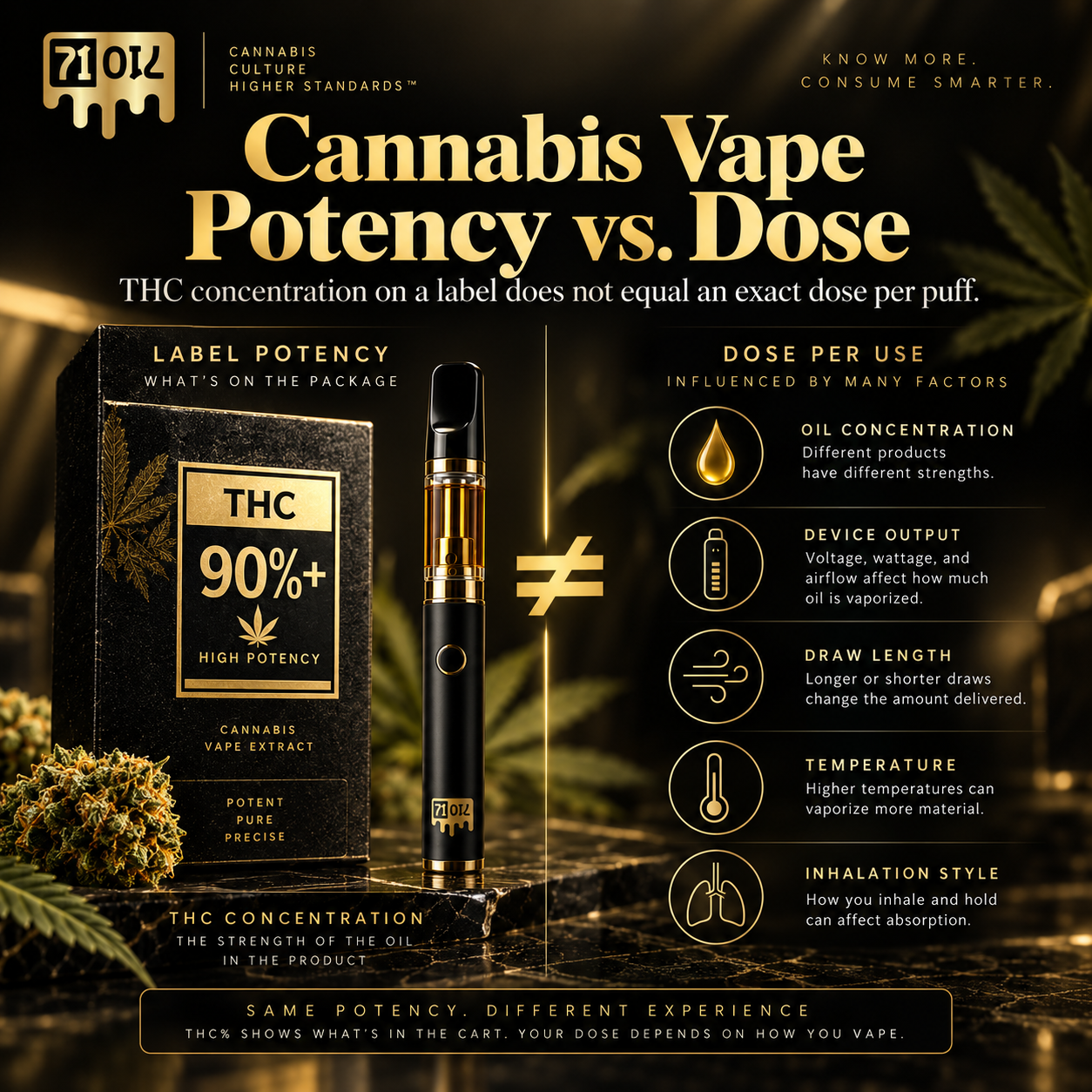
A label can tell you the THC concentration in the product. It cannot tell you exactly how much THC reaches the body from one inhalation.
Device output, formulation, temperature, draw length, airflow, inhalation behaviour, and the amount of aerosol produced can all change exposure. Two people can use the same product and receive different amounts of THC.
That is why puff counts are not a reliable way to compare cannabis dose across devices or products. A stronger label concentration may increase the potential THC available for delivery, but the number on the package is not a per-puff dose.
Potency Is Not a Quality Grade
A higher THC number does not automatically mean a better cannabis vape. It tells you about cannabinoid concentration, not the complete product.
Extract type, ingredients, flavour and aroma information, hardware, formulation, consistency, traceability, testing information, and regulated label details are separate considerations. Our guide to what makes cannabis premium explains why potency should not be used as a universal quality score.
For the broader product-comparison angle, see Beyond THC: Why Cannabis Brands Are Competing on Experience, Flavour, and Trust.
Why Can Cannabis Vapes Involve High THC Concentrations?
Cannabis vape liquids are cannabis extracts. Health Canada’s risks of vaping guidance notes that extracts used in vape pens can contain some of the highest THC levels across cannabis product types. Still, extract type does not determine one fixed potency. Adults should use the regulated label rather than assume strength from terms such as distillate, live resin, HTFSE, cartridge, or disposable.
What Can Higher THC Change?
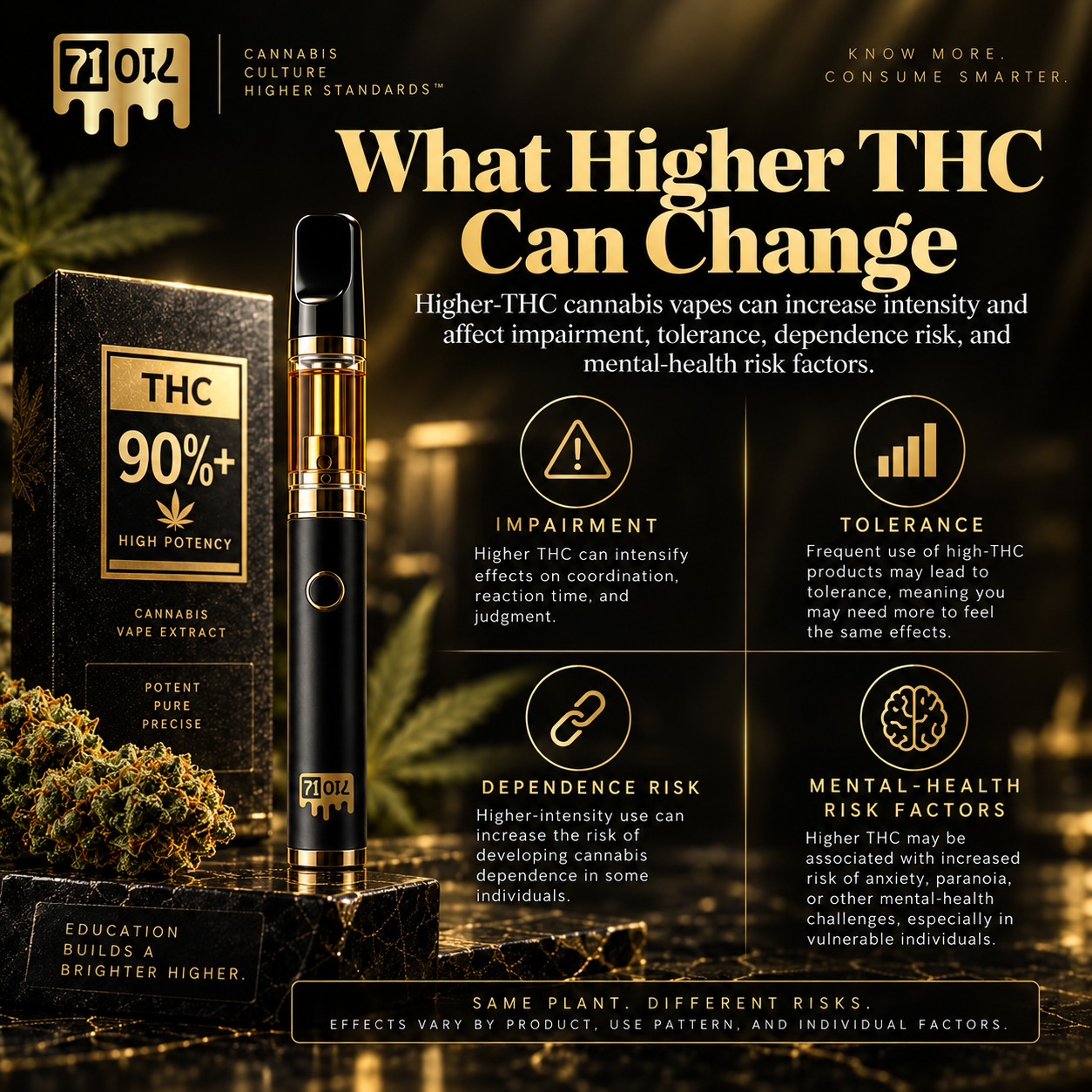
Higher THC can change the likelihood and intensity of some cannabis-related effects, but it does not determine an identical outcome for every person.
A 2025 systematic review in the American Journal of Psychiatry examined 42 studies on high-potency cannabis. The clearest signal was an association with more cannabis-related problems. Mental-health findings were less consistent, and the authors rated the overall certainty of evidence as very low. Potency matters, but the evidence does not support exaggerated certainty.
Stronger Intoxication and Impairment
Higher THC can produce greater impairment. Health Canada’s impairment and safety guidance explains that THC can affect coordination, reaction time, attention, judgment, and decision-making. Inhaled effects can begin within seconds to minutes, but a person still cannot infer the exact dose from one puff. Cannabis can impair driving and equipment use, and alcohol can increase impairment further.
Anxiety, Panic, and Paranoia
Cannabis can cause anxiety, panic, or paranoia in some people. Health Canada’s current mental-health guidance states that the higher the THC content of a product, the more likely a person is to experience harms related to mental health and brain function.
Not every person who uses a high-THC vape will experience anxiety or paranoia. Response varies with age, use history, frequency, other substances, health history, and individual sensitivity.
Cannabis Poisoning and Overconsumption
Higher THC can increase the chance that a person experiences stronger-than-intended effects. Health Canada’s consumer information on cannabis lists serious adverse effects that can include extreme confusion, severe anxiety, paranoia, hallucinations, and seizures.
The risk of overconsumption is one reason federal guidance tells adults using inhaled cannabis to allow time for the full effects to develop before using more. Rapid repeat inhalations can make it harder to judge the effect already developing.
If too much cannabis has been used and someone feels seriously unwell, Health Canada advises contacting poison services, emergency services, or the nearest hospital as appropriate.
Tolerance and Escalating Use
Tolerance means that a person may need more cannabis to experience effects similar to those they felt previously. It can develop with repeated exposure.
Health Canada lists increased tolerance among signs of cannabis dependence. The CDC’s cannabis use disorder guidance similarly notes that some people may need greater amounts or stronger concentrations over time to reach the same effect.
Tolerance alone does not diagnose cannabis use disorder. It becomes more concerning when it appears together with cravings, difficulty cutting down, using more than intended, or continuing to use despite problems.
Potency is only one part of the picture. See the warning signs cannabis use may be becoming difficult to control.
For a broader discussion of frequency and tolerance, read What Happens If You Vape Cannabis Every Day?.
Dependence and Cannabis Use Disorder
Higher-potency cannabis may increase concern about dependence, particularly when use is frequent. A 2026 narrative review found that concentrate use may be associated with greater cannabis use disorder risk, while noting that long-term, form-specific data remain limited. Dependence is not defined by one THC percentage or one day of use. Signs can include cravings, difficulty cutting down, increased tolerance, or continued use despite problems.
Psychosis and Schizophrenia Risk Factors
Health Canada identifies frequent use and higher THC as factors that can increase mental-health risk. Current guidance also advises extra caution for people with a personal or family history of psychosis, schizophrenia, or substance dependence.
Psychosis can involve severe paranoia, hallucinations, and disorganized thinking; schizophrenia is a longer-term disorder. The 2025 systematic review found psychosis-related findings tended toward poorer outcomes with higher potency, but the evidence base still had major limitations. Adults with personal or family vulnerability should treat high-THC use as a significant risk consideration.
How Does Daily or Near-Daily Use Change the Risk Picture?
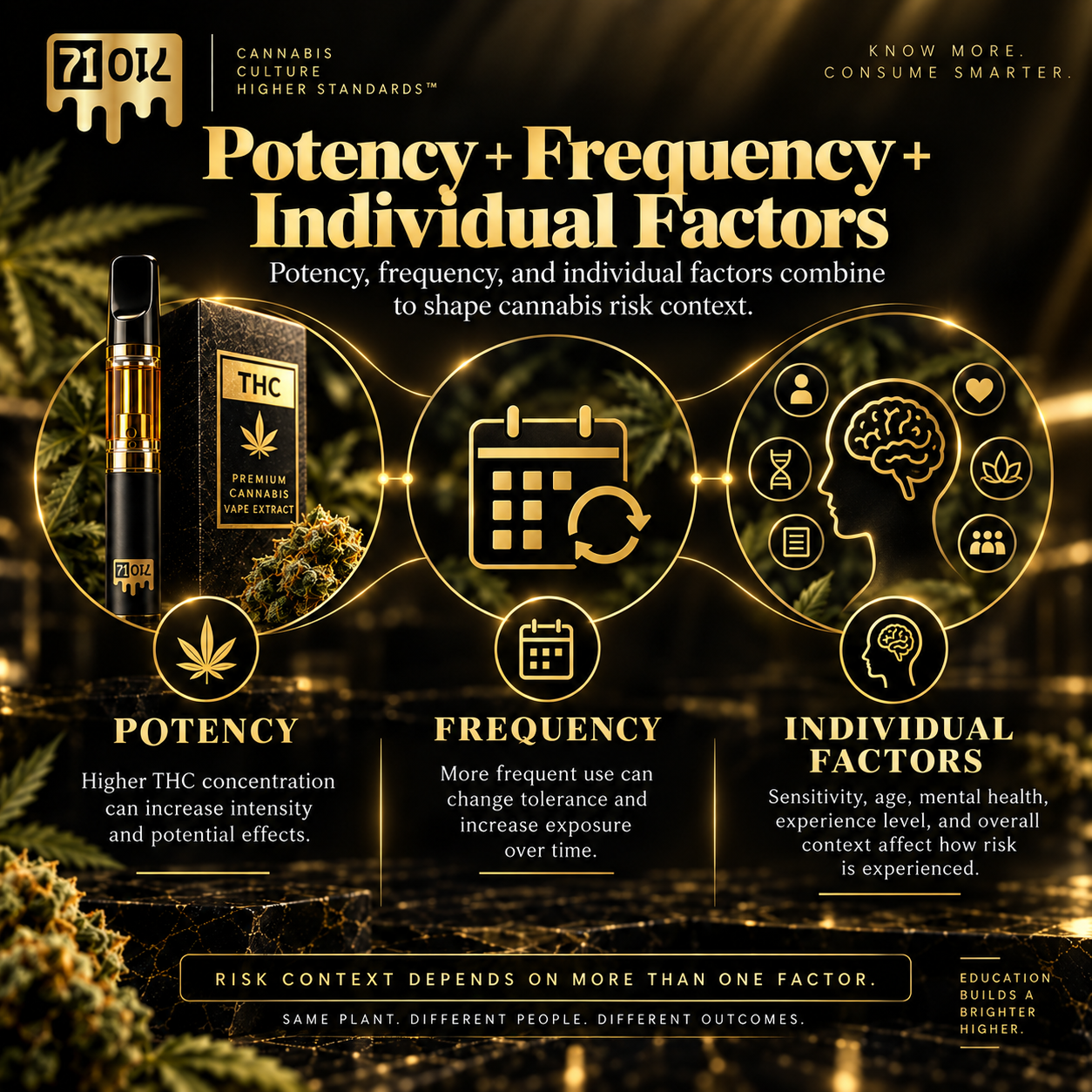
Potency and frequency are separate variables. They can overlap.
A lower-THC product used very frequently can still create a higher-risk pattern. A higher-THC product used frequently adds another concern because both concentration and repetition matter. Health Canada advises avoiding daily or near-daily use and separately recommends choosing lower-THC products. “How strong is the vape?” and “How often is it used?” are different questions.
| RISK CONTEXT: Potency + frequency + individual factors shape risk. There is no reliable one-number score that can predict an individual outcome. |
Does High THC Mean More Lung Damage?
Not necessarily. THC concentration and lung exposure are related cannabis-vaping questions, but they are not the same question.
Cannabis vape aerosol can contain harmful substances, and contaminants such as metals can enter cannabis concentrates or aerosol. Those inhalation risks can exist regardless of the THC percentage on the label.
Current evidence does not support turning a higher THC number into a claim that a vape will automatically release more metals, cause EVALI or VALI, or create a specific type of lung injury. Product formulation, hardware, temperature, contaminants, source, and use pattern can also affect respiratory exposure.
For the respiratory evidence, read How Does Vaping Cannabis Affect Your Lungs?. For the 2019 lung-injury outbreak and the role of vitamin E acetate and informal products, see What Is EVALI (VALI)? Vaping-Associated Lung Injury Explained.
Who May Need Extra Caution With High-THC Cannabis?
Some adults have risk factors that make high-THC cannabis a more important concern. Health Canada identifies greater risk among younger people and advises avoiding cannabis for those with a personal or family history of psychosis, schizophrenia, or substance dependence. Extra caution is also reasonable for:
- new or infrequent users
- adults who use cannabis daily or near-daily
- people combining cannabis with alcohol or other psychoactive substances
- people taking medications or living with significant health conditions who need individualized clinical advice
- anyone with a history of severe reactions after cannabis use
How to Read THC Potency on a Canadian Vape Label
A legal Canadian cannabis vape label is the best place to verify THC concentration.
For cannabis extracts intended for inhalation, Health Canada’s cannabis product label guidance requires Total THC and Total CBD concentration in mg/g for cannabis extracts intended for inhalation. The package also includes other information that helps adults identify and compare the product.
Check the following:
- Total THC and Total CBD: the labelled cannabinoid concentration for the product
- Product class: cannabis extracts include vape liquids and other extract formats
- Ingredients: cannabis extracts require an ingredient list
- Intended use: confirm that the product is intended for inhalation when applicable
- Health warning: required risk information on the front of the package
- Lot number and packaging date: useful for traceability
- Recommended storage conditions: manufacturer guidance for product quality
- Licence-holder information: contact information for the regulated producer
A complete label improves transparency, but it does not make the product risk-free or predict an exact response. For a step-by-step walkthrough, read How to Read a Cannabis Vape Product Label in Canada.
How Can Adults Reduce Risk if They Choose to Use Cannabis?
The lowest-risk option is not using cannabis. Adults who choose to use it can reduce some risks by following current Health Canada guidance.
- Choose lower-THC products rather than using potency as a quality target.
- Avoid daily or near-daily cannabis use.
- Allow time to assess the effects of inhaled cannabis before using more.
- Avoid combining cannabis with alcohol or other impairing substances.
- Do not drive, operate machinery, or perform safety-sensitive activities while impaired.
- Choose legal cannabis from authorized provincial or territorial retail channels.
- Read the regulated product label and follow device and manufacturer instructions.
- Stop using a product and seek professional advice when concerning symptoms develop.
These steps can reduce some avoidable risks. They do not make cannabis vaping safe, healthy, or risk-free.
For the full practical checklist, see Cannabis Vaping Tips for Responsible Adult Use. For the broader category overview, read What Are the Main Health Risks of Vaping Cannabis?.
When Should Someone Seek Medical Help?
Seek urgent medical help for severe or rapidly worsening symptoms after cannabis use or vaping. Health Canada’s consumer information identifies serious reactions that can include extreme confusion, severe anxiety, paranoia, hallucinations, and seizures. Breathing difficulty, chest pain, fainting, repeated vomiting, loss of consciousness, or rapid deterioration also need prompt assessment.
Symptoms alone cannot diagnose cannabis poisoning, psychosis, EVALI, VALI, or another condition. Tell the healthcare professional that cannabis or a vaping product was used because that information can help with assessment.
If too much cannabis was consumed and someone feels unwell, Health Canada advises calling 1-844-POISON-X (1-800-463-5060 in Quebec), calling 9-1-1, or going to the nearest hospital as appropriate. Do not drive yourself for care if you may be impaired.
Frequently Asked Questions
Are high-THC cannabis vapes more risky?
Higher THC can increase the likelihood of stronger impairment and some adverse effects. Health Canada links higher THC with greater mental-health and brain-function risk and advises more caution as THC concentration rises. Risk also depends on frequency, amount used, age, other substances, and individual vulnerability.
What percentage of THC is considered high?
There is no single universal safety cutoff. Health Canada’s current mental-health guidance describes products over 10% THC as high in that context. Separate federal inhalation guidance uses under 10%, 10–20%, and over 20% THC as escalating caution bands. These are risk-reduction guides, not guarantees of safety.
Is a 90% THC vape automatically more dangerous than a lower-THC vape?
A 90% THC label indicates a much higher THC concentration, so it warrants greater caution for impairment and adverse THC effects. However, overall risk is not determined by concentration alone. Delivered dose, frequency, device output, other substances, and individual factors also matter.
Can high THC increase anxiety or panic?
Yes, higher THC can increase the likelihood of adverse mental-health effects for some people. Health Canada lists anxiety, panic, and paranoia among possible cannabis effects and advises choosing lower-THC products to reduce mental-health and brain-function risk.
Does high THC increase the risk of dependence?
Higher-potency cannabis may increase concern about dependence, especially when use is frequent. Health Canada links higher THC and daily or near-daily use with greater dependence risk. Research reviews also suggest an association between high-potency or concentrate use and cannabis-related problems, although important evidence gaps remain.
Can high-potency cannabis increase psychosis risk?
Health Canada identifies higher THC, frequent use, younger age, and personal or family vulnerability as risk factors for psychosis-related harms. The evidence does not support saying that high-THC cannabis inevitably causes schizophrenia in every user.
Does lower THC make cannabis vaping safe?
No. Lower THC may reduce some THC-related risks, but cannabis vaping still involves inhaling aerosol and can involve device, contaminant, impairment, and product-source risks. Lower risk does not mean no risk.
How do you read THC strength on a Canadian cannabis vape label?
For cannabis extracts intended for inhalation, look for Total THC in mg/g. As a simple conversion, 100 mg/g equals 10% and 200 mg/g equals 20%. Also review Total CBD, ingredients, product class, intended use, health warning, lot number, packaging date, storage conditions, and licence-holder information.
Is high THC a sign of better cannabis quality?
No. THC concentration is one measurable product characteristic. It does not prove better extract quality, flavour, hardware, testing, purity, consistency, or overall value.
Does high THC cause more lung damage?
THC concentration by itself does not establish a specific level of lung damage. Cannabis vaping can expose the lungs to harmful substances regardless of potency. Respiratory risk also depends on formulation, hardware, temperature, contaminants, source, and use pattern.
High Potency Is Not a Quality Score
THC tells adults about cannabinoid concentration. It does not prove formulation quality, hardware quality, transparency, suitability, or safety. A complete comparison starts with the regulated label and puts potency beside the rest of the product information. Stronger should not automatically be read as better.
Understanding THC Potency Without Treating Stronger as Better
High-THC cannabis vapes require extra caution because potency can increase stronger impairment and some adverse THC-related risks, while frequent use can add to tolerance, dependence, and mental-health concerns. Individual outcomes still vary. Adults who choose to use cannabis should compare THC concentration carefully, avoid treating potency as a quality score, pay attention to frequency, and follow current Canadian risk-reduction guidance.
Continue with Cannabis Vaping Tips for Responsible Adult Use or the Health & Safety of Vaping Cannabis Guide for broader risk-reduction and product-safety context.
Resources Used
- Health Canada — Risks of vaping
- Health Canada — Cannabis and mental health
- Health Canada — Cannabis health effects
- Health Canada — What you need to know if you choose to consume cannabis
- Health Canada — Cannabis impairment and safety risk
- Health Canada — Consumer information: Cannabis
- Health Canada — How to read and understand a cannabis product label
- Health Canada — Cannabis health warning messages
- Lake et al. (2025), High-Potency Cannabis Use and Health: A Systematic Review of Observational and Experimental Studies, American Journal of Psychiatry
- Inman & Cservenka (2026), Cannabis flower, concentrates, and edibles: a narrative review comparing prevalence of use, methods of consumption, and cannabis use disorder outcomes
- CDC — Understanding Your Risk for Cannabis Use Disorder
| SOURCE NOTE: Official guidance and research links were rechecked on 23 September 2026. Recheck Health Canada guidance during future substantive refreshes. |
0 Responses