

How Does Vaping Cannabis Affect Your Lungs?
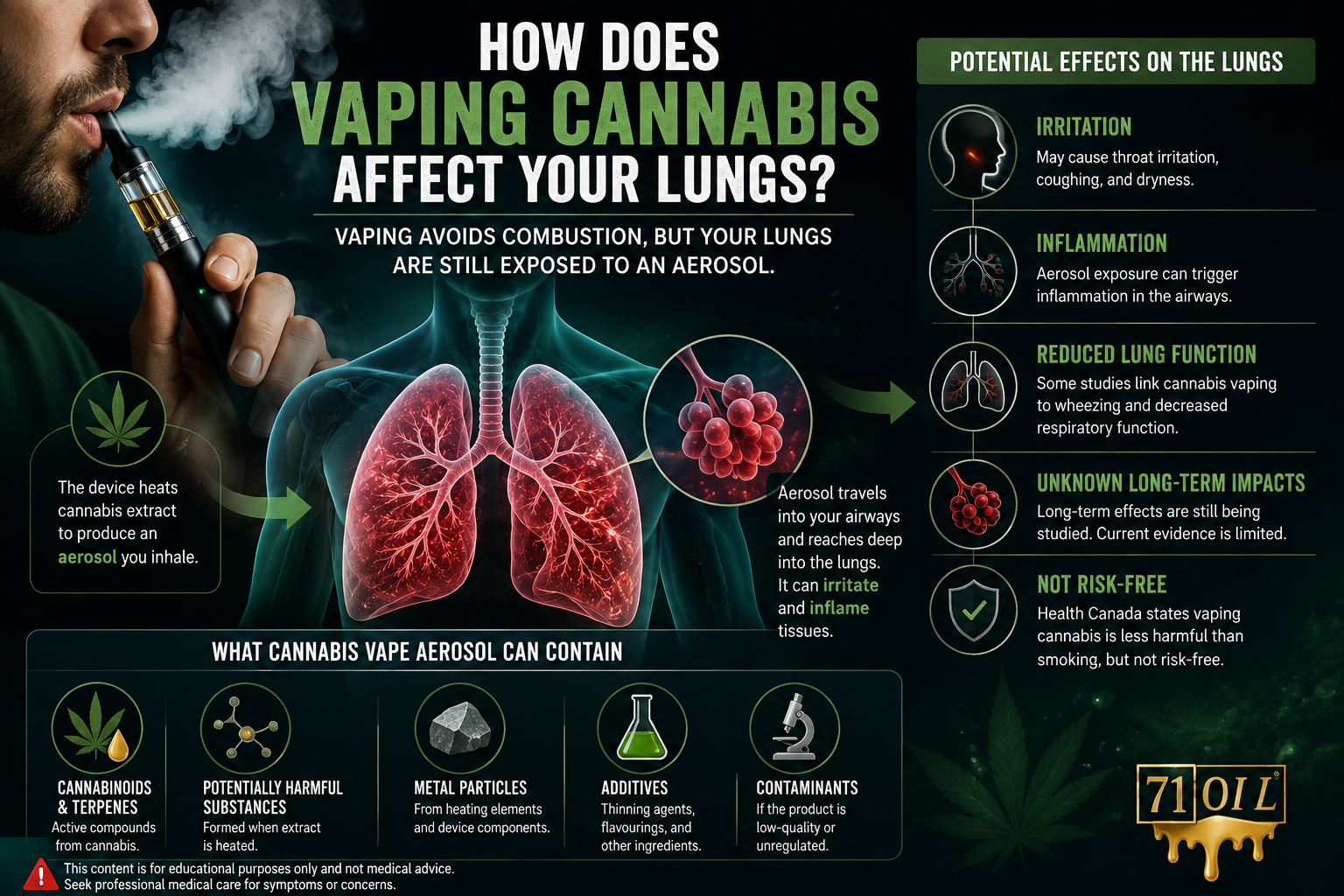
Cannabis vaping lung effects depend on several factors, including the product formulation, device hardware, heating temperature, and frequency of use. Although vaping avoids combustion, it still exposes the airways and lungs to an aerosol that may contain cannabinoids, terpenes, fine particles, heat-related chemicals, metals, or contaminants.
Research has associated cannabis vaping with symptoms such as wheezing and nighttime cough, and serious vaping-associated lung illness has occurred. Long-term cannabis-specific evidence remains limited, so vaping should not be described as safe or risk-free.
Cannabis vaping does not involve the same combustion process as smoking. However, avoiding smoke does not remove all lung exposure. The exact aerosol can change with the product formulation, cartridge materials, device temperature, hardware condition, and pattern of use.
| Medical information notice
This article provides general educational information and is not medical advice. Seek professional medical care for symptoms or concerns related to cannabis vaping. |
Key Takeaways
- Cannabis vape aerosol is not harmless water vapor.
- The aerosol can contain cannabinoids and terpenes, as well as heat-related by-products, metals, or contaminants.
- Coughing, throat irritation, wheezing, chest symptoms, and shortness of breath can occur, but a symptom alone cannot identify its cause or severity.
- VALI and EVALI describe serious acute lung illness associated with vaping and require medical evaluation.
- Long-term cannabis-specific outcomes remain uncertain. Health Canada describes vaping cannabis as less harmful to the lungs than smoking it, but not risk-free.
In This Guide
- What happens when cannabis vape aerosol enters the lungs?
- What can cannabis vape aerosol contain?
- Can cannabis vaping cause coughing, wheezing, or shortness of breath?
- What are VALI and EVALI?
- Can cannabis vaping cause permanent or long-term lung damage?
- Is vaping cannabis less harmful to the lungs than smoking it?
- What factors may change lung exposure?
- When should you seek medical help after cannabis vaping?
- How can adults reduce avoidable cannabis-vaping risks?
- Frequently asked questions
What Happens When Cannabis Vape Aerosol Enters the Lungs?
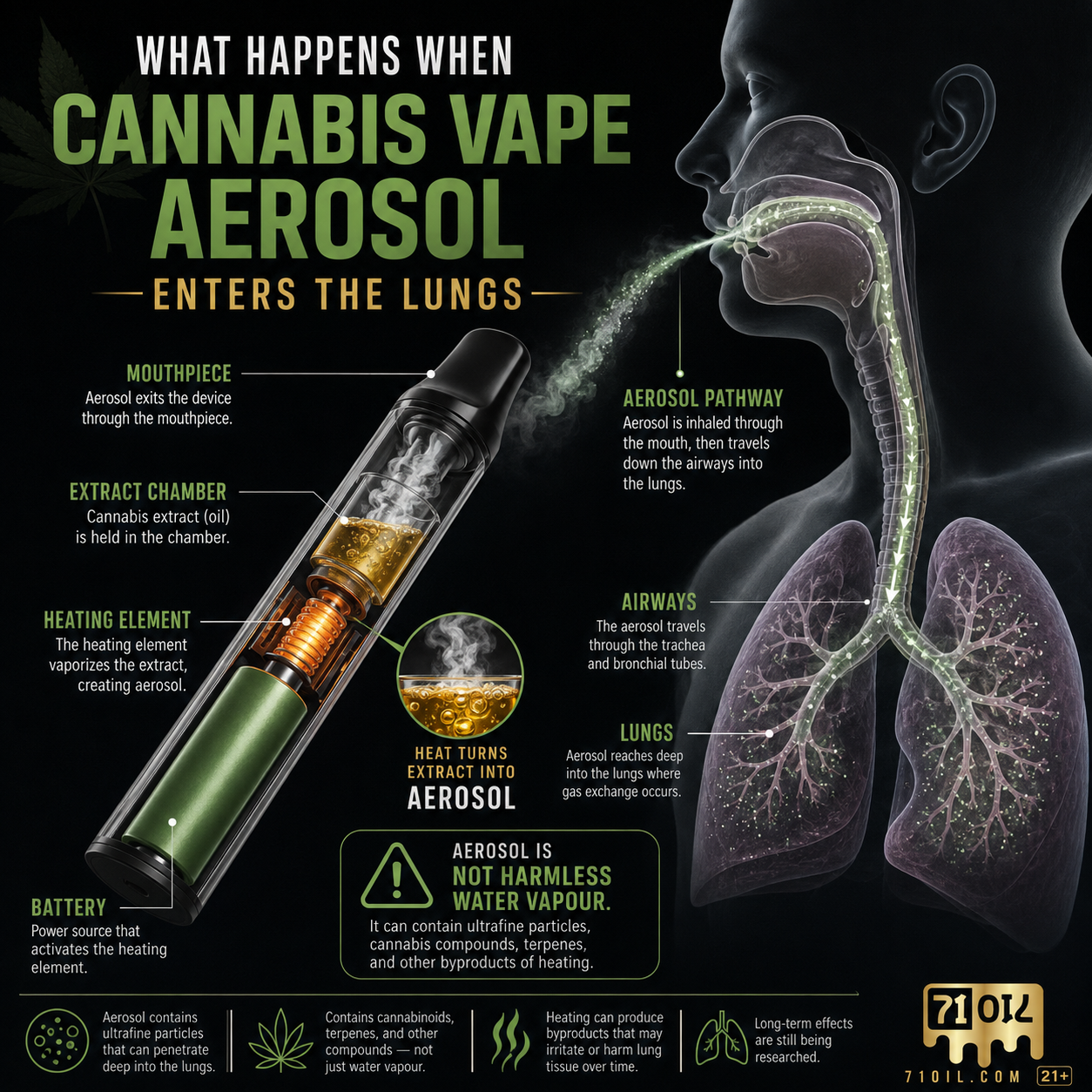
A cannabis vape device uses a battery-powered heating element to warm a liquid or solid cannabis extract. This process creates an aerosol that moves through the mouthpiece and into the airways when inhaled.
Health Canada explains that cannabis vape aerosol can contain harmful substances and that its composition can vary with the device, heating temperature, ingredients, product quality, and pattern of use. See Health Canada’s current vaping-risk guidance for the official Canadian overview.
Aerosol differs from smoke because the product is heated rather than burned. It is also different from clean steam or water vapour. The aerosol carries cannabis compounds and other substances into the respiratory system.
Cannabis vape aerosol may irritate the airways and can be followed by coughing or throat or mouth irritation. Responses differ between people and products, and a symptom cannot identify the substance that caused it.
What Can Cannabis Vape Aerosol Contain?
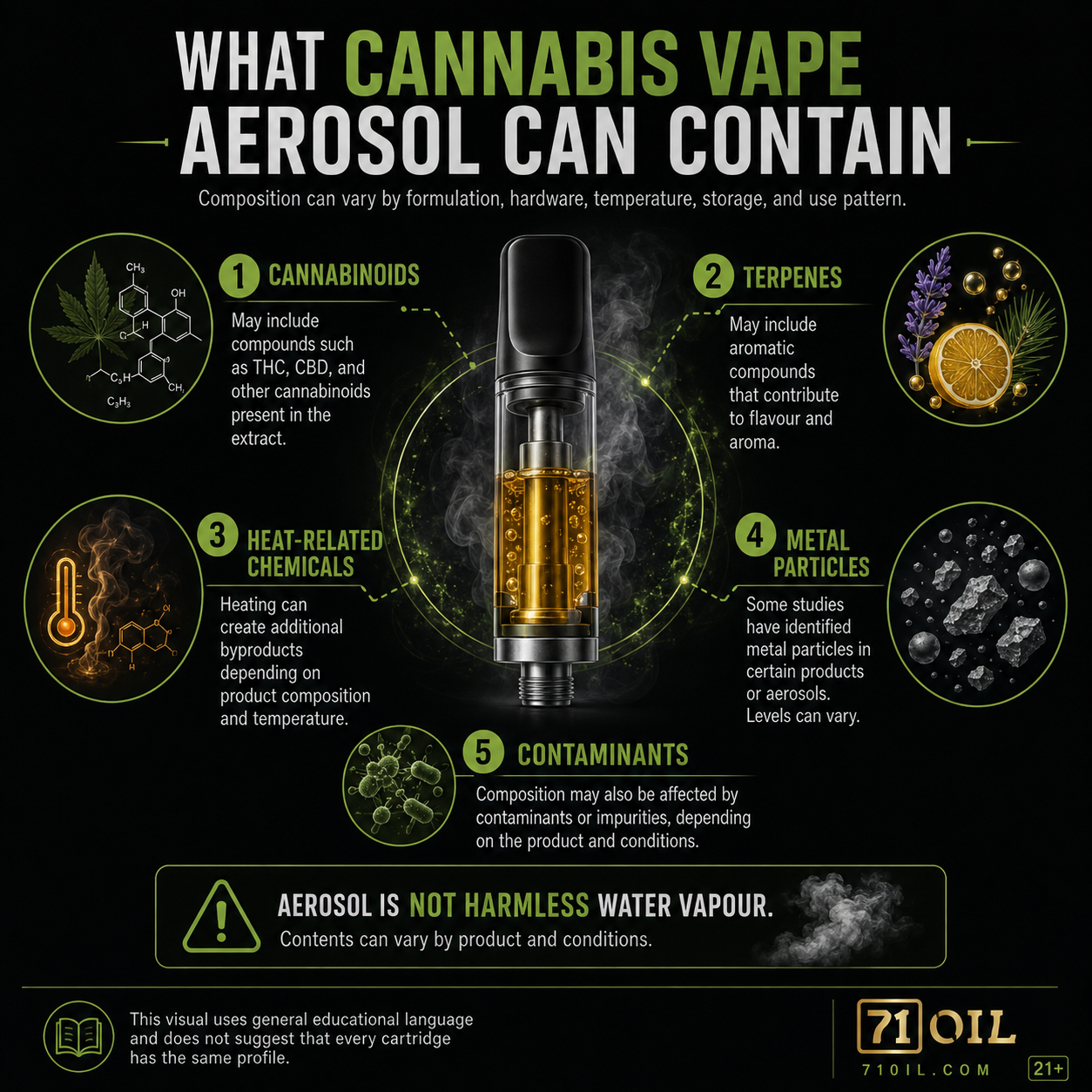
Cannabis vape aerosol normally carries compounds from the heated extract, including cannabinoids such as THC or CBD and aromatic compounds such as terpenes. It may also contain substances formed or released during heating.
Health Canada lists harmful substances such as benzene and styrene among the chemicals that may be present in cannabis-vaping aerosol.
The agency also notes that metals can leach from cannabis-vaping devices into the liquid and aerosol. The amount and composition can vary considerably between products and conditions. Read the federal guidance on cannabis-vaping risks.
A 2025 Canadian laboratory study examined a limited group of legal cannabis-vaping products and detected metal-containing particles in liquids and emitted aerosols. Some detected particles were consistent with cartridge components.
This finding identifies a hardware-related exposure concern in the tested samples; it does not prove that every cartridge releases the same metals or amounts. Review the Scientific Reports study.
| Evidence boundary
There is no universal chemical list for every cannabis vape cartridge. Product formulation, manufacturing controls, hardware, temperature, storage, damage, and use pattern can change the aerosol. |
Can Cannabis Vaping Cause Coughing, Wheezing, or Shortness of Breath?
Cannabis vaping may be followed by coughing, throat or mouth irritation, wheezing, chest discomfort, or shortness of breath. These symptoms range from mild and temporary irritation to signs that need prompt medical assessment.
Health Canada lists coughing and throat or mouth irritation among possible short-term effects associated with vaping.
A cough, wheeze, chest discomfort, or shortness of breath cannot diagnose lung injury on its own. Review the warning signs after cannabis vaping and when symptoms should be assessed.
Because much general vaping research includes nicotine products, these findings should not automatically be treated as cannabis-specific. See the Health Canada vaping-risk page.
Cannabis-specific observational evidence also raises concern. In a U.S. adult study using 33,606 survey participants, marijuana vaping was associated with wheezing, wheezing during exercise, and nighttime dry cough.
The study was cross-sectional, so it could identify an association but could not prove that cannabis vaping directly caused each symptom. Read the PubMed record.
A cough after vaping may reflect irritation, but it does not prove permanent lung damage or rule out a serious problem.
Respiratory symptoms can also result from infections, asthma, allergies, smoke exposure, heart conditions, or other causes. Seek professional evaluation when symptoms persist, worsen, or become severe.
What Are VALI and EVALI?
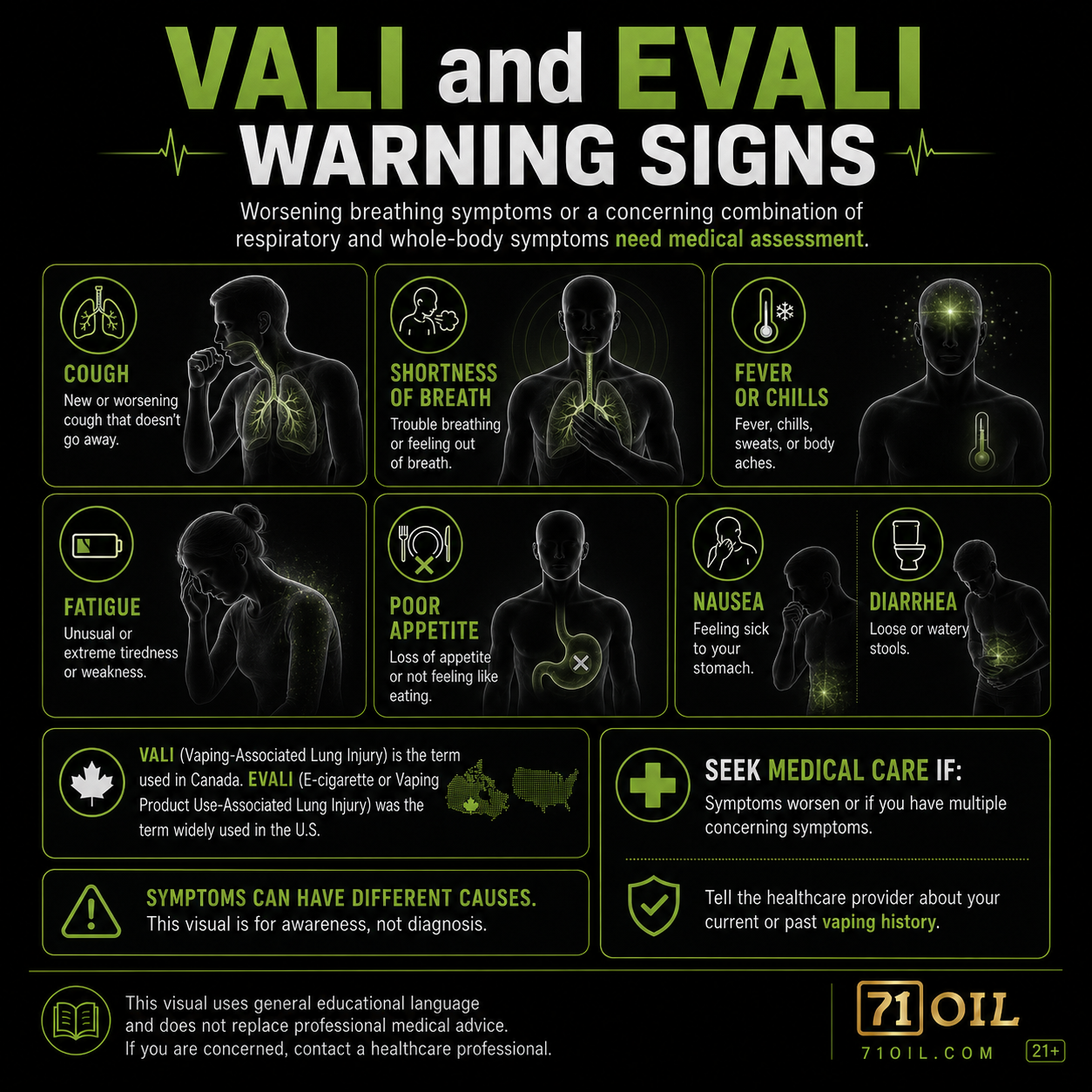
VALI means vaping-associated lung illness, the term commonly used in Canadian public-health guidance. EVALI means e-cigarette or vaping product use-associated lung injury, the term used widely in U.S. clinical and research reporting.
VALI can involve respiratory and whole-body symptoms, including cough, shortness of breath, fever, chills, fatigue, poor appetite, nausea, and diarrhea.
A diagnosis requires clinical assessment and the exclusion of other possible causes. Read the Public Health Agency of Canada’s VALI guidance.
The large U.S. EVALI outbreak in 2019 and 2020 was strongly linked to vitamin E acetate in many THC-containing products, particularly products obtained from informal sources.
This history does not mean that every modern cannabis vape contains vitamin E acetate or that one substance explained every case.
In one New England Journal of Medicine investigation, vitamin E acetate was detected in lung-fluid samples from 48 of 51 EVALI patients and was not detected in the healthy comparison group.
The study supported a strong association, while investigators still acknowledged that other contributors could not be excluded. Review the NEJM study.
Canadian surveillance did not identify vitamin E acetate in Canadian VALI cases, and Canadian authorities did not establish one specific cause for all cases. That difference is important when describing the outbreak and current risk.
For a deeper look at the outbreak history, vitamin E acetate evidence, and Canadian context, see our full guide to EVALI and VALI.
Can Cannabis Vaping Cause Permanent or Long-Term Lung Damage?
Long-term outcomes from cannabis-specific vaping are not yet well established. Vaping products, cartridge materials, formulations, and patterns of use have changed quickly, while long-term studies require many years of consistent follow-up.
Current evidence is enough to reject claims that cannabis vaping is harmless. It is not enough to promise that every user will develop permanent damage or that lungs will fully recover within a specific number of days, months, or years after stopping.
A healthcare professional can assess symptoms and individual risk factors. They may recommend testing or follow-up based on the person’s history and clinical findings.
Is Vaping Cannabis Less Harmful to the Lungs Than Smoking It?
Health Canada states that cannabis vaping is less harmful to the lungs than smoking cannabis, while also stating that vaping has its own risks. The distinction is about relative lung exposure, not a declaration that vaping is safe. See Health Canada’s inhalation-accessory guidance.
Smoking burns cannabis and produces smoke and combustion products. Vaping avoids combustion but produces an aerosol that can contain harmful chemicals, metals, or contaminants. Both methods expose the lungs to inhaled material.
Non-inhaled cannabis formats avoid direct smoke or aerosol exposure to the lungs. However, they have different onset, dosing, duration, impairment, and accidental-ingestion concerns. No consumption method should be reduced to a one-word label such as “healthy.”
| Format | What reaches the lungs | Important limitation |
|---|---|---|
| Smoking cannabis | Smoke created by combustion | Avoiding vaping does not make smoke exposure risk-free. |
| Vaping cannabis | Aerosol created by heating extract | Avoiding combustion does not make aerosol harmless. |
| Non-inhaled formats | No direct smoke or aerosol exposure | Different dosing, onset, impairment, and ingestion risks remain. |
What Factors May Change Lung Exposure?
There is no single exposure profile for all cannabis-vaping products. Several factors may change what enters the aerosol and how much reaches the lungs.
- Product source and manufacturing controls. Products from illegal or unregulated sources may not follow Canadian production, testing, packaging, or labelling requirements.
- Extract composition. Cannabinoids, terpene blends, flavouring ingredients, thinning agents, additives, or contaminants can vary between formulations.
- Cartridge and heating-element materials. Metals, solder, seals, ceramics, and other components may affect what is released under certain conditions.
- Power and temperature. Device settings, cartridge resistance, repeated overheating, and poor hardware compatibility can change heating conditions.
- Storage and physical condition. Heat, age, leaking, corrosion, or damage may affect the liquid and hardware.
- Frequency and inhalation pattern. More frequent use or deeper inhalation can increase total exposure, even when the exact dose per puff is unknown. Respiratory exposure is only one part of frequent use. Read what daily cannabis vaping can mean for health when THC exposure, tolerance, dependence, and impairment are also considered.
- Modification or refilling. Adding substances or using a product outside its intended format can introduce untested risks.
Before pairing a cartridge and battery, confirm the connection, voltage guidance, cartridge clearance, charging method, and manufacturer instructions.
The 71 Oil guide to 510-thread battery compatibility explains the relationship between cartridges and separate power hardware.
| Internal-link check
The 510-thread battery guide URL was verified on 4 August 2026. Keep product-format links neutral and do not place commercial prompts beside urgent symptom guidance. |
When Should You Seek Medical Help After Cannabis Vaping?
Seek medical care when breathing symptoms are new, persistent, worsening, or severe. Do not wait for a symptom to match an online checklist exactly.
The Public Health Agency of Canada advises people who currently vape or have vaped and develop listed symptoms, or feel generally unwell, to see a healthcare provider or visit an emergency department.
Tell the provider about current or past vaping and, when known, the type of product or substance used. Review the Canadian VALI guidance.
- Increasing shortness of breath or difficulty breathing
- Chest pain or tightness
- A persistent or worsening cough
- Fever, chills, or severe fatigue
- Poor appetite, nausea, vomiting, or diarrhea occurring with respiratory symptoms
- Any symptom that feels severe or rapidly worsens
Call emergency services for severe breathing difficulty or another immediate medical emergency. Tell the healthcare provider about current or past vaping and, when known, the type of product or substance used.
How Can Adults Reduce Avoidable Cannabis-Vaping Risks?
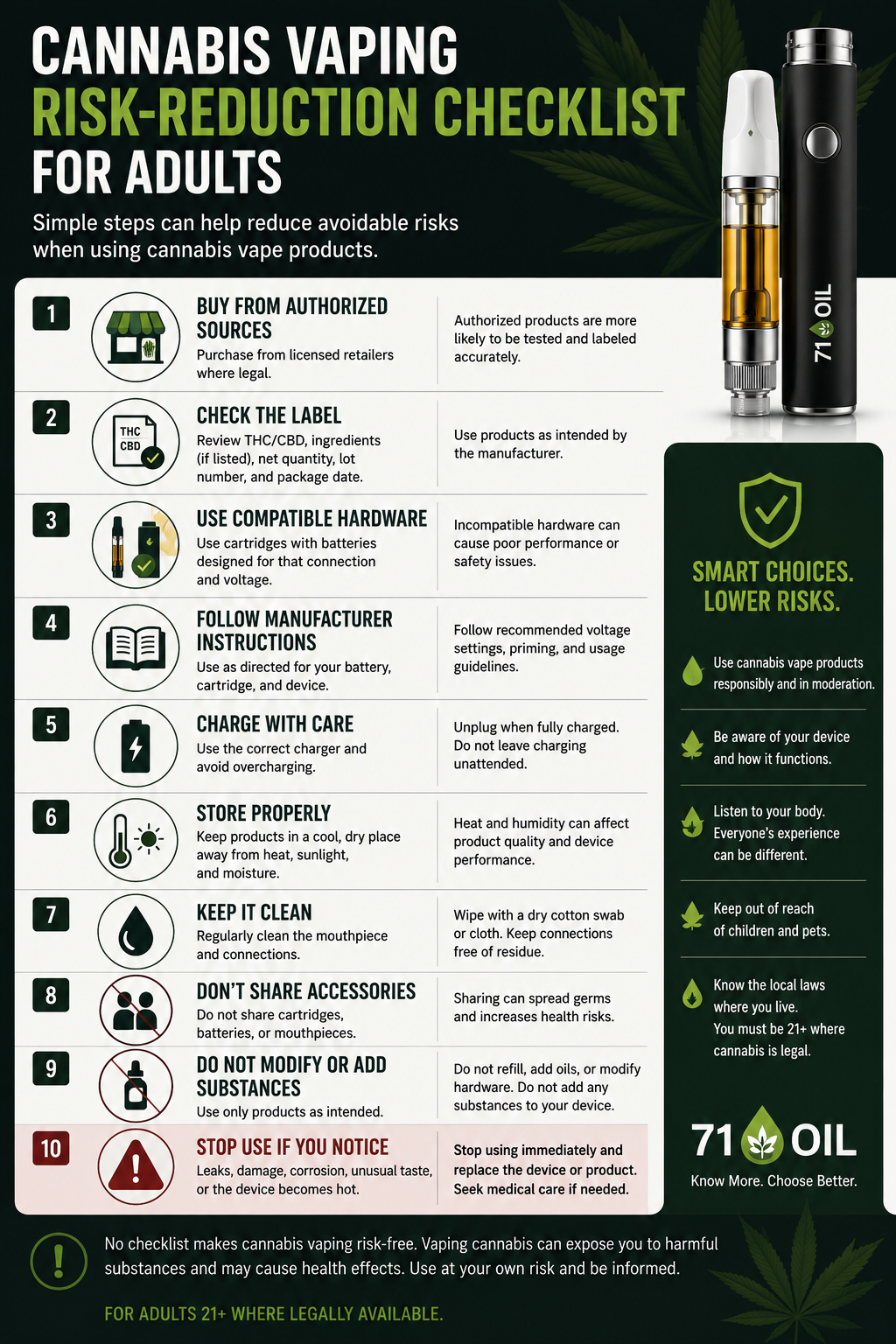
Not vaping cannabis avoids cannabis-vaping exposure to the lungs. Adults who choose to vape can still take practical steps to avoid some additional risks, although no checklist can make vaping risk-free.
- Purchase cannabis products through retailers authorized by the applicable province or territory, and avoid illegal or informal-source vape products.
- Do not modify, refill, or add substances to a cartridge or disposable device unless the manufacturer explicitly designed and instructed the product for that use.
- Use only an extract formulated for the selected inhalation device. Never place an ingestible cannabis oil or tincture into vape hardware.
- Follow the cartridge, battery, and charger instructions. Do not assume that every 510-thread product is an ideal electrical or physical match.
- Stop using damaged, leaking, corroded, or repeatedly overheating hardware.
- Avoid overcharging rechargeable accessories and replace malfunctioning equipment.
- Clean reusable mouthpieces and accessories according to the manufacturer’s directions, and avoid sharing mouthpieces.
- Store cannabis products and batteries away from children, pets, heat, and direct sunlight.
- Stop using the product and seek medical advice when respiratory symptoms appear or worsen.
Health Canada provides detailed recommendations on device components, battery charging, cleaning, sharing, authorized sources, and manufacturer instructions in its guide to cannabis accessories for inhalation.
Frequently Asked Questions
Can cannabis vaping make you cough?
Yes. Coughing and throat or mouth irritation can occur after vaping. Observational research has also associated marijuana vaping with wheezing and nighttime dry cough. Persistent, worsening, or severe symptoms need medical assessment.
Is cannabis vape aerosol harmful to the lungs?
Cannabis vape aerosol may contain heat-related chemicals, metals from device components, or contaminants. Its composition varies by formulation, device, temperature, hardware condition, and use pattern, so it should not be described as harmless water vapour.
Can your lungs recover after you stop vaping cannabis?
Recovery depends on the problem, its severity, the person’s health, and other exposures. Research does not support one universal timeline. A healthcare professional can assess persistent symptoms and determine whether testing or follow-up is needed.
Is vaping cannabis better for the lungs than smoking it?
Health Canada states that cannabis vaping is less harmful to the lungs than smoking cannabis because it avoids combustion. However, vaping creates its own aerosol exposures and is not risk-free. “Less harmful” is a relative comparison, not a safety guarantee.
What symptoms may indicate vaping-associated lung illness?
Possible VALI symptoms include cough, shortness of breath, fever, chills, fatigue, poor appetite, nausea, and diarrhea. These symptoms also occur with other illnesses, so diagnosis requires clinical evaluation. Seek prompt care when breathing symptoms worsen.
Can cannabis vape hardware release metals?
Metal transfer is possible. Health Canada notes that metals can leach from devices into cannabis-vaping liquid and aerosol. A 2025 Canadian laboratory study detected metal-containing particles in tested legal products, but limited samples cannot represent every cartridge.
What Adults Should Remember About Cannabis Vaping and Lung Health
Vaping cannabis avoids combustion, but it still exposes the lungs to an aerosol that may contain harmful substances. Respiratory symptoms have been associated with cannabis vaping, serious acute lung illness has occurred, and long-term cannabis-specific evidence remains incomplete.
Cannabis vaping is not risk-free. Product source, formulation, hardware, temperature, and use pattern can affect exposure, while persistent or worsening breathing symptoms need medical attention.
For a wider review of respiratory exposure, THC potency, impairment, dependence, product-source concerns, and device risks, read the 71 Oil guide to the main health risks of vaping cannabis.
Adults comparing product formats can review the neutral specifications in the 510 cartridges category and disposable vape pens category after reviewing the relevant health guidance and manufacturer instructions.
| Adult-use notice
Cannabis products are intended only for adults of legal age where available. Do not drive or operate machinery after using cannabis. Store cannabis securely away from children and pets. |
Resources Used
- Health Canada. Risks of vaping. — Canadian guidance on vaping aerosol, harmful substances, metals, short-term effects, exposure variability, and evidence limits.
- Health Canada. Cannabis accessories for inhalation: Minimizing your risk when smoking, vaping and dabbing. — Canadian guidance on cannabis-vaping definitions, relative lung risk, device components, charging, cleaning, sharing, and manufacturer instructions.
- Public Health Agency of Canada. Vaping-associated lung illness. — Canadian VALI terminology, symptoms, medical-care guidance, informal-source warning, and vitamin E acetate context.
- Xie, Z., & Li, D. Cross-sectional association between lifetime use of electronic cigarettes with or without marijuana and respiratory symptoms in U.S. adults. — Cross-sectional adult evidence on wheeze, exercise-related wheeze, and nighttime dry cough; it supports association, not causation.
- Gajdosechova, Z., et al. Tracking metal presence in cannabis vaping products from source to inhalation. — 2025 Canadian laboratory study of metal particles in tested cannabis-vape liquids, aerosols, and cartridge components; presented as sample-level evidence.
- Blount, B. C., et al. Vitamin E acetate in bronchoalveolar-lavage fluid associated with EVALI. — Primary EVALI investigation reporting vitamin E acetate in 48 of 51 patient lung-fluid samples and none of the healthy comparator samples.
0 Responses