

What Is EVALI (VALI)? Vaping-Associated Lung Injury Explained
EVALI is a serious lung injury associated with e-cigarette or vaping product use. In Canada, public-health authorities generally use the term VALI, or vaping-associated lung illness. VALI can involve coughing, shortness of breath and other symptoms, and severe cases may require hospitalization or respiratory support. Public Health Agency of Canada
The best-known outbreak occurred in the United States in 2019. Investigators found a strong association between many EVALI cases, THC-containing vaping products from informal sources and vitamin E acetate. Canada experienced a much smaller VALI outbreak with different product-use patterns, and Canadian investigators did not identify one common cause. CDC outbreak evidence
| Medical information notice
This article provides general educational information and is not medical advice. Symptoms after vaping can have many causes and cannot confirm VALI or EVALI. Seek professional medical care for concerning respiratory symptoms or if you feel seriously unwell. |
In This Guide
- What Is the Difference Between EVALI and VALI?
- What Symptoms Have Been Reported With VALI or EVALI?
- How Is VALI or EVALI Identified?
- What Happened During the 2019 EVALI Outbreak?
- What Role Did Vitamin E Acetate Play?
- Was the Canadian VALI Outbreak the Same as the U.S. EVALI Outbreak?
- Does EVALI Only Involve Cannabis or THC Vapes?
- What Does the Evidence Mean for Cannabis Vaping in Canada Today?
- How Does Product Regulation Affect EVALI Risk Context?
- Can You Tell Whether a Vape Product Will Cause EVALI?
- When Should Someone Seek Medical Care After Vaping?
- What Should You Tell a Healthcare Provider?
- What Should Canadian Adults Take Away From the EVALI Evidence?
- Frequently Asked Questions
- Resources Used
What Is the Difference Between EVALI and VALI?
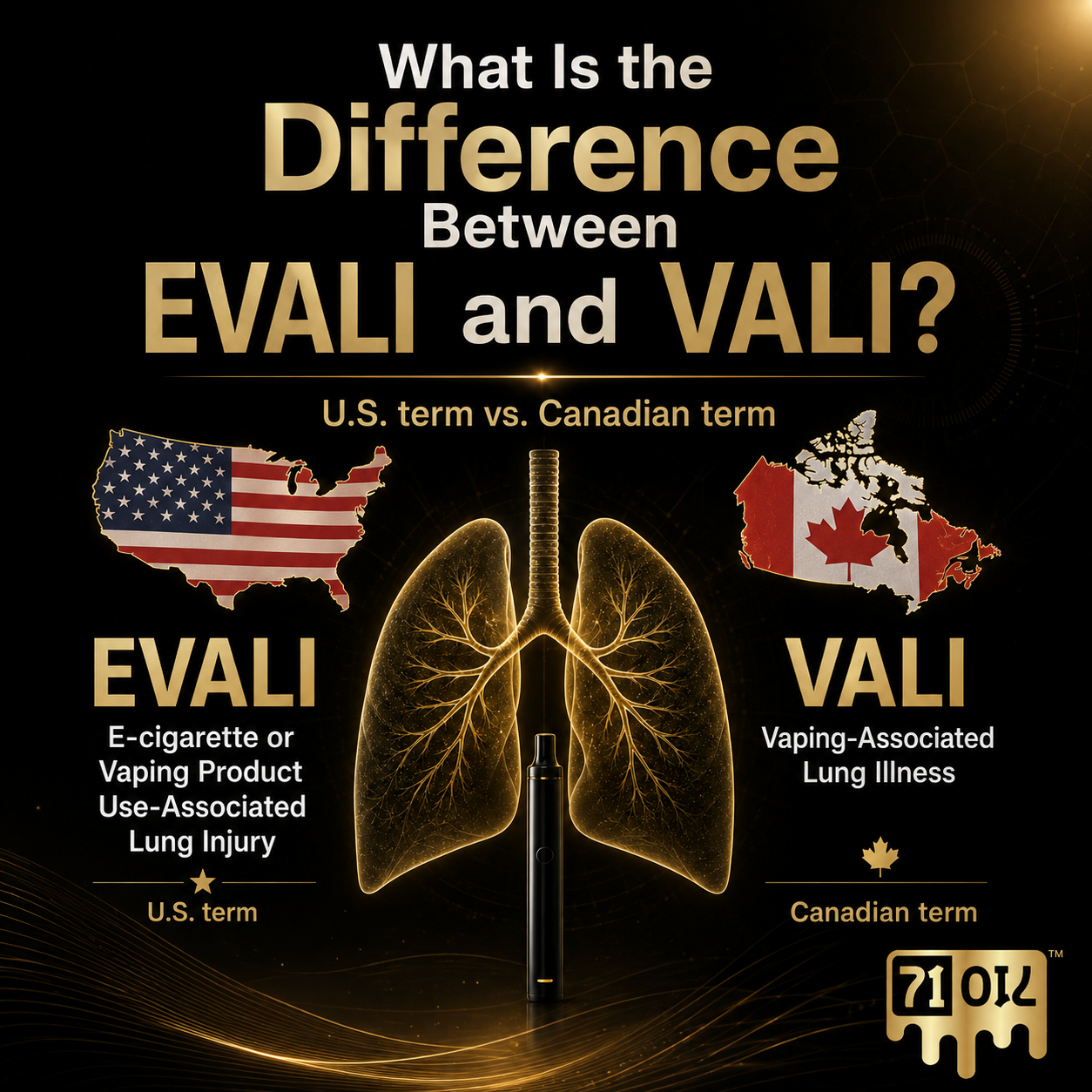
EVALI stands for e-cigarette, or vaping, product use-associated lung injury. The term became widely used during the U.S. lung-injury outbreak that began in 2019. CDC
Canadian public-health authorities generally use VALI, meaning vaping-associated lung illness. The Public Health Agency of Canada describes VALI as an acute respiratory illness involving lung damage following the use of certain vaping products. PHAC VALI guidance
The terminology differs, but EVALI and VALI address closely related respiratory illnesses associated with vaping.
Canada began investigating VALI after U.S. health authorities identified the EVALI outbreak. A national Canadian case definition was developed so public-health authorities could classify and report possible cases using consistent criteria. Canadian VALI descriptive analysis
For Canadian readers, VALI is therefore the term most commonly used in federal public-health guidance, while EVALI appears more often in U.S. research and outbreak reporting.
What Symptoms Have Been Reported With VALI or EVALI?
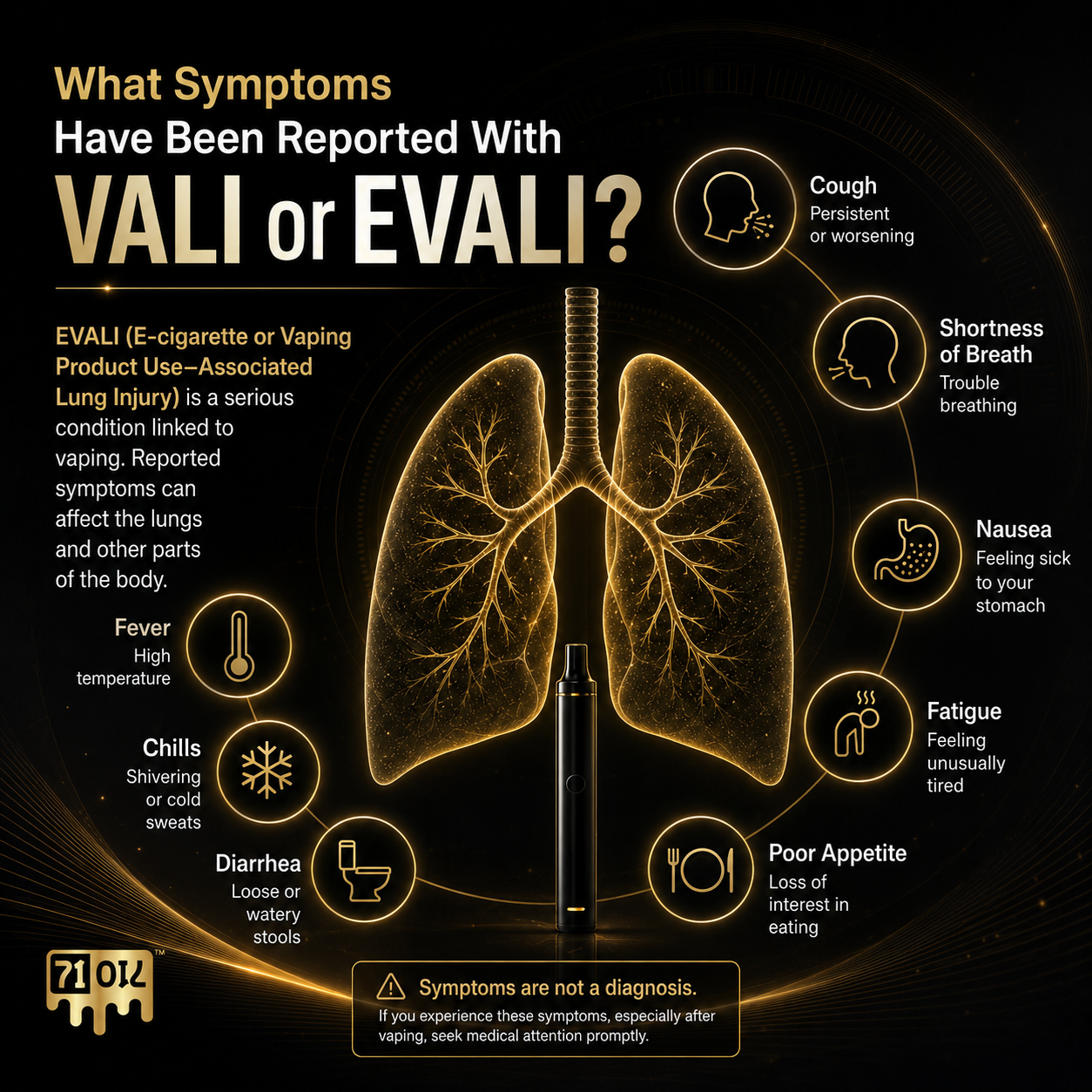
VALI can involve both respiratory and non-respiratory symptoms.
The Public Health Agency of Canada lists cough and shortness of breath among the main respiratory symptoms. Other reported symptoms include: PHAC guidance
- nausea
- diarrhoea
- chills
- fatigue
- fever
- poor appetite
During Canada’s outbreak investigation, all 20 reported patients experienced respiratory symptoms. Fifteen also experienced a combination of respiratory, gastrointestinal, constitutional or other symptoms. Canadian case analysis
However, these symptoms are not specific to VALI. Coughing, fever, nausea, fatigue or shortness of breath can occur with many different illnesses. A symptom list cannot determine whether someone has VALI or EVALI.
For a more detailed discussion of symptoms and when they deserve medical attention, see Early Warning Signs of Lung Problems After Vaping Cannabis.
How Is VALI or EVALI Identified?
VALI/EVALI cannot be confirmed from symptoms alone or through a home test.
During Canada’s outbreak investigation, the case definition considered factors such as a recent history of vaping or dabbing, evidence of abnormalities in the lungs, evaluation for respiratory infection and whether another plausible medical explanation was present. Canadian case definition and analysis
That distinction matters because respiratory infections and other health conditions can cause symptoms similar to those associated with VALI.
A history of vaping is therefore useful information, but it is only one part of a medical assessment. PHAC advises healthcare professionals to ask about current and past vaping when evaluating patients with respiratory complaints. PHAC guidance
| Key point
VALI or EVALI requires professional medical evaluation. Someone should not try to diagnose or rule out the condition based on a symptom checklist, how a cartridge looks, or how they feel immediately after vaping. |
What Happened During the 2019 EVALI Outbreak?
A large outbreak of severe lung injury associated with vaping emerged in the United States in 2019.
Cases increased rapidly during the summer and peaked around September. Most patients reported using THC-containing vaping products, and products obtained from informal sources such as friends, family members or unregulated dealers were a major focus of the investigation. CDC outbreak update
By February 2020, U.S. authorities had reported 2,807 hospitalized EVALI cases or deaths and 68 confirmed deaths. CDC outbreak evidence
Investigators examined product histories, vaping products and biological samples to understand what might be contributing to the outbreak. One finding became especially important: vitamin E acetate.
The evidence strongly connected vitamin E acetate with the U.S. outbreak, particularly in THC-containing products associated with informal sources. However, investigators did not establish one substance as the explanation for every individual case. CDC
The evidence does not support reducing the entire outbreak to the statement that “THC vaping causes EVALI.”
What Role Did Vitamin E Acetate Play?
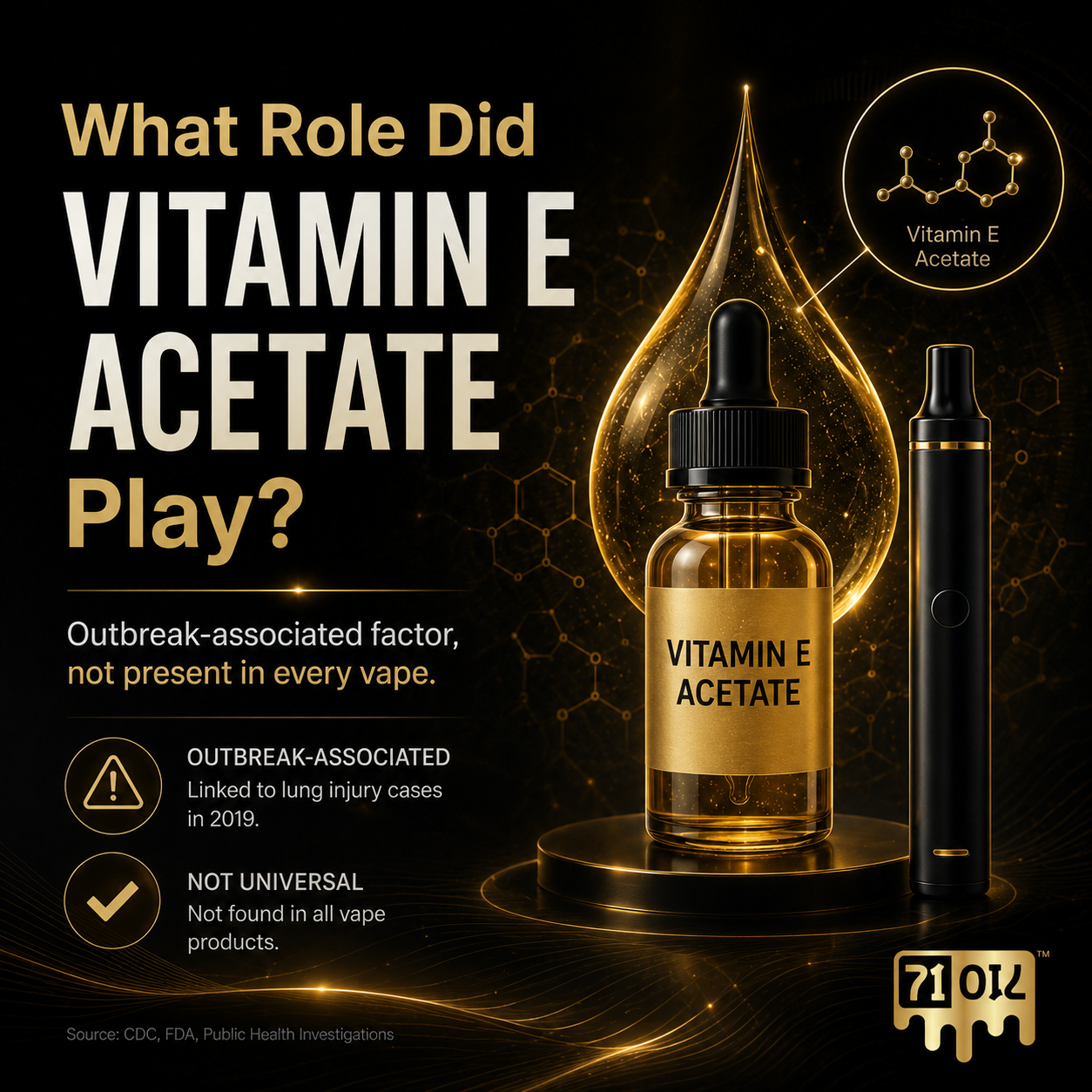
Vitamin E acetate was strongly associated with the 2019 U.S. EVALI outbreak and became one of its most significant findings.
A study published in the New England Journal of Medicine examined bronchoalveolar-lavage fluid collected from 51 EVALI patients in 16 U.S. states and compared it with samples from 99 healthy participants. Researchers detected vitamin E acetate in 48 of 51 EVALI patients, or 94%, and in none of the 99 healthy comparison participants. Read the primary study
THC exposure was also common. Among patients with relevant laboratory or use-history information, 47 of 50 either had evidence of THC exposure or reported vaping THC-containing products during the 90 days before illness. NEJM study
These findings provided strong evidence connecting vitamin E acetate with the outbreak.
However, researchers did not establish vitamin E acetate as the explanation for every EVALI case. It was absent from samples from three patients in the study, and the study itself had limitations, including its convenience sample and cross-sectional design. Study limitations
CDC reached a similarly careful conclusion: vitamin E acetate was strongly linked to the EVALI outbreak, but available evidence could not completely rule out the contribution of other chemicals in some cases. CDC
Was the Canadian VALI Outbreak the Same as the U.S. EVALI Outbreak?
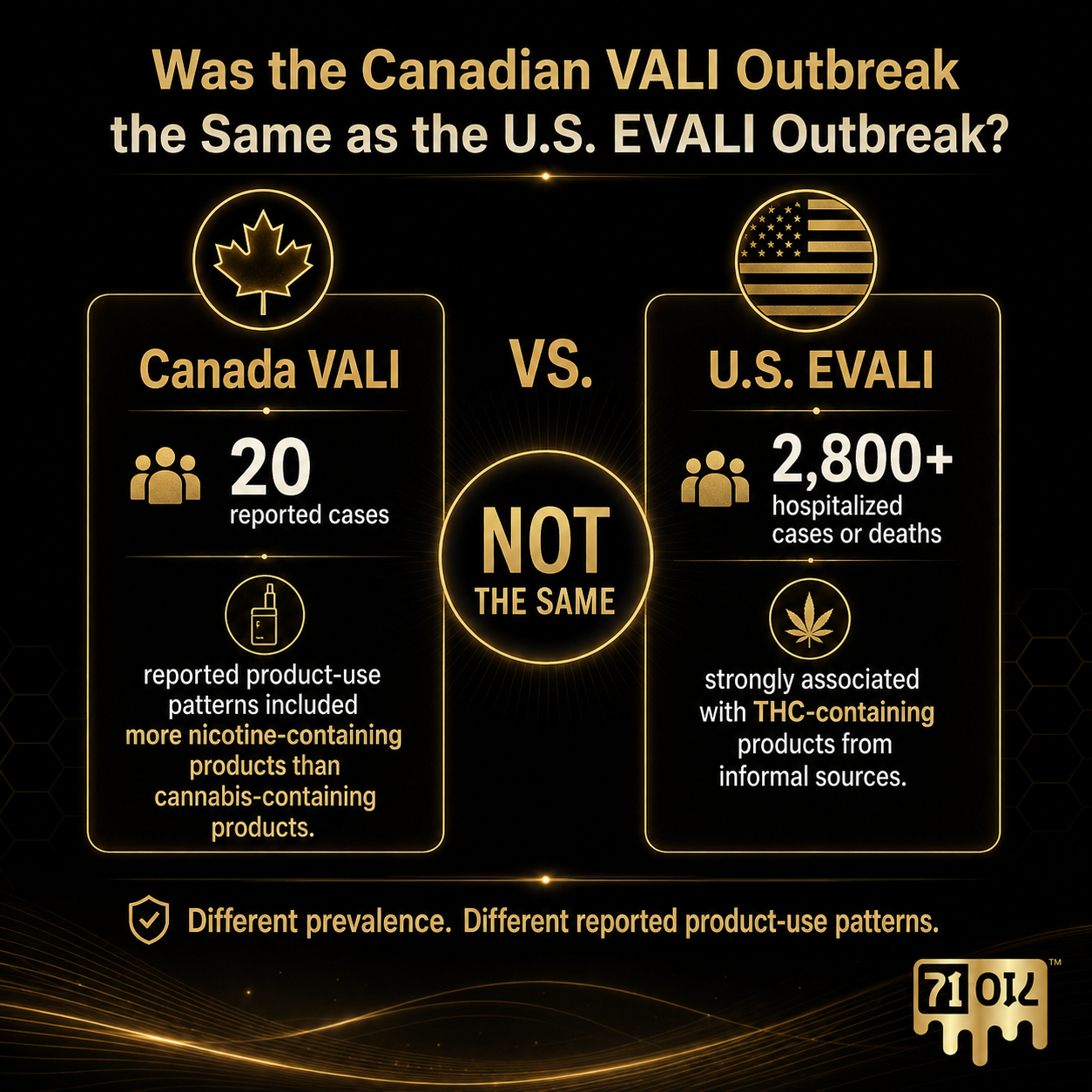
No. There were important differences.
Canada ultimately reported 20 VALI cases, including eight confirmed and 12 probable cases. Sixteen patients were hospitalized, and no deaths were reported. The Canadian outbreak investigation was later closed after the outbreak appeared to be over. PHAC final outbreak notice
Product-use patterns also differed. Among the 20 Canadian cases:
- 75% reported vaping nicotine-containing products
- 40% reported vaping or dabbing cannabis-containing products
- among the 14 patients with frequency information, 71% reported daily vaping
Canada also experienced far fewer reported cases relative to its population. PHAC later corrected the Canadian estimate to 0.63 cases per million, compared with approximately 8.5 EVALI cases per million in the United States during the periods studied. PHAC corrigendum
Canadian laboratory investigations also did not identify a single substance that explained the reported cases. PHAC’s current VALI guidance states that vitamin E acetate has not been identified in Canadian VALI cases. PHAC guidance
The U.S. and Canadian outbreaks should therefore not be treated as identical.
Does EVALI Only Involve Cannabis or THC Vapes?
No.
THC-containing vaping products played a major role in the U.S. outbreak. Informally sourced THC products were particularly prominent, and vitamin E acetate was strongly linked to those products. CDC outbreak evidence
However, not every U.S. patient reported THC use. One CDC analysis found that 14% of reported EVALI patients said they had exclusively used nicotine-containing products. CDC noted several possible explanations, including incomplete knowledge of product contents, inaccurate self-reporting, case misclassification or genuine nicotine-only exposure. CDC
Canada had a different pattern. Nicotine vaping was reported by three-quarters of the Canadian VALI patients, while 40% reported cannabis vaping or dabbing. Canadian case analysis
For that reason, describing EVALI simply as a “THC vape disease” is misleading.
What Does the Evidence Mean for Cannabis Vaping in Canada Today?
The 2019 outbreak remains relevant, but it should not be presented as though the same outbreak is occurring in Canada today.
Health Canada’s annual cannabis adverse-reaction reporting currently lists surveillance reports through 2024. In the 2024 report, Health Canada recorded no domestic reports of suspected cannabis-related VALI. Health Canada 2024 report
That finding does not mean cannabis vaping is risk-free.
In the same report, Health Canada recorded adverse events involving legal cannabis products, including cough and dyspnoea, or shortness of breath, among events assessed as certainly, probably or possibly related to the suspect products. Health Canada
| Current-context interpretation
Current Canadian surveillance does not show an ongoing cannabis-related VALI outbreak comparable with the large U.S. EVALI outbreak of 2019. That does not establish that cannabis vaping is free from respiratory risk. |
How Does Product Regulation Affect EVALI Risk Context?
Product regulation changes what manufacturers can put into legal cannabis extracts and the standards those products must meet.
Under Canada’s cannabis product requirements, cannabis extracts may contain only specified types of ingredients, such as carrier substances, flavouring agents and substances necessary to maintain product quality or stability. Additional standards apply to ingredients in cannabis extracts intended for inhalation.
Health Canada’s vaping-product guidance specifically notes that vitamin E acetate is not allowed in regulated vaping products. Health Canada vaping product safety
Regulated products are therefore subject to ingredient and composition controls that do not apply in the same way to products from illegal or unknown sources.
This distinction mattered during the outbreak investigations. PHAC’s final Canadian outbreak notice states that, among product samples collected from some Canadian VALI patients, none of the samples involving cannabis came from regulated sources. PHAC final outbreak notice
That does not mean regulated cannabis vaping is harmless. Regulation addresses product composition, contaminants, ingredients and manufacturing requirements. It does not eliminate the health risks associated with inhaling cannabis vape aerosol. For broader respiratory context, read How Does Vaping Cannabis Affect Your Lungs?.
Can You Tell Whether a Vape Product Will Cause EVALI?
You cannot determine that by looking at a cartridge or disposable vape.
Oil colour, thickness, packaging, flavour, strain name, hardware design or price cannot establish that a product is free from adulterants or respiratory risk.
This is particularly important with products from unknown or illegal sources, where consumers may not know exactly what a cartridge contains. Health Canada advises people against using vaping products from illegal or unregulated sources and against modifying vaping products or adding substances that were not intended by the manufacturer. Health Canada product-safety guidance
For adults who choose to use cannabis, a regulated source provides more product oversight than an unknown or illegal source. It should not be interpreted as a guarantee of safety.
When Should Someone Seek Medical Care After Vaping?
Symptoms after vaping should not automatically be assumed to be EVALI or VALI. They also should not automatically be ignored.
The Public Health Agency of Canada advises people who currently vape – or have vaped in the past – and develop symptoms associated with VALI, or generally feel unwell, to see a healthcare provider or visit the nearest Emergency Department. PHAC guidance
PHAC’s final outbreak guidance specifically mentions symptoms such as cough, shortness of breath, chest pain and generally feeling unwell. PHAC outbreak notice
A healthcare professional may need to consider several possible explanations because respiratory infections and other medical conditions can produce similar symptoms. Do not use an online symptom list to diagnose yourself with VALI.
For more detailed guidance on recognizing symptoms, see Early Warning Signs of Lung Problems After Vaping Cannabis.
What Should You Tell a Healthcare Provider?
If you develop concerning symptoms after vaping, information about what you used may help a healthcare provider evaluate the situation. Useful information can include:
- whether you currently vape or have vaped recently
- whether you used cannabis, nicotine or another substance
- where the product came from, if known
- whether the product or device was modified
- whether anything was added to the product
- when your symptoms began
- whether the symptoms are improving, remaining the same or becoming worse
PHAC specifically advises patients to tell healthcare providers about any history of current or past vaping. PHAC guidance
Do not continue using a product simply to determine whether the symptoms happen again. Professional medical assessment – not repeated exposure – is the appropriate way to investigate concerning symptoms.
What Should Canadian Adults Take Away From the EVALI Evidence?
EVALI was a serious public-health event, but understanding what happened requires more detail than simply associating the outbreak with “vaping.”
The strongest U.S. evidence connected many 2019 cases with THC-containing vaping products from informal sources and with vitamin E acetate. A major laboratory study detected vitamin E acetate in lung-fluid samples from 94% of the EVALI patients studied and none of the healthy comparison participants. NEJM study
Canada experienced a much smaller VALI outbreak with different product-use patterns. Canadian investigators did not identify one common cause, and PHAC states that vitamin E acetate was not identified in Canadian VALI cases. PHAC guidance
More recent Canadian cannabis surveillance adds useful context. Health Canada’s 2024 annual report recorded no domestic suspected cannabis-related VALI reports for that reporting year. That finding is surveillance information – not evidence that cannabis vaping is harmless. Health Canada 2024 report
For a wider review of lung exposure, impairment, potency, dependence and product-quality concerns, continue to What Are the Main Health Risks of Vaping Cannabis? For practical risk-aware adult-use guidance, see Cannabis Vaping Tips for Responsible Adult Use.
Frequently Asked Questions
What does EVALI stand for?
EVALI stands for e-cigarette, or vaping, product use-associated lung injury. It became the standard term used in the United States during the 2019 vaping-related lung-injury outbreak. Source
Is VALI the same as EVALI?
The terms are closely related. Canadian public-health authorities generally use VALI, or vaping-associated lung illness, while U.S. authorities commonly use EVALI. Canada began its VALI investigation after identifying cases with similarities to the U.S. EVALI outbreak. Source
What are the symptoms of EVALI or VALI?
Reported symptoms include cough and shortness of breath. Nausea, diarrhoea, fever, chills, fatigue and poor appetite have also been reported. These symptoms are not unique to VALI and cannot confirm the condition without medical assessment. Source
Is EVALI caused by vitamin E acetate?
Vitamin E acetate was strongly associated with the 2019 U.S. EVALI outbreak. A major study detected it in 48 of 51 EVALI patients and none of 99 healthy comparison participants. Investigators did not establish it as the explanation for every reported case. Source
Did Canada have VALI cases?
Yes. Canada reported 20 confirmed or probable cases during the national outbreak investigation. Sixteen people were hospitalized, and no deaths were reported. Source
Was vitamin E acetate found in Canadian VALI cases?
PHAC states that vitamin E acetate has not been identified in Canadian VALI cases. Canadian investigators did not identify one specific common cause for the outbreak. Source
Are cannabis-related VALI cases still being reported in Canada?
Health Canada’s published annual cannabis adverse-reaction reporting currently runs through 2024. The 2024 report recorded no domestic suspected VALI reports involving cannabis. This does not mean cannabis vaping is risk-free or that future cases cannot occur. Source
Resources Used
- Public Health Agency of Canada – Vaping-Associated Lung Illness (VALI) – Canadian definition, symptoms, medical-care guidance, cause uncertainty, and vitamin E acetate context.
- Public Health Agency of Canada – Final VALI Outbreak Notice – Canadian outbreak totals, hospitalizations, product-source information, and status of the national outbreak investigation.
- Baker et al. / PHAC – Vaping-Associated Lung Illness in Canada – Canadian epidemiology, product-use patterns, symptoms, and comparison with U.S. EVALI.
- PHAC Corrigendum – Canadian VALI Prevalence – Corrects the Canadian prevalence estimate to 0.63 cases per million.
- Health Canada – 2024 Cannabis Adverse-Reaction Annual Report – Current Canadian cannabis adverse-reaction surveillance and 2024 VALI reporting.
- Health Canada – Cannabis Product Composition Requirements – Rules governing ingredients and composition of cannabis extracts intended for inhalation.
- Health Canada – Vaping Product Safety – Guidance on regulated and unregulated products, product modification, and vitamin E acetate.
- Blount et al. – New England Journal of Medicine – Primary study examining vitamin E acetate in bronchoalveolar-lavage samples from EVALI patients and healthy comparators.
- U.S. Centers for Disease Control and Prevention – EVALI Outbreak Evidence – Historical U.S. outbreak evidence, informal product-source findings, THC-product context, and vitamin E acetate interpretation.
| Adult-use notice
Cannabis products are intended only for adults who meet the legal age requirement in their province or territory. Cannabis use can cause impairment and carries health risks. Follow applicable laws and product information, do not drive while impaired, and keep cannabis away from children and pets. |
0 Responses