

Does Vaping Cannabis Smell? Vape Odour vs. Flower and Smoke
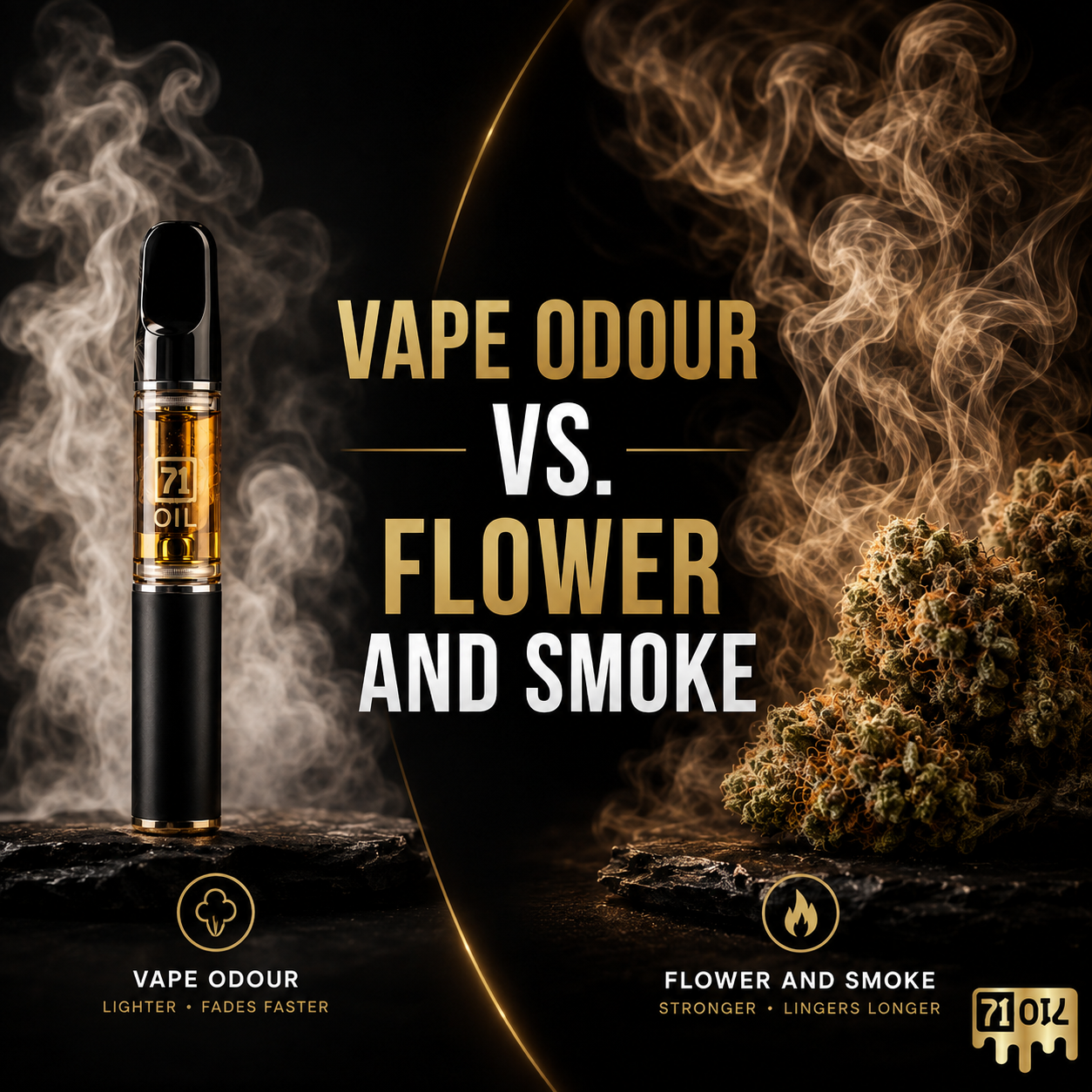
Yes. Cannabis vapes can produce a noticeable smell.
A cannabis vape heats an extract to create an aerosol rather than burning cannabis flower to create smoke. That aerosol can carry aromatic compounds from the product, so cannabis vaping should not be described as odourless. Health Canada defines vaping as inhaling an aerosol produced by heating a liquid or solid cannabis extract inside a vaping accessory.
How noticeable the aroma is depends on the product, extract profile, device, amount of aerosol produced, room size, and airflow. Compared with burning flower, the odour profile is different, but there is no reliable universal rule for exactly how strong a cannabis vape will smell or how long that smell will remain.
Quick Answer: Does Vaping Cannabis Smell?
| Quick answer Yes. Cannabis vaping can produce a noticeable aroma because heating cannabis extract creates an aerosol that can carry terpenes and other volatile compounds. The exact smell varies by product and device. Compared with burning flower, the odour profile is different, and its noticeability or persistence depends on the extract, amount used, room size, and airflow. |
In This Guide
- What does a cannabis vape smell like?
- Why does cannabis vape have an aroma?
- Cannabis vape vs. flower smoke: which smells stronger?
- Do all cannabis vapes smell the same?
- How long does cannabis vape smell last?
- Can cannabis vape smell stick to clothes, furniture, or breath?
- What makes cannabis vape odour more noticeable?
- Does lower odour mean it is fine to vape indoors?
- What should adults compare when flavour and aroma matter?
- Frequently asked questions
| Key Takeaways Cannabis vapes are not odourless. Vaping creates aerosol rather than combustion smoke. Aroma varies with the extract, strain chemistry, hardware, aerosol amount, and airflow. Terpenes matter, but research shows that minor nonterpenoid and sulfur-containing compounds can also shape cannabis aroma. Lower odour is not a safety or permission claim. |
What Does a Cannabis Vape Smell Like?
There is no single cannabis vape smell. Depending on the product, the aroma may be described as herbal, earthy, pine-like, citrus, floral, fruit-forward, spicy, fuel-like, or another strain-associated profile. Some products may be relatively subtle, while others can be more distinctive.
Aroma depends on the volatile compounds present in the cannabis material or extract. Terpenes such as myrcene, limonene, caryophyllene, and terpinolene are often discussed because they contribute to cannabis aroma. However, a 2023 ACS Omega study found that minor nonterpenoid compounds can strongly influence specific aroma differences even when major terpene profiles look similar.
That is why two products with similar dominant-terpene information can still smell different. Product descriptions and terpene lists are useful context, but they are not a complete chemical fingerprint of what someone will notice in the air.
Why Does Cannabis Vape Have an Aroma?
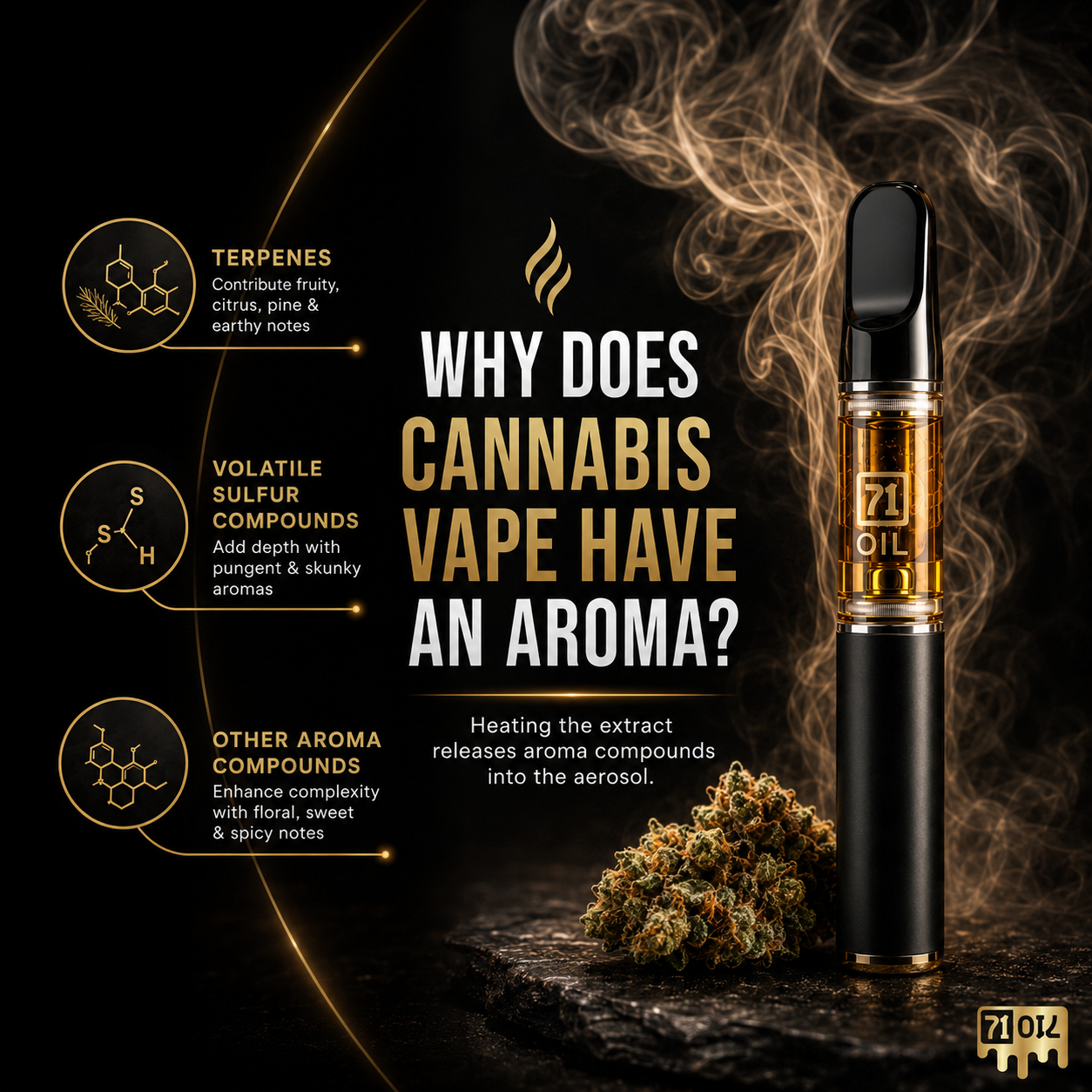
Health Canada describes cannabis vaping as heating a liquid or solid cannabis extract to produce an aerosol. During that process, volatile compounds in the product can become part of the vapour and aerosol phases and can contribute to what a person smells during and after use.
Terpenes and Other Volatile Compounds
Terpenes are an important part of cannabis flavour and aroma, but they are not the whole story. A 2021 ACS Omega study identified prenylated volatile sulfur compounds associated with the characteristic pungent or skunk-like odour of cannabis. Later work found additional minor compounds associated with distinct citrus, savoury, and chemical aromas.
The practical takeaway is simple: cannabis aroma is chemically more complex than a short terpene list. That is useful context when comparing strain descriptions, extracts, or vape products marketed around aroma and flavour.
Extract and Strain Profile
Different extracts can preserve or emphasize different parts of a cannabis profile. A highly refined formulation may present a different aroma from a terpene-rich or fuller-spectrum product, while the strain or phenotype used as starting material can also influence the finished sensory profile.
For more on one terpene-focused extract category, read 71 Oil’s What Is HTFSE? High-Terpene Full-Spectrum Extract Explained. The label HTFSE does not guarantee one exact odour intensity; the finished product still depends on its formulation, hardware, and use conditions.
For broader extract terminology, see What Are Cannabis Concentrates and Extracts?.
Cannabis Vape vs. Flower Smoke: Which Smells Stronger?
The clearest difference is the process. Smoking burns cannabis and produces smoke. Vaping heats an extract to produce an aerosol. Health Canada uses this same distinction in its cannabis inhalation guidance.
Because combustion and aerosolization create different mixtures, their smell is not identical. Flower smoke has the distinctive odour of burned plant material in addition to the plant’s volatile compounds. Vape aerosol can carry cannabis and strain-related aroma without the same combustion-smoke profile. Exact noticeability still varies by product and setting.
| Factor | Cannabis vape aerosol | Cannabis flower smoke |
|---|---|---|
| How it is produced | Cannabis extract is heated to create an aerosol. | Cannabis flower is burned to create smoke. |
| Aroma source | Volatile compounds in the extract/formulation become noticeable during heating and exhalation. | Plant volatiles mix with the odour of combustion and burned material. |
| Smell character | Can reflect strain, extract, formulation, and operating conditions. | Includes the recognizable odour of burning cannabis flower. |
| How long it lingers | Variable. Airflow, room size, product profile, and amount used matter. Avoid a fixed universal time. | Smoke odour can persist in air and on materials; persistence varies by exposure and environment. |
| What smell tells you | Odour alone does not indicate that the aerosol is harmless or that indoor use is permitted. | Odour strength is not a precise measure of exposure or risk. |
A 2019 ACS Omega laboratory study found that gas-phase products differed between cannabis vaping/dabbing and literature-sourced cannabis smoke values under the study conditions. The authors also cautioned that real-world exposure can vary with products and use patterns. That makes process comparison useful, but it should not be turned into a blanket safety claim.
Do All Cannabis Vapes Smell the Same?
No. “Cannabis vape” covers multiple product and hardware formats. Oil cartridges, integrated disposable pens, terpene-rich formulations, concentrates, and dry-herb vaporizers do not all start with the same material or operate in exactly the same way.
Oil Cartridges and Disposable Pens
Cartridges and disposable vape pens heat a prepared cannabis extract. Their aroma can therefore vary with the extract profile, formulation, hardware, operating conditions, and amount of aerosol produced. Research on cannabis vaping mixtures also shows that changes in terpene content and applied power can change the chemical composition of the emitted aerosol. RSC Advances study This does not directly measure human odour perception, but it supports the narrower point that product composition and operating conditions can change what is released.
Adults comparing current 71 Oil formats can browse 510 Cartridges or Disposable Vape Pens by strain and product format.
HTFSE and Fuller-Spectrum Extracts
Extracts positioned around preserved aromatic compounds may present more strain character than highly refined formulations. That does not mean every HTFSE or full-spectrum vape will smell stronger. The actual result depends on the volatile profile, formulation, device, and how the product is used.
What About Dry-Herb Vaporizers?
Dry-herb vaporizers should be treated separately from oil cartridges. They heat cannabis flower rather than a prepared vape oil, so the entire plant material and its volatile profile are part of the aroma context. This guide focuses primarily on cannabis oil cartridges and disposable pens rather than dry-herb devices.
How Long Does Cannabis Vape Smell Last?
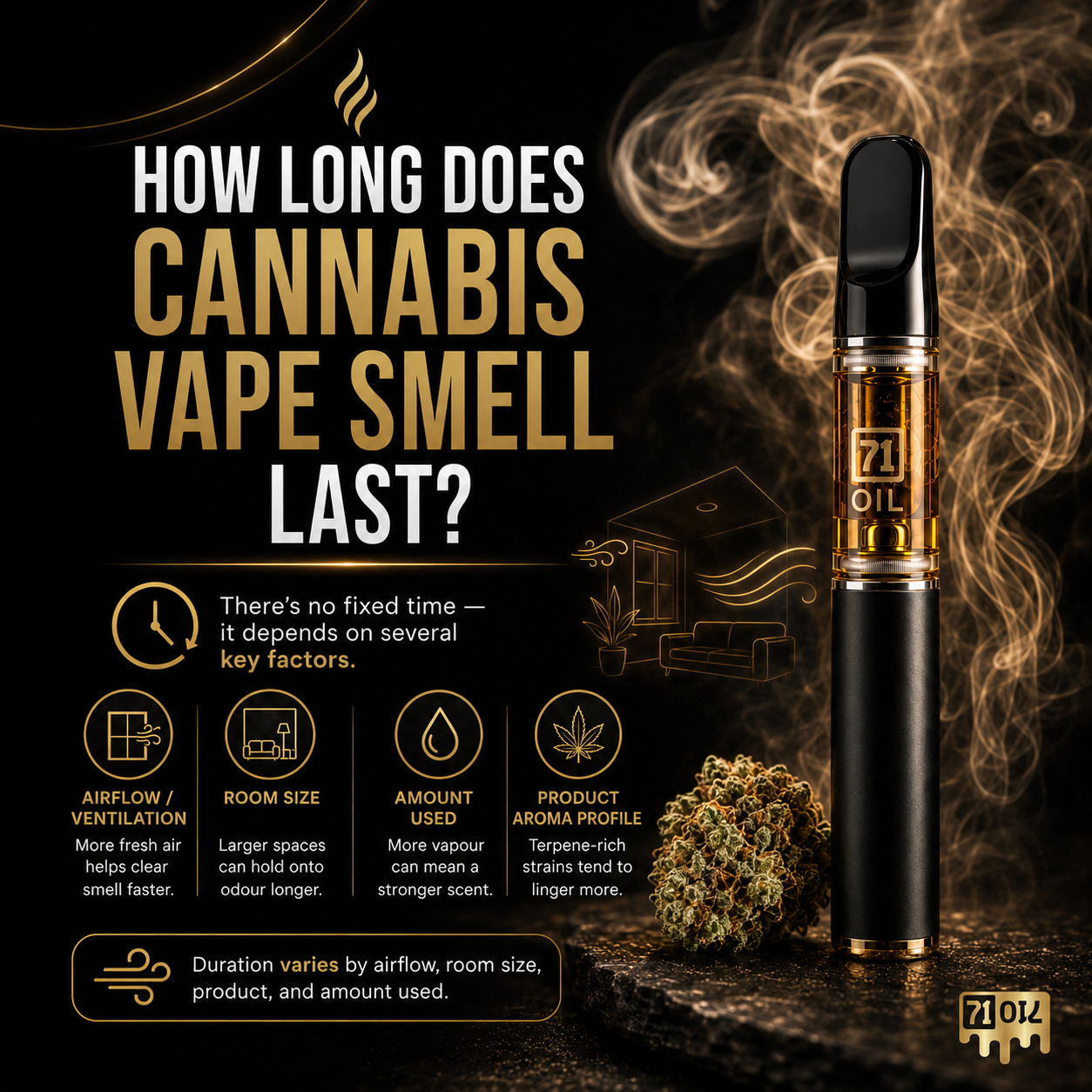
There is no single evidence-based duration that applies to every cannabis vape, room, or session. A strong claim such as “the smell disappears in five minutes” ignores the variables that affect indoor air and odour perception.
How long an aroma remains noticeable can change with the extract profile, amount of aerosol, frequency of use, room volume, ventilation, air exchange, fabrics, and other nearby materials. A small enclosed room and a large space with active air movement should not be expected to behave the same way.
For a closer look at room size, airflow, repeated use, indoor surfaces, and the difference between odour and aerosol persistence, see how long cannabis vape smell can last in a room.
Can Cannabis Vape Smell Stick to Clothes, Furniture, or Breath?
It can under some conditions, but absolute claims are not justified. Repeated use in an enclosed area is a different exposure pattern from one brief use in a larger, ventilated space. The product, amount used, surfaces, and air movement can all affect whether an aroma remains noticeable.
Odour and aerosol deposition are also different questions. A room no longer smelling strongly of cannabis does not prove that nothing from the aerosol entered the surrounding air or contacted surfaces. Health Canada’s general vaping guidance notes that bystanders can be exposed to exhaled aerosol and that vaping can increase some chemicals on indoor surfaces and in indoor air.
The same caution applies to breath and clothing: there is no reliable rule that cannabis vape use will always be noticeable, or never be noticeable, after use.
What Makes Cannabis Vape Odour More Noticeable?
1. Extract and aroma profile
Terpenes, sulfur-containing compounds, and other volatile molecules can influence the character of a cannabis product’s aroma.
2. Device output and heating conditions
Operating conditions can change aerosol chemistry. This is one reason device and formulation differences should not be treated as interchangeable.
3. Amount and frequency of aerosol
A single short use and repeated aerosol production do not place the same amount of material into the surrounding air.
4. Room size and airflow
Enclosed spaces and areas with stronger air exchange behave differently, making fixed odour-duration promises unreliable.
5. Device and product condition
Residue around a mouthpiece, cartridge, or chamber can carry its own aroma. Health Canada recommends following manufacturer instructions and properly cleaning reusable vaping accessories.
Does Lower Odour Mean It Is Fine to Vape Indoors?
No. How strongly a product smells is not a safety test and does not determine whether vaping is allowed in a particular space.
Health Canada states that aerosol from cannabis vaping can contain harmful substances and that contaminants such as heavy metals may enter the extract and aerosol. Health Canada’s broader vaping guidance also notes that bystanders can be exposed to exhaled aerosol and recommends vaping outdoors only.
Adults should also respect provincial, territorial, municipal, workplace, building, rental, and property rules, as well as the preferences of other people sharing the space. Lower odour should never be marketed as a way to bypass those rules or avoid other people noticing use.
Odour is not a reliable measure of whether aerosol exposure remains. Read our guide to secondhand cannabis vape aerosol for what current evidence says about indoor particles and bystander exposure.
What Should Adults Compare When Flavour and Aroma Matter?
If flavour and aroma are part of a product decision, compare the information actually available for the product rather than relying on a vague promise that a vape is “low smell” or “discreet.”
- Strain and aroma profile – review the product’s described herbal, citrus, pine, floral, earthy, fuel-like, spice, or other sensory notes.
- Extract type – distillate, HTFSE, live-resin-style, and other formulations may preserve or emphasize different parts of the source material.
- Terpene information – useful for part of the aroma profile, but not a complete explanation of cannabis scent.
- Hardware format – 510 cartridges, integrated disposables, and dry-herb devices use different hardware and materials.
- Manufacturer instructions and product condition – use the intended hardware, follow operating guidance, and avoid damaged or malfunctioning equipment.
For product discovery, compare current 71 Oil 510 Cartridges and Disposable Vape Pens by strain and format. For extract education, read the 71 Oil HTFSE guide.
Frequently Asked Questions
Do weed vapes smell like weed?
They can. Cannabis vape aerosol can carry cannabis- and strain-related aromatic compounds. The exact smell varies by product, extract, hardware, and operating conditions.
Can you smell a cannabis vape on someone?
Possibly. Aroma may remain around a recently used device, in exhaled breath, or in the surrounding air. Noticeability varies, so it is not accurate to promise that cannabis vape use is always detectable or always undetectable.
Does vaping cannabis make your breath smell?
It can temporarily leave an aroma in the mouth or exhaled air because aromatic compounds are present in the aerosol. Intensity and persistence vary by product and use conditions.
Does cannabis vape smell stick to clothes?
It may under some conditions, especially with repeated exposure in an enclosed space. There is no reliable universal rule that vape odour never remains on fabrics.
How long does cannabis vape smell stay in a room?
There is no universal evidence-based duration. Product composition, aerosol amount, room size, airflow, frequency of use, and surrounding materials can all influence persistence.
Do cannabis cartridges smell when they are not being used?
A cartridge or device may have some aroma when it is not operating if extract or residue is exposed around the mouthpiece, airflow path, or other components. Store and maintain the device according to manufacturer instructions.
Is a cannabis vape completely odourless?
No. Cannabis vapes can produce a noticeable aroma during use. “Odourless,” “smell-proof,” and “undetectable” are not appropriate universal claims.
Final Takeaway
So, does vaping cannabis smell? Yes. Cannabis vape aerosol can carry a noticeable aroma, but there is no one smell or persistence time that applies to every cartridge, disposable, room, or session.
The extract, strain chemistry, volatile compounds, device output, amount used, and airflow can all influence what someone notices. Vaping also differs from smoking because it heats cannabis extract rather than burning flower, but that distinction should not be turned into a safety guarantee or an excuse to ignore indoor-use rules.
Adults comparing products by flavour and aroma can use verified product information, extract type, strain profile, hardware format, and manufacturer guidance as better context than broad claims about being “discreet” or “smell-free.”
| Explore 71 Oil Compare 71 Oil 510 cartridges and disposable vape pens by strain and format, or read the HTFSE guide for more context on terpene-rich extract profiles. |
510 Cartridges | Disposable Vape Pens | What Is HTFSE?
Resources Used
- Health Canada – Cannabis accessories for inhalation – Official terminology for cannabis smoking, vaping, aerosol, device components, and cannabis-vaping risk context.
- Health Canada – Risks of vaping – Second-hand aerosol, indoor-air/surface context, and outdoor-vaping recommendation.
- Oswald et al. (2021) – Identification of Prenylated Volatile Sulfur Compounds in Cannabis – Primary research on sulfur-containing compounds associated with characteristic cannabis aroma.
- Oswald et al. (2023) – Minor, Nonterpenoid Volatile Compounds Drive Aroma Differences – Primary research showing that minor nonterpenoid compounds can strongly influence specific cannabis aromas.
- Meehan-Atrash et al. (2019) – Aerosol Gas-Phase Components from Cannabis E-Cigarettes and Dabbing – Primary laboratory research on cannabis-vaping aerosol chemistry and comparison with literature-sourced cannabis smoke values.
- Meehan-Atrash et al. (2021) – Influence of Terpenes on Cannabis Vaping Aerosols – Primary research showing that terpene content and applied power can change the chemical composition of cannabis-vaping aerosol under study conditions.
Content note: Sources were used for regulatory terminology, aerosol chemistry, and cannabis-aroma context. The article intentionally avoids medical claims, guaranteed odour-duration claims, and concealment guidance.
0 Responses