

Is Secondhand Cannabis Vape Aerosol Harmful? What Adults Should Know
Secondhand cannabis vape aerosol should not be treated as harmless indoor air. People nearby can be exposed to aerosol that is exhaled after cannabis vaping, and cannabis-specific research shows that fine particles can remain in indoor air after an emission event.
What is less certain is the exact health effect from a given real-world exposure, because dose, product composition, device output, ventilation, room size, and exposure time can all differ.
That distinction matters. The evidence supports reducing bystander exposure, but it does not support claiming that every brief exposure causes a specific illness. It also does not support calling indoor cannabis vaping safe simply because there is less visible smoke or less odour than with burning cannabis flower.
For broader context on direct-user risks, start with 71 Oil’s Health & Safety of Vaping: Cannabis Vape Guide.
This article is for adults of legal age in legal cannabis markets. It is educational information, not medical advice.
Quick Answer: Can Other People Be Exposed to Cannabis Vape Aerosol?
| QUICK ANSWER Yes. Exhaled cannabis vape aerosol can add particles and cannabis-related constituents to indoor air, so people nearby can be exposed. Cannabis-specific evidence is still limited, and real-world dose varies widely, but current research does not support treating secondhand aerosol as harmless. Health Canada recommends vaping outdoors only and being cautious around others. |
In This Guide
- What secondhand cannabis vape aerosol is
- What cannabis-specific research shows – and where the evidence is still limited
- How common secondhand cannabis smoke or vapour exposure is in Canada
- How cannabis vape aerosol differs from secondhand cannabis smoke
- Why smell does not tell you whether indoor air is clear
- How long cannabis vape aerosol may remain indoors and why there is no universal clearance time
- Whether secondhand aerosol can contain THC or cause noticeable effects
- Who adults should be especially careful around in shared spaces
- Practical ways adults can reduce bystander exposure
- What we know, what remains uncertain, and frequently asked questions
What Is Secondhand Cannabis Vape Aerosol?
Cannabis vaping heats a liquid or solid cannabis extract to create an aerosol that the user inhales. Health Canada uses the term aerosol because the material in the air is not simply harmless water vapour. The aerosol can contain very small particles and substances from the cannabis extract, the formulation, and the device itself.
Secondhand exposure happens when some of that aerosol is exhaled into the surrounding air and other people share the same space. Unlike a burning joint or cigarette, a vape device does not create continuous sidestream smoke between puffs. That means the exposure pattern is different, but “different” does not mean “none.”
Health Canada notes that cannabis-vaping aerosol can contain harmful substances and that contaminants such as heavy metals may leach into cannabis concentrates and be inhaled. The exact mix can vary by product, device, temperature, and use pattern.
What Does Cannabis-Specific Research Show?
Cannabis-specific secondhand aerosol research is still much smaller than the evidence base for tobacco smoke or nicotine e-cigarettes. Two studies are especially useful because they focus on cannabis rather than assuming all vaping aerosols behave the same way.
A 2025 Simulated-Chamber Study
A 2025 study published in Environmental Science & Technology examined simulated cannabis vaping aerosols in a 20-cubic-metre chamber. The researchers generated aerosols from mixtures containing terpenoids, cannabinoids, cannabis-extract constituents, and, in some experiments, vitamin E acetate. They measured particle concentrations over time and used a respiratory dosimetry model to estimate where inhaled particles could deposit.
Under those laboratory conditions, particle levels peaked soon after the emission event and then declined. At 60 minutes, the measured particle-number concentration was still 21% to 57% of the peak, while fine-particle mass was still 33% to 69% of the peak. The model estimated the greatest deposited aerosol fraction in the pulmonary region of the respiratory tract.
| IMPORTANT LIMITATION This was a simulated chamber study, not a clinical trial in occupied homes. It shows that cannabis-vape aerosols can persist indoors and supports the possibility of secondhand inhalation. It does not prove that every real-world exposure produces a specific health outcome. |
A 2021 In-Silico Exposure Study
A 2021 computer-modeling study also evaluated secondary indoor pollution associated with cannabis vaping. Its results supported the idea that exhaled cannabis aerosols can become an indoor exposure source for non-users through inhalation and other pathways.
Again, the evidence is useful for understanding exposure, not for assigning a guaranteed medical outcome to a bystander. Modeled exposure and measured disease are different questions.
How Common Is Secondhand Cannabis Exposure in Canada?
Health Canada’s 2024 Canadian Cannabis Survey reported that 57% of people surveyed had experienced second-hand cannabis smoke or vapour in at least one location during the previous 30 days. Public places were the most commonly reported location, followed by the home, workplace or school, and cars.
That survey is useful as context, but it combines cannabis smoke and vapour. It therefore cannot tell us what percentage of those exposures came specifically from vape aerosol. That limitation should stay visible when the number is used.
Is Secondhand Cannabis Vape Aerosol the Same as Secondhand Cannabis Smoke?
No. Cannabis smoke and cannabis vape aerosol come from different processes.
| Question | Cannabis vape aerosol | Cannabis smoke |
|---|---|---|
| How it is produced | Cannabis extract is heated to form an aerosol. | Cannabis material is burned, producing combustion smoke. |
| Secondhand source | Primarily exhaled aerosol from the person vaping. | Exhaled smoke plus smoke produced by ongoing combustion. |
| What it contains | Particles and constituents that vary with extract, formulation, device, and temperature. | Combustion products plus cannabis constituents; composition varies with material and burning conditions. |
| What “different” means | Not equivalent to smoke, but not harmless or exposure-free. | Known inhalation exposure from combustion; should not be used as a benchmark that makes vaping “safe.” |
Health Canada’s general vaping guidance says secondhand vaping aerosol is expected to pose much lower risk than secondhand tobacco smoke because it contains fewer chemicals. That statement should not be turned into a cannabis-specific safety guarantee. Cannabis products, devices, and aerosol composition differ, and cannabis-specific secondhand research remains limited.
Does Cannabis Vape Smell Tell You Whether the Air Is Clear?
No. Odour is not a reliable measurement of aerosol concentration or bystander exposure.
Cannabis vape aerosol can carry aromatic compounds, including terpenes and other volatile compounds, so a person may notice an odour. But smell perception depends on the product, room, airflow, individual sensitivity, and the compounds present. A faint smell does not prove that particle levels are low, and the disappearance of a noticeable smell does not prove that aerosol is completely gone.
For a separate look at aroma and persistence, see Does Vaping Cannabis Smell? Vape Odour vs. Flower and Smoke.
How Long Can Cannabis Vape Aerosol Stay in a Room?
There is no evidence-based universal clearance time for cannabis vape aerosol in a room. Any fixed claim such as “the air is clear after 10 minutes” ignores the variables that control how aerosols build up and disperse.
The 2025 chamber study is useful because aerosol concentrations were still measurable at substantial fractions of their peak after 60 minutes under the study conditions. A real room, however, may have very different air exchange, temperature, furnishings, occupancy, device output, and vaping pattern.
Ventilation can dilute and remove airborne particles, but an open window, fan, purifier, or larger room should not be treated as proof that secondhand exposure has been eliminated. There is no single waiting period that applies to every home, vehicle, office, or device.
Can Secondhand Cannabis Vape Aerosol Contain THC?
Cannabis vape aerosol can contain cannabinoids from the product, including THC when the extract contains THC. The 2025 chamber study specifically evaluated aerosol mixtures containing THC, and the 2021 modeling study also considered cannabis constituents in passive-exposure scenarios.
That does not create a reliable rule for how much THC a bystander will absorb in a real room. Dose depends on the aerosol source, distance, ventilation, time, product composition, and other factors. The available evidence supports avoiding unnecessary exposure, not predicting a universal blood level or intoxication threshold from passive exposure.
Can Someone Get High From Secondhand Cannabis Vape Aerosol?
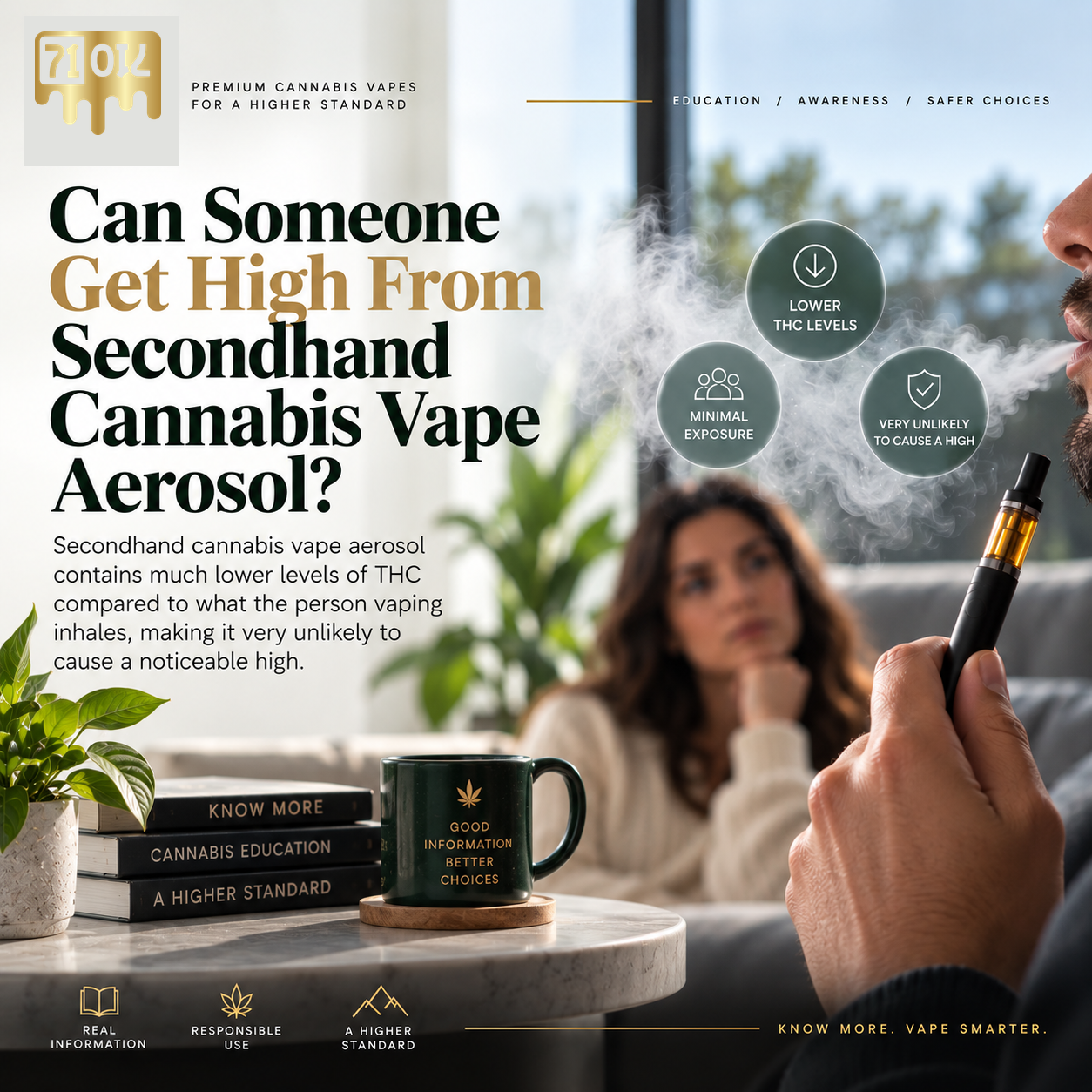
Current evidence does not support a simple universal answer based only on being in the same room. Research shows that secondhand exposure can occur, but the amount a bystander would actually inhale and absorb can vary greatly.
It would therefore be inaccurate to promise that passive exposure can never produce noticeable effects, just as it would be inaccurate to claim that ordinary secondhand vape exposure will reliably intoxicate someone. If avoiding THC exposure matters, the practical approach is to avoid sharing indoor air with active cannabis vaping rather than trying to calculate a “safe” number of puffs or minutes.
Who Should Adults Be Especially Careful Around?
A shared-space decision should start with the people who are present, not only with whether the aerosol is visible or strongly scented.
- Children and youth: Cannabis products are for adults in legal markets, and children should not be deliberately exposed to cannabis aerosol.
- Pregnant or breastfeeding people: Health Canada advises avoiding cannabis during pregnancy and breastfeeding. Secondhand exposure should not be treated as harmless simply because the cannabis is being vaped rather than smoked.
- People who do not consent to exposure: A shared home, vehicle, workplace, or social space may include people who do not want cannabis aerosol around them. Lower odour does not remove that concern.
- People with health concerns: Anyone worried about respiratory or other health effects should be able to avoid exposure and seek personalized advice from a qualified healthcare professional when needed.
What About Vaping Cannabis Indoors With a Window Open?
Opening a window may increase air exchange in some situations, but it does not create a verified safe indoor vaping condition. Air movement is not uniform, and aerosol can remain in parts of a room or move into adjacent spaces.
Health Canada’s current general vaping guidance recommends vaping outdoors only and being cautious about using vaping products around others. For cannabis, that approach is consistent with the available evidence: reduce the opportunity for exhaled aerosol to accumulate in shared indoor air rather than relying on smell or ventilation as a safety guarantee.
Practical Ways Adults Can Reduce Bystander Exposure
- Use cannabis vapes outdoors rather than in shared indoor spaces. This aligns with Health Canada’s general secondhand-aerosol recommendation.
- Keep distance from people who do not want exposure. Do not exhale aerosol toward other people or use low odour as a reason to ignore consent.
- Follow local smoke- and vape-free rules. Restrictions can vary by province, territory, municipality, workplace, housing policy, and venue.
- Do not treat a fan or open window as a guarantee. Ventilation can reduce concentrations, but it does not establish a universal zero-exposure condition.
- Do not use smell as the clearance test. Aroma and aerosol particle concentration are not the same measurement.
- Keep the broader cannabis risk picture in mind. Secondhand exposure is one issue; direct users also need to consider THC strength, impairment, frequency, product source, and device condition.
For direct-user lung context, read How Does Vaping Cannabis Affect Your Lungs? and the broader Health & Safety of Vaping: Cannabis Vape Guide before treating any inhaled cannabis product as risk-free.
What We Know – and What We Still Do Not Know
| What the evidence supports | What the evidence does not establish |
| Cannabis vaping creates aerosol, not harmless water vapour. | A universal health outcome from one brief bystander exposure. |
| Exhaled cannabis aerosol can contribute to indoor secondhand exposure. | A universal “safe distance” from someone vaping. |
| Cannabis-specific chamber and modeling studies show indoor particles and potential inhalation pathways. | A universal room-clearance time. |
| Aerosol levels can persist after active emission stops. | That lack of smell means the air is exposure-free. |
| Outdoor use and avoiding vaping around others can reduce shared indoor exposure. | That any cannabis vape product or indoor-use pattern is risk-free. |
Frequently Asked Questions
Is secondhand cannabis vape aerosol harmful?
Secondhand cannabis vape aerosol should not be treated as harmless. Research supports the conclusion that bystanders can be exposed to exhaled aerosol and indoor particles. The exact health effect of a specific real-world exposure remains difficult to quantify because dose and aerosol composition vary.
Is secondhand cannabis vape aerosol the same as smoke?
No. Vaping heats an extract to create aerosol, while smoking burns cannabis and creates combustion smoke. The exposure profiles are different, but neither difference nor lower visible smoke proves that indoor vape aerosol is risk-free.
How long does cannabis vape aerosol stay in a room?
There is no universal clearance time. In a 2025 simulated-chamber study, substantial fractions of peak particle levels remained after 60 minutes. Real rooms vary in ventilation, size, device output, formulation, and use pattern, so a fixed time should not be generalized.
Does opening a window make it safe to vape cannabis indoors?
No ventilation setup can be described as a universal safe condition. Opening a window may reduce indoor concentrations in some circumstances, but it does not guarantee that secondhand exposure is eliminated. Health Canada recommends vaping outdoors only.
Can secondhand cannabis vape aerosol contain THC?
Yes, aerosol from a THC-containing cannabis product can contain cannabinoids. The amount a bystander might inhale or absorb depends on the product, aerosol amount, room, distance, ventilation, and exposure time.
Can someone get high from secondhand cannabis vape aerosol?
Research supports the possibility of passive exposure, but it does not provide a universal real-world intoxication threshold. It is not accurate to promise that passive exposure is always zero, or to claim that ordinary secondhand exposure will reliably intoxicate someone.
Does low cannabis vape odour mean low exposure?
No. Odour perception and aerosol concentration are different measurements. A room can smell faint while aerosol particles are still present, and the absence of noticeable smell is not proof that the air is exposure-free.
Treat Cannabis Vape Aerosol as an Indoor Exposure, Not Just an Odour
Secondhand cannabis vape aerosol is a developing research area, but the evidence is strong enough to reject two common assumptions: that vape aerosol is only harmless water vapour, and that low odour means there is no indoor exposure.
Cannabis-specific laboratory and modeling studies show that vaping can add fine aerosol particles and cannabis-related constituents to indoor air. What remains uncertain is the exact dose and health effect for a particular bystander in a particular room.
For adults who choose to vape cannabis, the practical approach is straightforward: avoid creating unnecessary indoor exposure, vape outdoors, respect other people’s choice not to be exposed, and follow local rules. Those steps can reduce exposure; they do not make cannabis vaping safe or risk-free.
Resources Used
- Health Canada – Cannabis accessories for inhalation: Minimizing your risk when smoking, vaping and dabbing — Cannabis aerosol definition, harmful-substance framing, contaminants, and device guidance.
- Health Canada – Risks of vaping — Current second-hand aerosol guidance, outdoor-vaping recommendation, and cannabis-vaping aerosol risk context.
- Tang et al. – Secondhand Exposure to Simulated Cannabis Vaping Aerosols (2025) — Cannabis-specific chamber study of indoor aerosol concentrations and modeled respiratory deposition.
- Secondary indoor air pollution and passive smoking associated with cannabis vaping (2021) — In-silico cannabis-vaping study of secondary indoor exposure pathways.
- Health Canada – Canadian Cannabis Survey 2024 — Canadian context for reported second-hand cannabis smoke or vapour exposure; survey does not isolate vaping from smoke.
0 Responses