

How Long Does Cannabis Vape Smell Last in a Room?
Cannabis vape smell does not follow one reliable timer. In some rooms, the aroma may become less noticeable relatively quickly. In others, especially smaller or poorly ventilated spaces or rooms where vaping occurs repeatedly, it may remain noticeable longer.
How long does cannabis vape smell last in a room? The answer depends on the product, amount of aerosol released, room size, airflow, ventilation, frequency of use, and surrounding materials. There is also an important distinction between how long someone can smell cannabis vape aerosol and how long aerosol particles remain measurable in indoor air. Those are not the same measurement.
In This Guide
- Quick answer: how long cannabis vape smell lasts
- Why cannabis vape leaves a smell
- Why there is no universal time
- Cannabis vape smell vs. aerosol persistence
- What affects how long the smell lingers
- Windows, ventilation, and air purifiers
- Cannabis vape smell vs. cannabis smoke
- Shared-space considerations
- Frequently asked questions
Quick Answer: How Long Does Cannabis Vape Smell Last?
| There is no universal evidence-based number of minutes that cannabis vape smell lasts in a room. The perceived aroma can vary with the cannabis extract, aromatic compounds in the product, amount of aerosol produced, room volume, ventilation, repeated use, and nearby surfaces. Smell duration should not be used as a direct measure of how long aerosol remains in the air. |
What Affects How Long Cannabis Vape Smell Lingers?
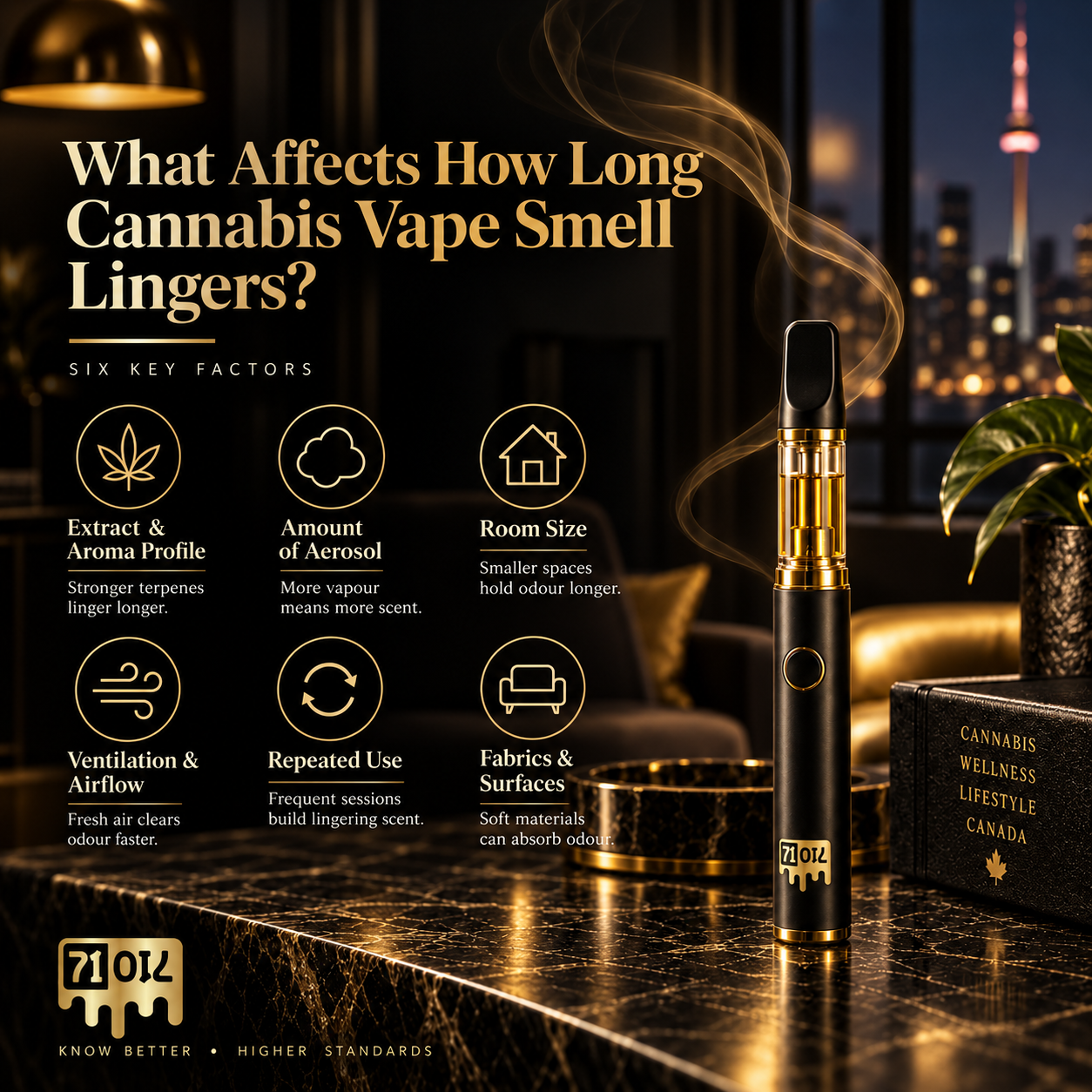
| Factor | Why It Can Matter |
|---|---|
| Extract and aroma profile | Different cannabis formulations can contain different aromatic compounds and terpene blends. |
| Amount of aerosol | More aerosol changes the amount of material introduced into the room. |
| Room size | Smaller enclosed spaces provide less volume for dispersion. |
| Airflow and ventilation | Air exchange can change how quickly indoor concentrations decline. |
| Repeated use | Repeated emissions can change room conditions compared with one isolated event. |
| Surfaces and fabrics | General vaping research shows some aerosol-related chemicals can settle on indoor surfaces, but cannabis-specific odour data are limited. |
Why Does Cannabis Vape Leave a Smell?
Health Canada defines cannabis vaping as inhaling an aerosol produced when a vaping accessory heats a liquid or solid cannabis extract. Unlike smoking, this process does not burn cannabis flower.
Health Canada also notes that cannabis vape liquids are typically almost entirely cannabis extract and may include a botanical extract or terpene blend. Aromatic compounds in the formulation can contribute to the smell that enters the surrounding air when the device heats the product and the user exhales the aerosol.
Do not describe cannabis vaping as completely odourless. Its aroma can differ from cannabis smoke, but different is not the same as absent.
For a broader explanation of what creates cannabis vape aroma and how vaping compares with flower smoke, see Does Vaping Cannabis Smell? Vape Odour vs. Flower and Smoke.
Why Is There No Universal Time for Cannabis Vape Smell to Disappear?
Claims such as “vape smell disappears in five minutes” sound precise, but the evidence does not support one fixed rule for every cannabis vape or room.
Different products, devices, room sizes, airflow patterns, ventilation rates, and use frequency can create very different indoor conditions. Product composition matters too. A terpene-forward formulation may present a more distinct aromatic profile than another extract, but extract type alone cannot predict exactly how long the smell will remain.
Odour perception also varies between people and can change over time. Do not confuse a weaker perceived smell with proof that the aerosol or its components have disappeared.
Cannabis Vape Smell vs. Aerosol Persistence: Are They the Same Thing?
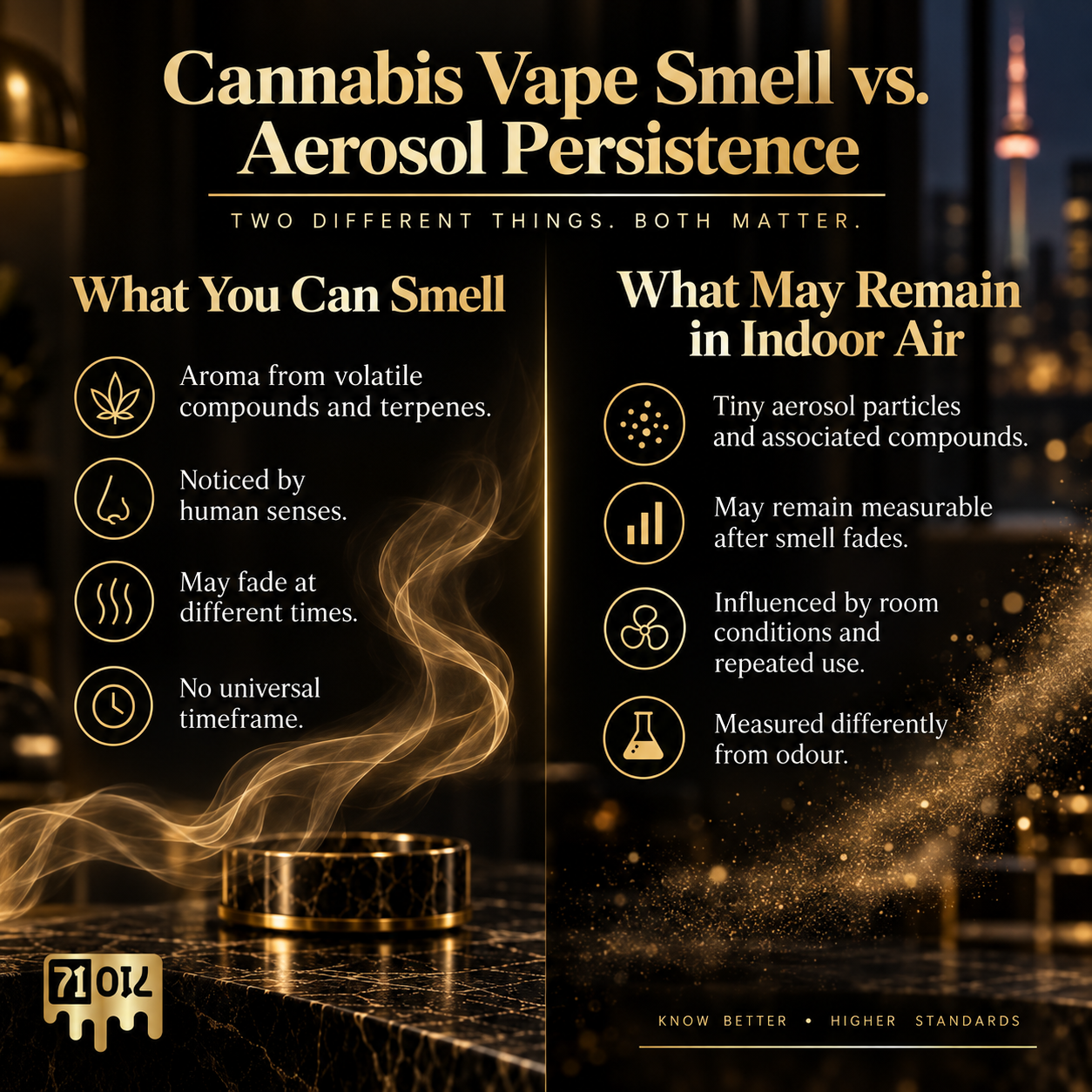
No. Odour persistence and aerosol persistence describe different things.
Odour persistence refers to how long a person can perceive an aroma. Aerosol persistence refers to how long particles, droplets, or related compounds remain measurable in indoor air.
This difference matters because cannabis-vaping studies often measure particles rather than human smell.
A 2021 chamber study of compounds found in vaporizable cannabis concentrates reported that ultrafine particles generated during heating remained airborne for at least three hours under the study conditions. That does not mean cannabis vape smell always lasts three hours. The researchers measured particles, not the point at which people stopped smelling cannabis.
A 2025 simulated cannabis-vaping study found that particle concentrations peaked shortly after emission and remained measurable at 60 minutes, although concentrations had declined from their peaks. Again, the study measured aerosol concentrations, not perceived odour duration.
The evidence supports a careful conclusion: cannabis-vaping aerosol can remain measurable after vaping stops, but do not convert those particle measurements into an exact “smell lasts X minutes” rule.
Extract and Aroma Profile
Different cannabis extracts and formulations can have different volatile profiles. Health Canada notes that cannabis vaping liquids may contain botanical extracts or terpene blends in addition to cannabis extract.
Terpenes contribute to cannabis flavour and aroma, but an aromatic product does not come with a predictable indoor duration. HTFSE, for example, emphasizes a terpene-rich, full-spectrum extract profile. That makes aroma an important product characteristic, but the term HTFSE alone does not establish how long the smell will persist indoors.
For more about this extract category, see What Is HTFSE? High-Terpene Full-Spectrum Extract Explained.
Amount of Aerosol Released
The amount of material released into a room affects the starting indoor concentration. One brief use event and repeated vaping over a longer period are not equivalent, and different devices can produce different aerosol outputs.
This is one reason a fixed duration estimate is unreliable.
Room Size
Room volume changes how emissions disperse. A small enclosed room has less air volume available for dispersion than a large open space.
Room size alone does not determine smell duration, but it can influence how concentrated the aroma initially seems and how quickly it becomes less noticeable.
Ventilation and Air Exchange
Air exchange can affect indoor concentrations. Open windows or doors, mechanical ventilation, and outdoor-air exchange can dilute or remove airborne material at different rates.
Do not treat ventilation as a way to make indoor vaping harmless. U.S. EPA guidance for electronic-cigarette aerosol states that ventilation, filtration, and air cleaning may reduce indoor contaminants but are not likely to eliminate them completely. This is general vaping evidence, not a cannabis-specific performance standard.
Health Canada recommends vaping outdoors only and advises caution when using vaping products around others.
Frequency and Repeated Indoor Use
Repeated vaping can create different indoor conditions from one isolated event. When a person vapes repeatedly, each new emission enters the room before earlier material has necessarily dispersed or settled.
Repeated use may also increase opportunities for aerosol-related chemicals to settle on surfaces. General e-cigarette research provides stronger evidence for surface deposition than cannabis-specific vaping research, so keep that distinction clear.
Fabrics, Upholstery, and Other Surfaces
EPA guidance notes that some chemicals released during smoking or vaping can remain indoors, build up on hard surfaces, and become embedded in soft materials such as clothing, upholstery, drapes, bedding, and carpets.
That does not prove cannabis vape odour will remain on every fabric for a particular number of hours or days. Researchers still have limited cannabis-specific evidence on odour persistence on surfaces.
The practical takeaway is narrower: surrounding materials add another variable, so room air alone cannot predict how long an indoor aroma will remain noticeable.
Does Opening a Window Make Cannabis Vape Smell Disappear Faster?
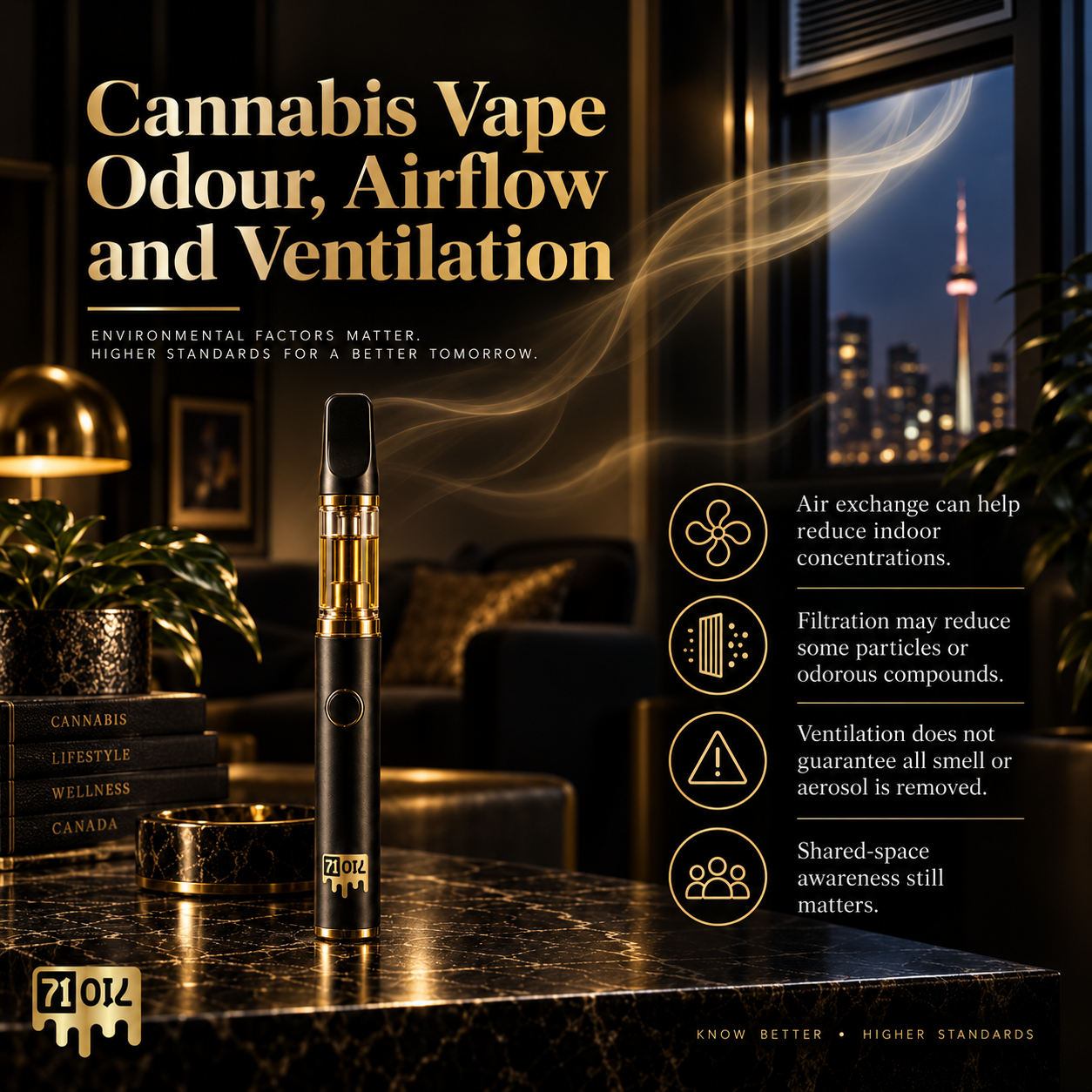
Increasing outdoor-air exchange may reduce the concentration of airborne material and make an aroma less noticeable. But no source can guarantee how long an open window will take to remove cannabis vape smell.
The result can depend on window size, airflow direction, outdoor conditions, room volume, and how much aerosol the vaping event released.
Opening a window also does not override building rules, rental policies, workplace requirements, or smoke-free and vape-free restrictions. Ventilation guidance should explain indoor-air factors, not provide instructions for concealing use.
Can an Air Purifier Reduce Cannabis Vape Odour?
An air purifier may reduce some airborne particles or odour-producing compounds depending on the filtration system, airflow rate, filter condition, and room size.
EPA guidance on home air cleaners explains that HEPA filters target particles, while activated-carbon filters can help remove some gases and odours. Do not describe either technology as guaranteed to remove all cannabis vape aerosol or aroma.
EPA guidance for electronic-cigarette aerosol also says filtration and air cleaning may reduce indoor contaminants but are not likely to eliminate them completely. Because this guidance addresses electronic cigarettes generally, do not treat it as a direct cannabis-vape performance standard.
Does Cannabis Vape Smell Last as Long as Cannabis Smoke?
Cannabis vaping and cannabis smoking create different emissions.
Smoking burns cannabis flower and produces combustion smoke. Health Canada distinguishes that process from cannabis vaping, which heats an extract to produce an aerosol.
Because the emissions are different, the odour profile can also be different. The existing 71 Oil smell guide explains that cannabis vapes can produce a noticeable aroma without creating the same combustion smoke as burning flower.
What the evidence does not support is a universal statement that cannabis vape smell always disappears after a specific number of minutes or always clears faster than smoke in every room.
Does No Smell Mean the Room Is Clear?
No.
Human smell is not an indoor-air measuring instrument. A person may stop noticing an aroma while particles or other compounds remain measurable.
The cannabis-specific chamber studies discussed above show that aerosol particles can persist after a vaping event ends. Health Canada also notes that bystanders can encounter aerosol exhaled by people who vape.
Do not use the disappearance of a noticeable smell as proof that the room is free of vaping-related aerosol.
What Should Adults Consider When Vaping Around Other People?
Shared indoor spaces involve more than odour.
Adults should consider consent, household rules, property policies, workplace restrictions, children, pets, and other occupants who may not want cannabis-vaping aerosol in a shared space.
Health Canada recommends vaping outdoors only and being cautious around others. It also notes that many Canadian provinces, territories, and municipalities prohibit vaping in public places and workplaces where rules already prohibit smoking.
For broader adult-use guidance, see Cannabis Vaping Tips for Responsible Adult Use.
Frequently Asked Questions
How long does cannabis vape smell last in a house?
There is no fixed evidence-based duration that applies to every home. The product, amount of aerosol, room size, airflow, ventilation, frequency of vaping, and surrounding materials can all affect how long the aroma remains noticeable.
Do cannabis vapes leave a smell in a room?
They can. Cannabis vape aerosol may carry aromatic compounds from the extract, including terpenes or botanical components when present. The strength and persistence of the aroma vary by product and environment.
How long does a weed vape linger in the air?
Cannabis-vaping aerosol can remain measurable after vaping stops, but aerosol persistence and smell duration are not the same measurement. Controlled studies have detected particles at 60 minutes and, under some experimental conditions, for at least three hours. Those results should not be treated as an exact odour timetable.
Will opening a window remove cannabis vape smell?
Additional air exchange may reduce indoor concentrations and make the aroma less noticeable, but there is no guaranteed timeframe. Ventilation can reduce secondhand aerosol exposure; it does not eliminate it or override no-vaping rules.
Does cannabis vape smell stick to furniture or clothes?
General vaping research shows that some aerosol-related chemicals can settle on hard and soft indoor surfaces. Cannabis-specific research still does not establish a universal duration for cannabis vape odour on clothing or furniture.
Can an air purifier remove cannabis vape smell?
An air purifier may reduce some particles or odour-producing compounds depending on filter type, room size, airflow, and filter condition. Do not describe an air purifier as guaranteed to remove all cannabis vape aerosol or smell.
Does no smell mean cannabis vape aerosol is gone?
No. Smell perception and aerosol measurement are different. A room may no longer smell strongly even while some aerosol particles or compounds remain measurable.
Understanding Cannabis Vape Odour Indoors
So, how long does cannabis vape smell last in a room? There is no universal answer.
The cannabis extract, aromatic compounds, amount of aerosol, room size, ventilation, repeated use, and surrounding materials can all change what someone notices. Research also shows why smell should not act as an indoor-air timer: cannabis-vaping aerosol can remain measurable after vaping stops even as human odour perception changes.
The most accurate approach avoids unsupported claims such as “the smell disappears in five minutes,” keeps odour and aerosol persistence separate, and follows applicable shared-space and no-vaping rules.
For a broader look at why cannabis vapes smell and how their aroma differs from flower smoke, continue with Does Vaping Cannabis Smell? Vape Odour vs. Flower and Smoke.
Resources Used
- Health Canada — Risks of Vaping
- Health Canada — Cannabis Accessories for Inhalation: Minimizing Your Risk When Smoking, Vaping and Dabbing
- U.S. EPA — Secondhand Electronic-Cigarette Aerosol and Indoor Air Quality
- U.S. EPA — Secondhand Smoke and Electronic-Cigarette Aerosols
- U.S. EPA — Guide to Air Cleaners in the Home
- Tang et al. (2025) — Secondhand Exposure to Simulated Cannabis Vaping Aerosols
- Emissions from Heated Terpenoids Present in Vaporizable Cannabis Concentrates (2021)
- 71 Oil — Does Vaping Cannabis Smell? Vape Odour vs. Flower and Smoke
- 71 Oil — What Is HTFSE? High-Terpene Full-Spectrum Extract Explained
- 71 Oil — Cannabis Vaping Tips for Responsible Adult Use
0 Responses