

Button-Activated vs. Draw-Activated Vape Batteries
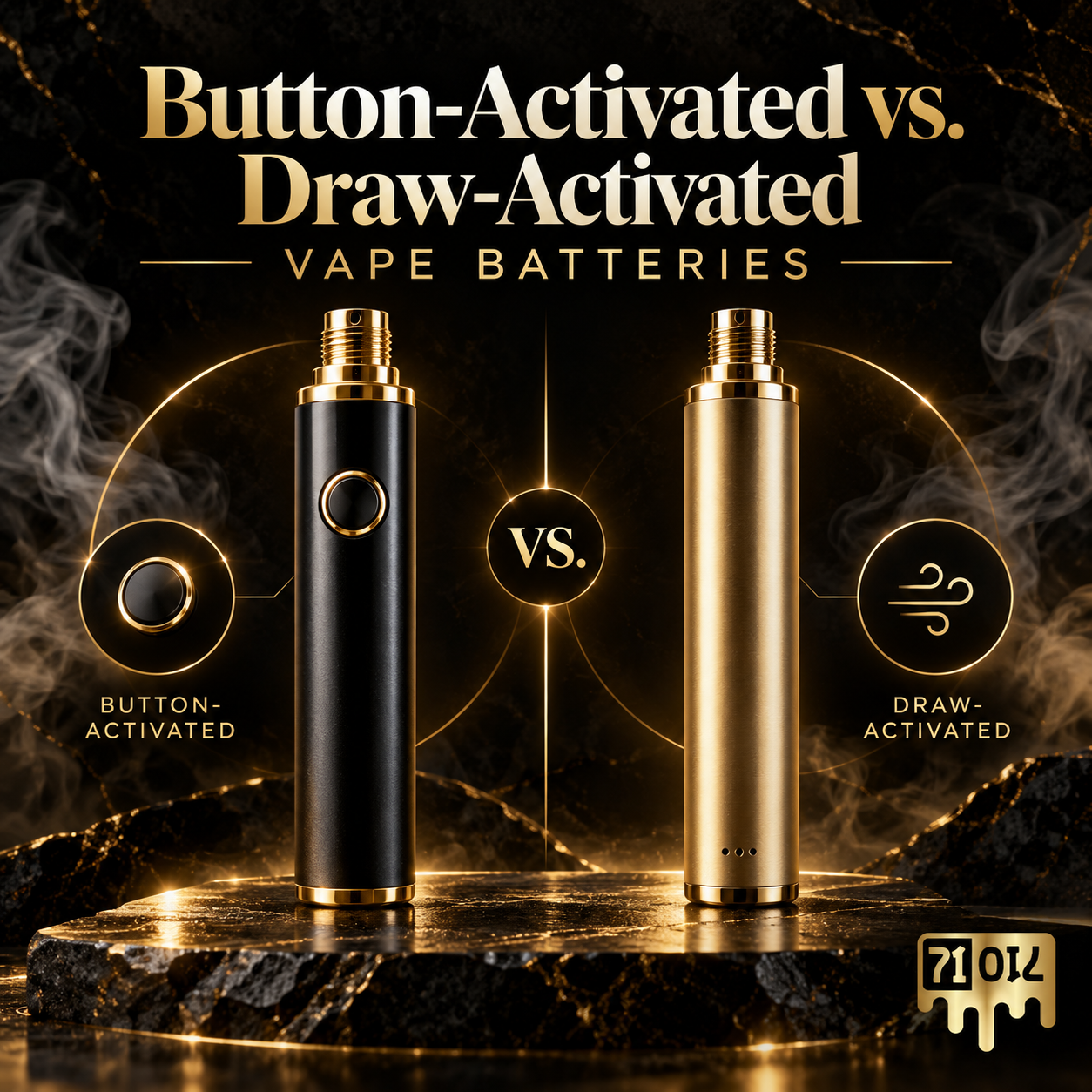
Button vs. draw activated vape battery comparisons often come down to how each device operates, how much control the user wants, and which features matter most. Button-activated batteries require a manual press to activate the device, while draw-activated (auto-draw) batteries activate when the user inhales. Understanding these differences can help adults compare vape battery options based on their preferences and hardware needs.
Vape batteries are available with different activation methods, controls, and features. Neither style is automatically the right choice for every user. The better option depends on factors such as convenience, control, compatibility, and how the battery fits into the overall cartridge setup.
This guide explains how button-activated and draw-activated vape batteries work, the key differences between them, and what to consider before choosing either type.
Quick Answer: What Is the Difference Between Button and Draw-Activated Vape Batteries?
| QUICK ANSWER:
A button-activated vape battery requires a manual press to activate the cartridge, while a draw-activated or auto-draw battery normally activates when it detects airflow or a pressure change during a draw. Button models may offer direct controls, but auto-draw models can also include adjustable features. Neither format is universally better. |
In This Guide
- How button-activated vape batteries work
- How draw-activated or auto-draw batteries work
- Button vs. draw-activated batteries at a glance
- Which activation style fits different priorities
- What to check before buying either type
- Common battery activation misconceptions
- Battery care and use
- Frequently asked questions
How Does a Button-Activated Vape Battery Work?
A button-activated vape battery uses a physical control to start the normal power cycle for a compatible cartridge. On many designs, the user holds the button during activation. The exact operation depends on the battery model.
The same button may also control other functions. Some models use multi-click sequences for power, lockout, voltage selection, or preheat. Those sequences are not standardized, so a five-click rule should not be treated as universal.
Button activation may suit adults who want deliberate manual control. Some models also include a lock or power-off function.
The tradeoff is that there can be more controls to understand. A button can also be pressed unintentionally if the device is stored incorrectly or not placed in its intended locked or off state. Check the manual for the exact battery before using button sequences copied from another device.
If you need the connection basics first, read 71 Oil’s What Is a 510-Thread Battery? guide. A 510 connection describes how compatible cartridges and batteries attach; it does not determine whether the battery is button-activated, auto-draw, fixed-output, or adjustable.
How Does a Draw-Activated Vape Battery Work?
A draw-activated vape battery, also called an auto-draw, inhale-activated, or buttonless battery, normally begins its power cycle when a built-in sensor detects the airflow or pressure change created during a draw.
This removes the need to hold a firing button during normal activation and can reduce the number of manual steps.
However, auto-draw does not automatically mean “no settings.” Some draw-activated batteries also include a separate button, dial, or other control for voltage, preheat, or status functions while still using inhalation for normal activation.
Airflow also matters. The battery sensor and cartridge need the device’s intended airflow path to operate correctly. A cartridge can use 510 threading and still have fit, airflow, contact, or operating requirements that affect the pairing.
For a deeper compatibility check, see Are All 510-Thread Batteries Compatible With Cannabis Cartridges?
Button-Activated vs. Draw-Activated Vape Batteries at a Glance
| Feature | Button-Activated Battery | Draw-Activated Battery |
|---|---|---|
| Activation | Manual button press | Airflow or pressure sensing during a draw |
| Primary interface | Physical control | Usually automatic during normal activation |
| Lock / on-off control | May include a lock or power sequence | May have no traditional fire-button lock; controls vary by model |
| Voltage settings | Available on some models | Available on some models; auto-draw does not always mean fixed output |
| Preheat | Available on some models | Available on some models |
| Learning curve | More controls may need to be learned | Can have fewer manual steps |
| Storage considerations | Follow lock/off instructions where provided | Follow storage instructions; do not assume sensor activation is impossible while stored |
| Troubleshooting | Button state, mode, charge, connection, and compatibility may matter | Sensor/airflow path, charge, connection, and compatibility may matter |
| Compatibility | Depends on connection, fit, airflow, operating requirements, and manufacturer guidance | Depends on the same complete hardware checks |
The comparison is not a quality ranking. The complete specifications matter more than the activation label alone.
Which Activation Style Fits Your Priorities?
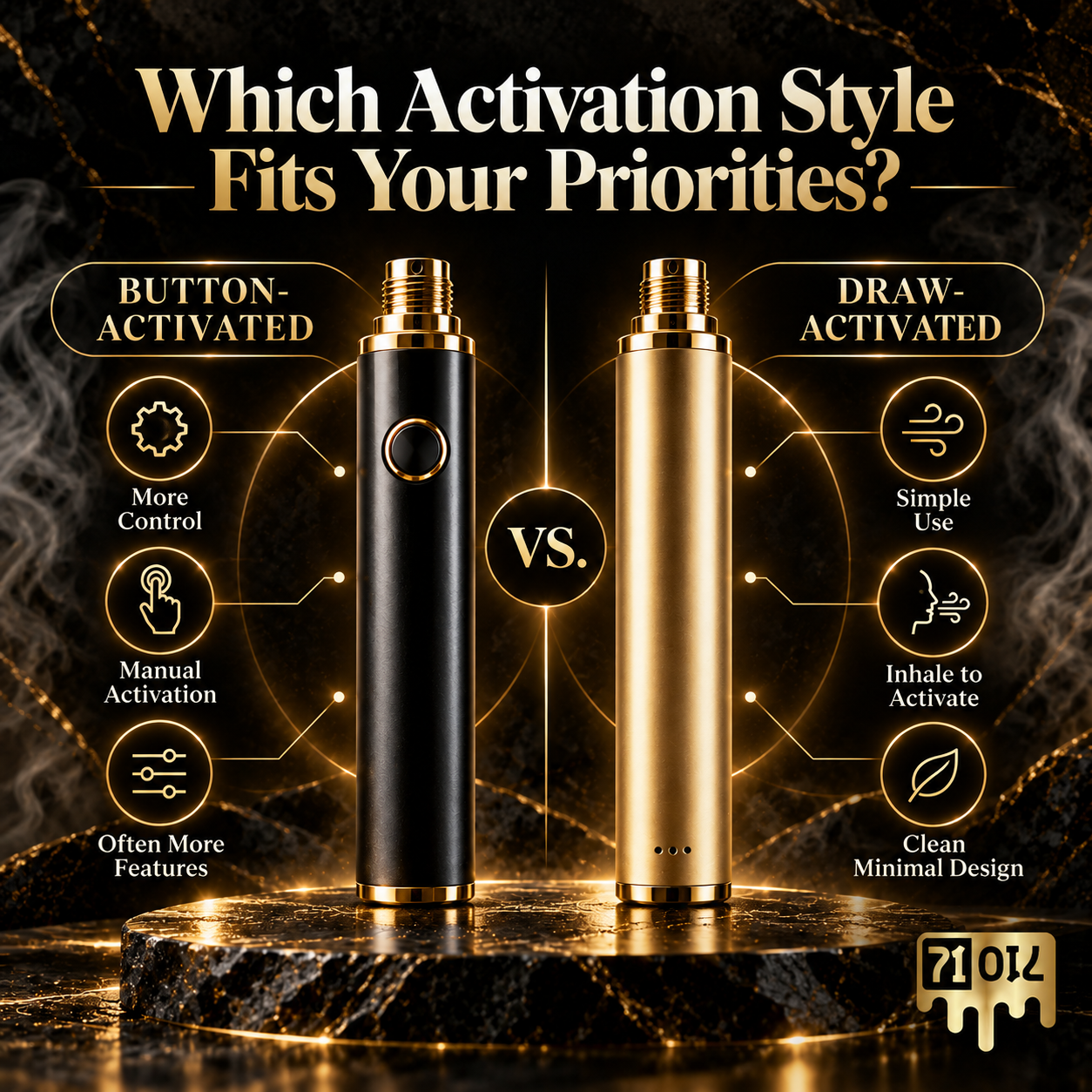
Choose Simplicity as the Priority
A draw-activated battery may suit adults who prefer a minimal interface with fewer manual steps during normal activation.
Models can still differ in charging, indicators, voltage controls, adapters, cartridge clearance, and other features.
Choose Manual Control as the Priority
A button-activated battery may suit adults who prefer deliberate activation or direct access to model-specific controls.
If lockout, preheat, or adjustable output matters to you, confirm those features in the specifications rather than assuming every button battery includes them.
Choose Features, Not Just Activation Method
Activation style is only one part of the decision. Also compare:
- cartridge connection and physical clearance
- supported operating requirements
- fixed or adjustable output
- preheat, if supported
- battery capacity
- charging method
- indicator system
- build quality and clear manufacturer instructions
The 71 Oil Battery for Cannabis Cartridge: 510 Buying Guide covers those selection factors in more detail.
What Should You Check Before Buying Either Type?
-
Connection and Cartridge Compatibility
Start with the cartridge rather than the battery feature list. Confirm whether the cartridge uses a standard 510 connection or a proprietary system.
For a 510 setup, check more than the thread. Cartridge diameter, recessed battery housings, airflow, electrical contact, adapters, and manufacturer restrictions can affect compatibility.
Do not force a cartridge that does not fit naturally. The 71 Oil 510 compatibility guide explains why “510” does not mean every battery-and-cartridge combination is automatically suitable.
-
Voltage and Cartridge Requirements
A battery can be button-activated or auto-draw and still use either fixed or adjustable output.
If the cartridge or battery manufacturer provides an operating range or preset guidance, use that information rather than a generic internet chart. There is no single voltage that applies to every cannabis cartridge.
For that decision, see What Voltage Should You Use for a Cannabis Vape Cartridge?
-
Controls and Lockout
Check how the exact model turns on, locks, changes mode, or indicates status. Do not assume a five-click power sequence, three-click voltage change, or another common pattern applies to every button battery.
If the battery uses LED signals, keep in mind that colours and blink counts can be model-specific. Our vape battery blinking guide explains how to troubleshoot indicators without assuming a universal code.
-
Preheat and Other Features
Preheat is a separate function from the activation method. A button battery may have preheat, an auto-draw battery may have preheat, or either type may omit the feature entirely.
Use only the controls documented for the battery. See What Does Preheat Mode Do on a Vape Battery? for the limits of preheat and why repeated heating should not be used to force malfunctioning hardware to work.
-
Charging Method and Battery Care
Follow the charging instructions for the specific battery. Health Canada advises consumers using rechargeable lithium-ion batteries to charge them according to manufacturer instructions and to use compatible charging equipment.
Do not improvise a charger because the connector happens to fit. Charging voltage, current, cable, and device requirements can differ.
-
Build Quality and Safety Information
Choose hardware from a reputable source with clear specifications and instructions. Do not modify, open, rebuild, bypass, or repair a lithium-ion battery unless the manufacturer specifically provides a supported procedure.
Health Canada advises against using damaged lithium-ion batteries. Stop using a battery that is swollen, dented, leaking, visibly damaged, or becoming abnormally hot, and follow manufacturer, retailer, and local disposal guidance.
Common Misconceptions About Vape Battery Activation
“Every button battery uses five clicks.”
No. Five-click power or lock sequences are common on some devices, but controls vary. Use the instructions for the exact model.
“Auto-draw batteries have no settings.”
Not always. Some auto-draw batteries combine inhale activation with separate controls for voltage, preheat, or other functions.
“Button batteries are more powerful.”
Not necessarily. Activation style does not determine battery output. Voltage, regulation, cartridge resistance, and the complete device design affect operation.
“Draw-activated batteries cannot activate accidentally.”
Do not make that assumption. Storage and standby behaviour vary by device. Follow the manufacturer’s storage and lockout instructions, if applicable.
“Any 510 cartridge will work with any 510 battery.”
No. Threading is only one compatibility factor. Physical fit, airflow, electrical contact, output requirements, and manufacturer restrictions can still matter.
Battery Care and Use: Keep the Guidance Conservative
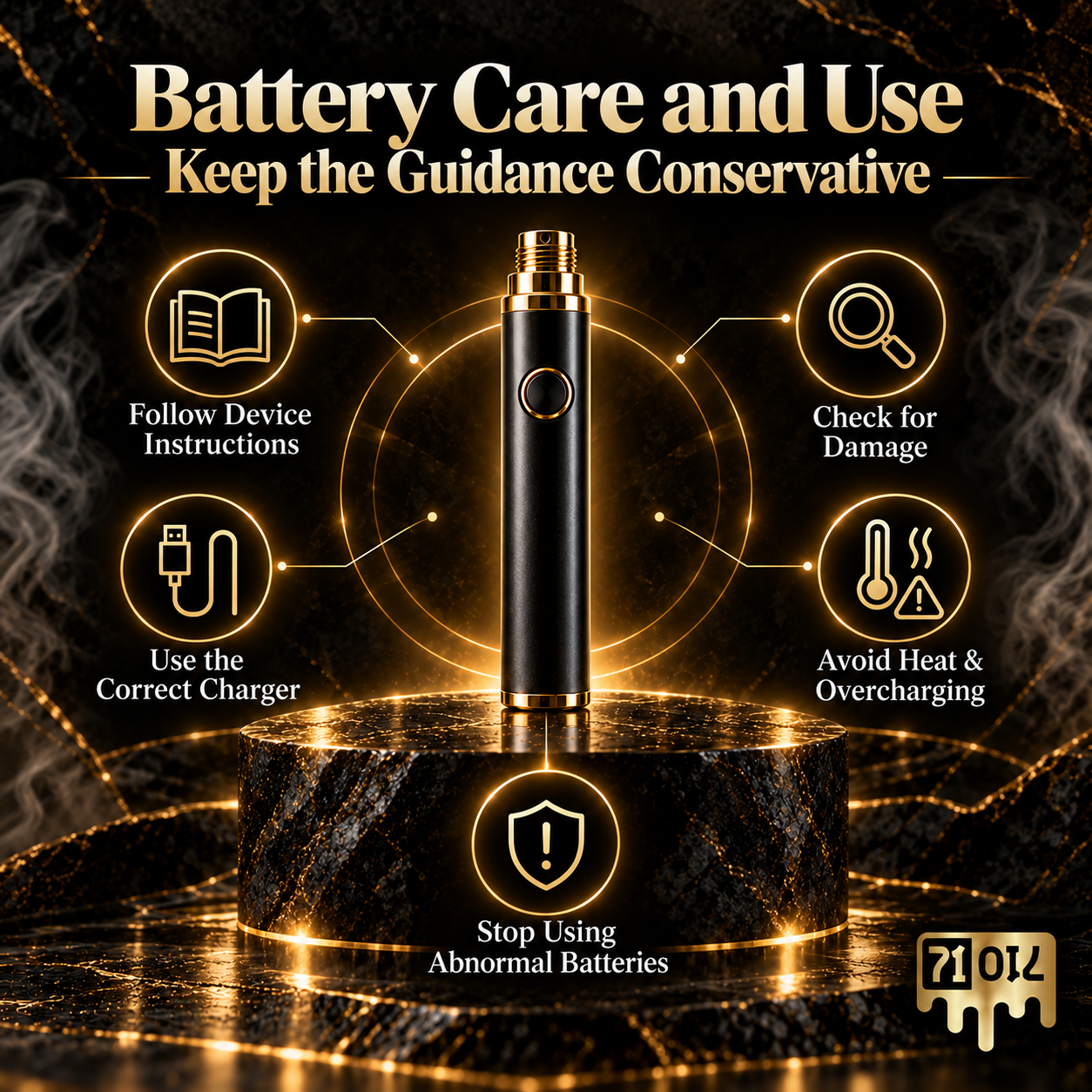
Treat the battery and cartridge instructions as the final reference.
For either activation style:
- use only compatible cartridges and charging equipment
- follow the manufacturer’s instructions for activation, charging, storage, cleaning, and disposal
- do not modify the battery or bypass built-in protection features
- keep accessible connection areas maintained only as the manufacturer recommends
- stop using hardware that is damaged, swollen, leaking, unusually hot, or repeatedly malfunctioning
- keep cannabis products and vaping accessories secured away from children and pets
Health Canada advises adults to follow manufacturer instructions, avoid overcharging rechargeable accessories, and learn lithium-ion battery precautions. These steps do not make cannabis vaping safe.
Frequently Asked Questions
Is a button or draw-activated vape battery better?
Neither is universally better. Draw-activated batteries may suit people who prefer a minimal interface, while button-activated models may suit people who want deliberate manual activation or direct controls. Compare compatibility, output, charging, lockout, and other model-specific features before deciding.
What is an auto-draw vape battery?
An auto-draw vape battery is a device that normally activates its power cycle when a built-in sensor detects airflow or a pressure change during a draw. It may also be described as draw-activated, inhale-activated, or buttonless.
Do all button vape batteries use five clicks?
No. Some button batteries use five clicks for power or lockout, but the sequence is not universal. Other devices can use different controls. Follow the battery manual or manufacturer instructions for the exact model.
Do draw-activated batteries have variable voltage?
Some do. Draw activation describes how normal heating is triggered; it does not define the battery’s output controls. An auto-draw battery can be fixed-output or adjustable depending on the model.
Can a draw-activated battery work with any 510 cartridge?
Not necessarily. A shared 510 connection does not guarantee full compatibility. Cartridge dimensions, battery housing, airflow, electrical contact, operating requirements, and manufacturer guidance can still affect the setup.
Do button-activated batteries always have preheat mode?
No. Preheat is a model-specific feature. Some button batteries include it, while others do not. Some auto-draw batteries can also include preheat through separate controls.
Can a vape battery activate accidentally in a pocket or bag?
Unintended activation can be a storage concern depending on the device. Do not assume one activation type eliminates the risk. Follow the battery’s power, lockout, transport, and storage instructions.
What should I do if a vape battery is damaged or overheating?
Stop using and charging it. Do not open, modify, or continue testing a swollen, dented, leaking, damaged, or abnormally hot lithium-ion battery. Follow the manufacturer or retailer guidance and use the appropriate local battery-disposal option.
Compare the Features That Matter for Your Cartridge
The clearest difference between button-activated and draw-activated vape batteries is the activation method: one uses a manual control, while the other normally responds to airflow or pressure.
That difference matters, but it should not be the only buying criterion. Check cartridge compatibility, physical fit, battery output, controls, charging requirements, build quality, and manufacturer instructions before choosing hardware.
If you are still comparing the full setup, start with the Battery for Cannabis Cartridge: 510 Buying Guide. You can also review the 510-thread battery guide, cartridge compatibility guide, voltage guide, and preheat guide for the next layer of detail.
Resources Used:
- Health Canada — Cannabis accessories for inhalation — Accessory components, manufacturer instructions, charging and battery precautions, malfunction context.
- Health Canada — Battery safety: Lithium-ion batteries — Lithium-ion battery damage signs, charging, storage, modification, and disposal guidance.
- Health Canada — Industry Guide to Vaping Products Subject to the CCPSA — Electrical/mechanical considerations, replacement-part compatibility, battery and charger considerations.
- CILICON — How to Use a 510 Battery With a Button — Manufacturer/industry example showing that button functions and click sequences can vary by model.
- HoneyStick — Auto-Draw 510 Battery — Manufacturer/retailer example showing that an auto-draw battery can still include adjustable settings and preheat.
- 71 Oil — What Is a 510-Thread Battery? — Internal foundation page for thread, activation, and battery terminology.
- 71 Oil — Battery for Cannabis Cartridge: 510 Buying Guide — Internal buying framework covering fit, controls, charging, and capacity.
- 71 Oil — Are All 510-Thread Batteries Compatible With Cannabis Cartridges? — Internal compatibility guide for fit, airflow, contact, operating requirements, and adapters.
- 71 Oil — What Voltage Should You Use for a Cannabis Vape Cartridge? — Internal guidance separating activation style from operating output.
- 71 Oil — What Does Preheat Mode Do on a Vape Battery? — Internal guide separating preheat from activation method and voltage.
- 71 Oil — Why Is My Vape Battery Blinking? — Internal troubleshooting guide for model-specific indicator lights and operating modes.
0 Responses